A planetary flyby with a dual purpose
On May 15, 2026, at approximately 5:03 a.m. PDT, NASA's Psyche spacecraft made its closest approach to Mars as part of a planned gravity assist maneuver. This technique, a staple of interplanetary mission design, allows a spacecraft to reshape its trajectory and build velocity by passing through a planet's gravitational field — all without burning additional propellant. For Psyche, the Mars flyby was a carefully engineered stepping stone on the long journey to its primary scientific target: the metallic asteroid 16 Psyche, located in the main belt between Mars and Jupiter.
As the spacecraft drew closer to the planet, its onboard multispectral imager captured a final full-disk view of Mars as a crescent — the optical geometry that emerges when only a portion of a planet's sunlit hemisphere falls within an observer's line of sight. That image, taken just as Mars began to exceed the instrument's field of view, marks the threshold between approach and closest encounter.
Huygens crater and the story written in color
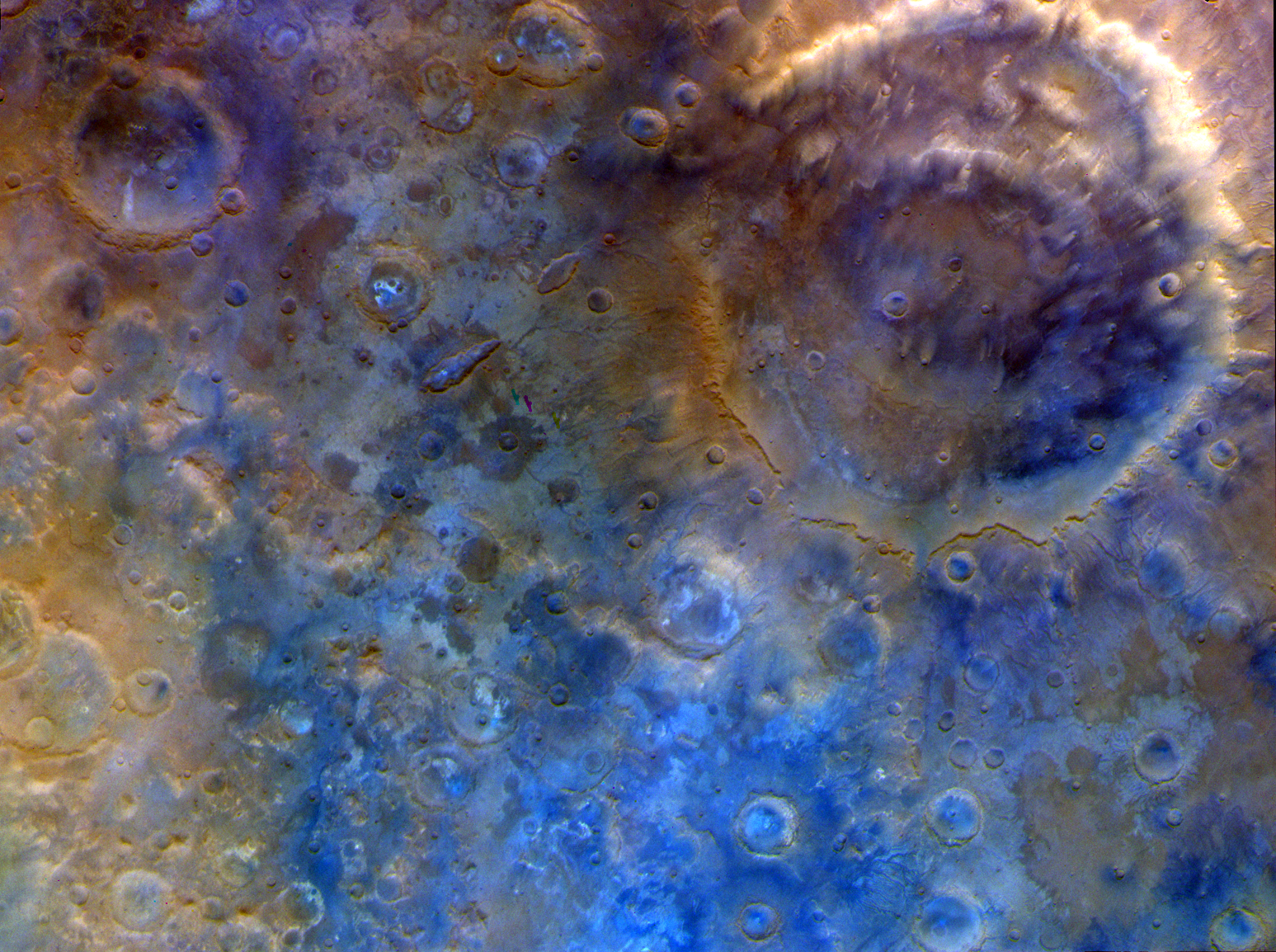
Among the images returned to Earth is an enhanced-color view of Mars's heavily cratered southern highlands, with the Huygens impact basin prominently featured. This double-ring structure spans roughly 470 kilometers in diameter and sits near 15 degrees south latitude, making it one of the largest impact features in the Martian southern hemisphere.
The vivid color variations seen in the image are not a natural-light representation of the Martian surface. Instead, they result from image processing designed to amplify differences in surface composition and physical properties across the terrain. NASA notes that these chromatic contrasts most likely reflect variations in the mineralogical makeup of the materials covering this ancient, impact-scarred region. The fact that Psyche's multispectral imager — built primarily to study an asteroid — can yield scientifically relevant planetary data along the way speaks to the versatility of the instrument design.
Bonus science on the road to an asteroid
Psyche's core mission remains the investigation of the metallic asteroid sharing its name, a body that scientists hypothesize may be the exposed iron-nickel core of an early planetary building block that never fully formed — or that lost its outer layers through ancient collisions. That destination still lies years away. But the Mars flyby has provided an early opportunity to stress-test the spacecraft's instruments under real operational conditions and gather data on a well-characterized planetary environment.
The spacecraft launched in October 2023 aboard a SpaceX Falcon Heavy rocket from Kennedy Space Center in Florida. The Mars gravity assist was integral to the mission profile developed by NASA's Jet Propulsion Laboratory to set Psyche on an efficient path through the inner solar system. The imagery produced during this flyby serves as a reminder that interplanetary missions can generate meaningful science at every leg of the journey — not only upon arrival at their final destination.

