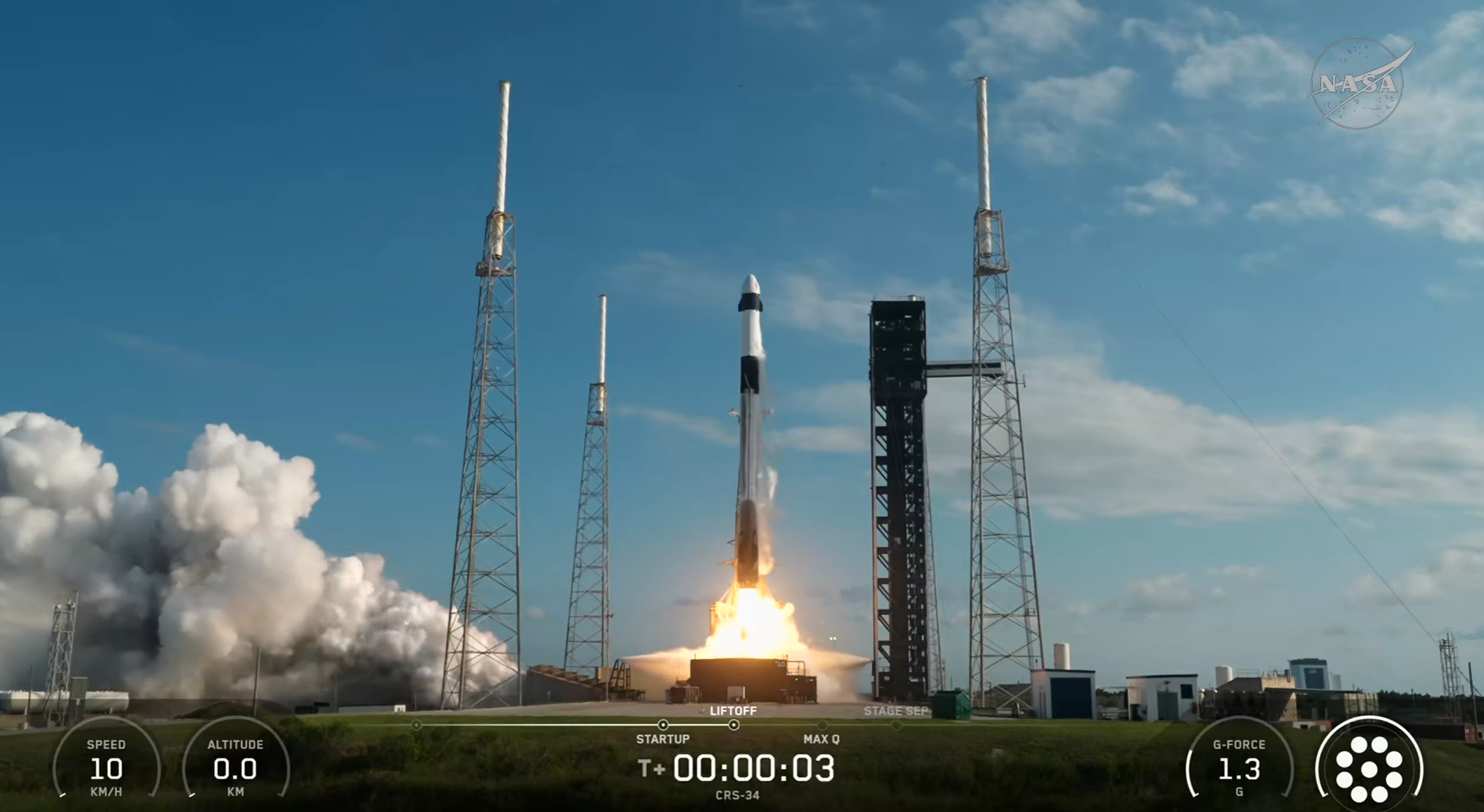
A brief delay before a smooth liftoff
The road to orbit for CRS-34 was not entirely straight. The mission had originally been scheduled earlier in the week, but a 24-hour delay pushed the launch window to the evening of Friday, May 15, 2026. At 6:05 p.m. Eastern Time, a Falcon 9 rocket climbed away from Space Launch Complex 40 at Cape Canaveral Space Force Station in Florida, carrying the Cargo Dragon toward the International Space Station. By all accounts, the ascent proceeded nominally.
Brief scrubs and short delays have become a familiar part of the ISS logistics calendar, and mission planners treat them as a routine precaution rather than a setback. The Station had recently welcomed the Russian Progress MS-34 cargo vehicle, which docked a little over two weeks prior. The arrival of the Cargo Dragon adds another layer to the coordinated resupply ballet that keeps the orbiting laboratory continuously stocked and operational.
Nearly three tons of cargo packed into the Dragon
The Cargo Dragon lifted off with approximately 6,500 pounds — close to 2,950 kilograms — of supplies distributed across several categories: scientific hardware, maintenance equipment, and consumables for the crew. NASA, which funds the mission through its Commercial Resupply Services contract, had not released a full manifest of the science investigations at the time of publication, but CRS flights routinely carry experiments spanning biology, fluid physics, and materials science.
These periodic deliveries form the backbone of research activity aboard the ISS. Without them, scientists from universities and research institutions worldwide would have no way to get their instruments into low Earth orbit or retrieve processed samples for ground-based analysis. The Cargo Dragon's ability to return cargo intact — a capability not shared by all current resupply vehicles — makes it especially valuable for time-sensitive biological and materials research that cannot be evaluated solely in orbit.
A commercial partnership that has reshaped orbital logistics
CRS-34 is the thirty-fourth delivery SpaceX has completed under its commercial contract with NASA, a program that began back in 2012 with the first Dragon resupply flight. Over the course of more than a decade, this arrangement has helped drive down the per-kilogram cost of delivering cargo to low Earth orbit while freeing up NASA resources for deeper exploration goals, including the Artemis lunar program.
True to SpaceX's reusability philosophy, the Falcon 9 booster used for this mission had previously flown on earlier flights, though SpaceX had not confirmed the exact number of previous uses at press time. First-stage recovery — the booster landing on a drone ship downrange in the Atlantic — remains a reliable indicator of the program's operational maturity and is attempted on virtually every CRS launch.
The Cargo Dragon was expected to berth with the ISS within a day or two of launch, after which the crew would begin the process of unloading supplies and activating the science investigations. CRS-34 fits into a contract structure that extends through the end of the decade, reflecting the continued confidence NASA places in SpaceX to keep the Station's research pipeline running without interruption.