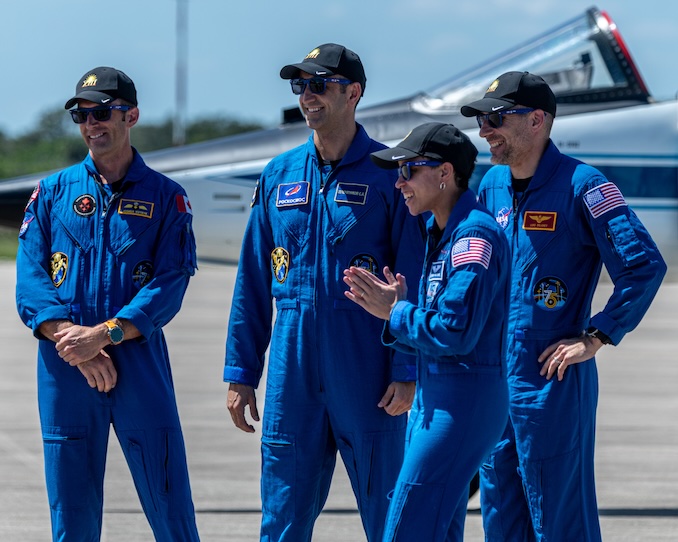
Four crew members, one destination
The four-person crew assigned to SpaceX's Crew-13 mission touched down in Florida in late September, completing the last leg of their pre-launch journey. The team includes three astronauts and one cosmonaut, a composition that reflects the longstanding multinational character of the International Space Station program. Liftoff is currently scheduled no earlier than October 1, pending favorable weather conditions and final technical readiness reviews.
As with previous Commercial Crew rotations, SpaceX will provide the Crew Dragon spacecraft and Falcon 9 rocket under NASA's ongoing commercial partnership. Since the retirement of the Space Shuttle, this arrangement has become the primary means of ferrying NASA-affiliated crews to and from the station. Crew-13 will continue that cadence, slotting into a schedule designed to keep the ISS permanently staffed and fully operational.
Expedition 75 keeps science moving
While Crew-13 ran through final ground preparations, the astronauts and cosmonauts of Expedition 75 were keeping a full workload in orbit. Research activities aboard the station spanned a broad range of fields, including cellular biology, fluid dynamics in microgravity, and human physiology studies relevant to long-duration spaceflight. These experiments take advantage of conditions that simply cannot be replicated in any ground-based facility, making the ISS an irreplaceable platform for fundamental and applied research alike.
The handover between expeditions follows a well-established protocol. Incoming crews overlap with departing ones for a period of joint operations, during which knowledge, ongoing experiments, and station systems are formally transferred. This overlap is not merely procedural — it ensures that no data is lost and that long-running experiments can continue without interruption across crew rotations.
A mission set against a shifting backdrop
Crew-13 launches at a moment when the ISS program is navigating significant uncertainty about its long-term future. NASA and its international partners have committed to operating the station through the late 2030s, after which a controlled deorbit is planned. In parallel, the agency has been working with commercial companies — including Axiom Space and others — to develop privately owned orbital platforms that could eventually absorb some of the ISS's research and crew functions.
Amid this transition planning, day-to-day operations between NASA and Roscosmos continue with a degree of pragmatism that stands in contrast to broader geopolitical friction between Washington and Moscow. Seat-sharing arrangements on crewed missions remain one of the few direct operational links still active between the two space powers. For now, the focus is squarely on countdown: Crew-13 is ready, the pad is ready, and launch day is close.


