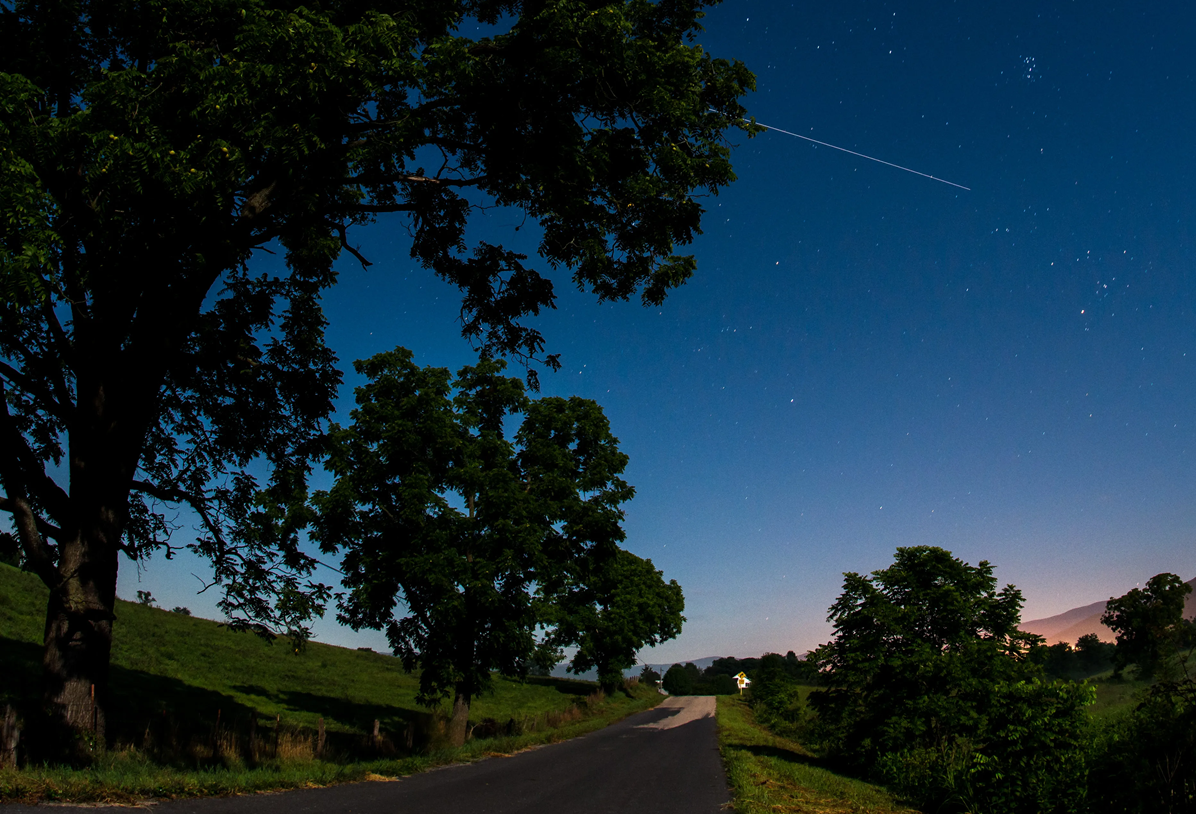
Travelling at roughly 27,000 kilometres per hour at an altitude of around 400 kilometres, the International Space Station is one of the brightest objects in the night sky — after the Moon and Venus. You do not need a telescope, a star chart, or any prior astronomy knowledge to see it.
What you actually see when the ISS passes over
The station produces no light of its own. What you observe from the ground is sunlight reflecting off its large solar arrays, which span a width greater than a standard football pitch. That reflection appears as a steady, white point of light moving smoothly and silently from one horizon to the other in roughly two to five minutes, depending on the geometry of the pass. Unlike an aircraft, it does not blink and leaves no contrail. Its apparent speed is consistent and unhurried.
The best viewing conditions occur in the hour or so after sunset or before sunrise. The sky is dark enough to see clearly, but the station is still in direct sunlight and reflects strongly. On a clear night with limited light pollution, its brightness can rival that of Jupiter.
Bebeksat: real-time ISS tracking for any city in the world
To find out exactly when the ISS will pass over your location, bebeksat.com offers a browser-based real-time tracking tool that requires no installation or account. The interactive map displays the station's current position, its projected ground track, altitude, and orbital velocity. By double-clicking on the ISS within the interface, users can generate flyover predictions for any city on Earth.
The platform also tracks other objects in low Earth orbit — including China's Tiangong station and Starlink constellations — but the ISS, listed under its NORAD catalogue number 25544, remains the primary target for naked-eye observers. Orbital calculations are performed using the SGP4 propagation model, the civil standard for satellite tracking.
NASA's official Spot the Station app
NASA offers its own dedicated mobile application, Spot the Station, available on both iOS and Android. The app delivers personalised alerts ahead of each visible pass over your location, provides flyover schedules, and includes a live tracking view directly on your phone.
- iOS (App Store): https://apps.apple.com/us/app/spot-the-station/id6449235044
- Android (Google Play): https://play.google.com/store/apps/details?id=gov.nasa.hq.SpotTheStation
The application is free and does not require a NASA account. It covers locations worldwide and sends a push notification a few minutes before the station rises above the horizon, giving you just enough time to step outside and face the right direction.
A shared moment that needs nothing but your eyes
Watching the ISS cross the sky is probably the most accessible astronomical experience available to anyone. There is nothing to buy and nothing to calibrate. You just need to be outside at the right time, looking in the right direction — and to hold in mind that the silent point of light moving overhead carries a crew of human beings going about their work, meals, and rest, four hundred kilometres above you.
It lands differently with children, who can point at something genuinely real in the sky rather than at a picture in a book. It works just as well for adults who rarely look up after dark. The station orbits continuously and visible passes recur regularly — often within 48 to 72 hours of one another. There is no meaningful barrier to giving it a try.


