A dwarf galaxy consumed at the dawn of the Milky Way
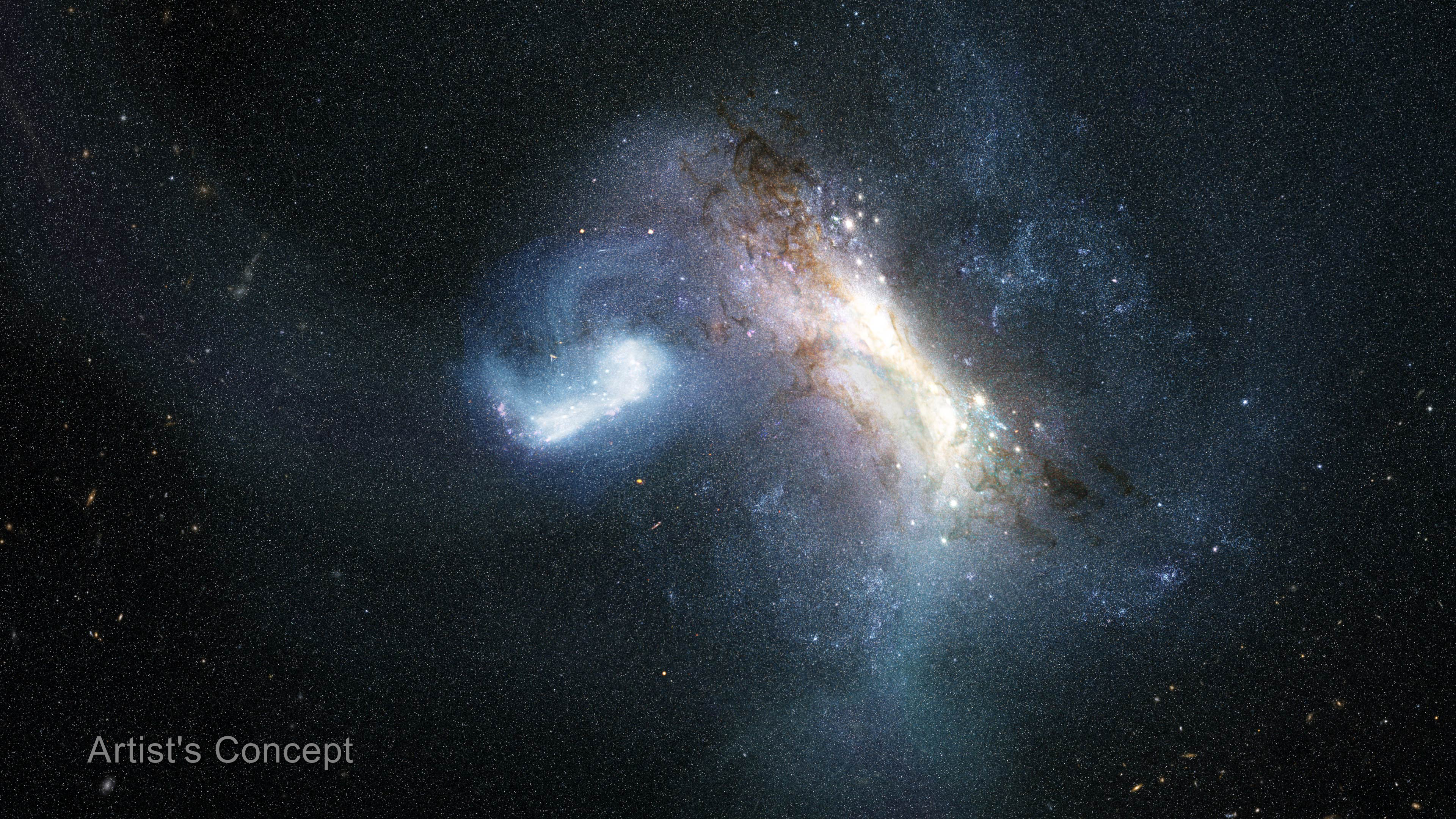
The Milky Way we live in today is not the same galaxy that existed billions of years ago. Like most large spiral galaxies, it grew steadily by pulling in smaller, less massive neighbours over cosmic timescales. While this process has been documented for more recent merger events, tracing it back to the very earliest stages of galactic evolution has remained out of reach — until now. A new analysis drawing on data from both the NASA/ESA Hubble Space Telescope and the ESA Gaia satellite provides definitive observational evidence that a dwarf galaxy merged with the young Milky Way during the earliest phases of its formation.
The significance of this finding goes well beyond adding another entry to our galaxy's timeline. It extends the reach of direct, observational knowledge of the Milky Way's history by 1.8 billion years — a substantial leap that places instruments-based evidence into an era previously accessible only through theoretical modelling and simulation.
Why the Hubble-Gaia pairing made the difference
Detecting a merger this ancient required combining two complementary datasets that, on their own, would not have been sufficient. Hubble, which has been operating in low Earth orbit since 1990, contributed high-precision photometric measurements of specific stellar populations. Gaia, ESA's astrometric survey satellite launched in 2013 and designed to map over a billion stars across the Milky Way in three dimensions, provided critical kinematic data — proper motions and positional information — for those same stars.
By weaving together Hubble's fine photometry with Gaia's astrometric precision, research teams were able to isolate a distinct stellar population whose chemical compositions and orbital dynamics point clearly to an extragalactic origin. These stars, now fully integrated into the Milky Way's structure, still carry the chemical fingerprint of the dwarf galaxy they once belonged to. In a sense, they function as stellar fossils — living records of a collision that took place when the universe itself was still in its infancy.
Broader lessons for galaxy formation science
The discovery carries implications that extend well beyond our own galaxy. The standard cosmological framework, known as Lambda-CDM, predicts that large galaxies assemble through a hierarchical process — gradually growing by accreting smaller structures over time. This newly confirmed early merger provides a direct observational anchor for those theoretical predictions at a cosmic epoch where hard evidence has been scarce.
It also opens new questions. How many other dwarf galaxies did the young Milky Way consume during this early period? What additional merger signatures remain buried in the chemistry of stars populating the galactic halo, waiting to be identified? Upcoming observational campaigns — including further Gaia data releases and the capabilities of the James Webb Space Telescope — may help answer these questions with greater precision.
What this discovery makes clear, above all, is that the Milky Way's apparent stability today conceals a turbulent past of collisions and absorptions. We are only beginning to read the earliest pages of that story.