A cosmic neighbor close enough to study in depth
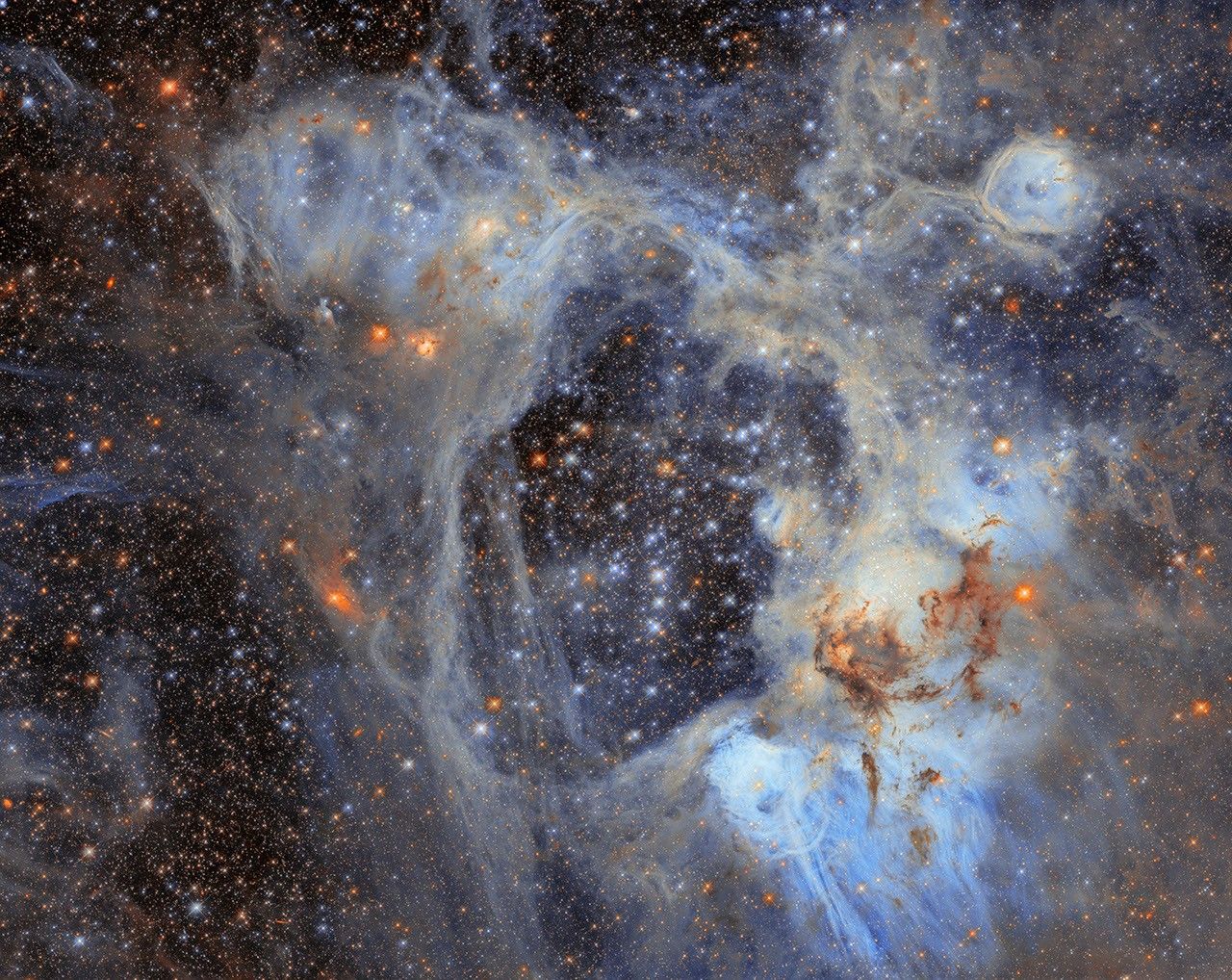
At a distance of roughly 160,000 light-years, the Large Magellanic Cloud (LMC) ranks among the most accessible galaxies for detailed observation. As the largest of the dwarf galaxies orbiting the Milky Way, it sits close enough that individual star-forming regions can be resolved with existing space telescopes. On September 3, 2026, NASA and ESA jointly released a new Hubble Space Telescope image showcasing one of the LMC's most dramatic features: the nebula formally catalogued as LHA 120-N44, or simply N44, located in the southern constellation Dorado.
The structure spans hundreds of light-years and belongs to a class of objects known as superbubbles — vast cavities carved into the interstellar medium by the combined energy output of massive stars and supernova explosions. N44 is not merely a passive cloud of gas and dust; it is an active, evolving environment where stellar birth and stellar death are happening in close proximity.
The violent physics behind a superbubble
Superbubbles are forged through a chain of high-energy events. Clusters of young, massive stars — known as OB associations — generate powerful stellar winds that push surrounding gas outward over timescales of millions of years. As the most massive of these stars exhaust their nuclear fuel and detonate as supernovae, their shock waves add to the outward pressure, expanding the cavity further. The result is a shell-like structure filled with hot, low-density plasma surrounded by denser, cooler material.
The process carries an inherent duality. On one hand, these winds and shocks disperse the molecular gas that would otherwise collapse into new stars. On the other hand, the compression of gas at the shell's edges can trigger fresh star formation in the surrounding regions. The bright arcs and filaments visible along N44's rim in the Hubble image are consistent with exactly this kind of triggered stellar activity — new generations of stars ignited by the shock fronts radiating outward from the bubble's interior.
The image itself combines data from multiple wavelength filters, each sensitive to a different ionized element: hydrogen, doubly ionized oxygen, and sulfur. This multi-filter approach, standard practice for Hubble imaging campaigns, allows researchers to map the physical and chemical conditions across the nebula's full extent.
Hubble's continued scientific relevance in the JWST era
The release comes at a time when Hubble's long-term operational status remains a subject of discussion within the astronomical community. Launched in April 1990 and serviced multiple times by Space Shuttle crews, the telescope has been operating under adjusted protocols since the gradual failure of some of its gyroscopes. NASA has confirmed that modified pointing procedures allow science operations to continue, though with some constraints on scheduling flexibility.
The James Webb Space Telescope, operational since mid-2022, has transformed infrared astronomy and produced landmark images of star-forming regions at unprecedented resolution. However, Webb does not observe in ultraviolet or blue visible wavelengths — precisely the range where Hubble continues to deliver unique scientific data. The two observatories are therefore genuinely complementary, and a coordinated study of N44 across both platforms would be well within the realm of possibility.
For now, this latest Hubble image serves as a reminder that some of the most productive scientific instruments are also among the oldest still flying — and that a nebula 160,000 light-years away can still raise fundamental questions about how stars are born, live, and die.