Thirty-seven dwarf galaxies, and the oxygen that should not be missing
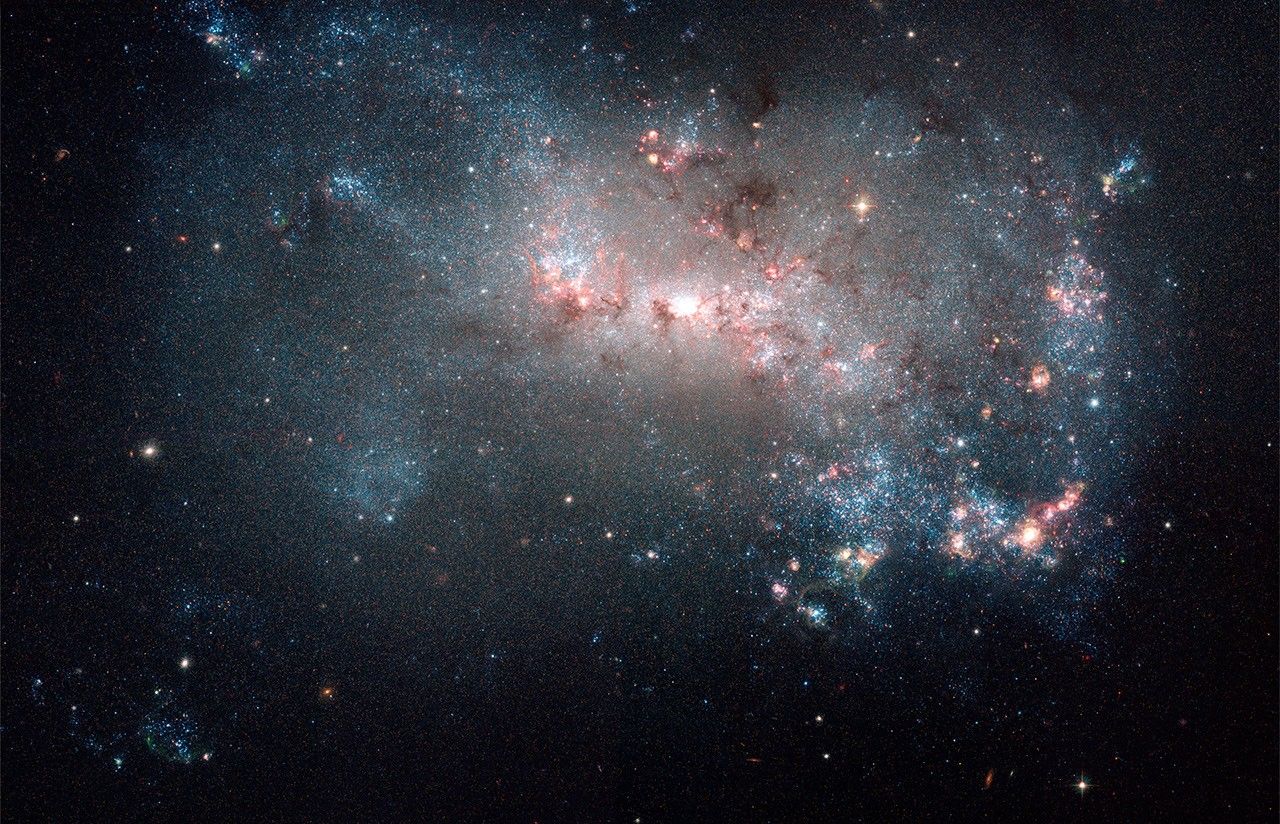
Astronomers using the Hubble Space Telescope have identified a striking chemical discrepancy in a sample of 37 dwarf galaxies located in our cosmic neighborhood. When they tallied the oxygen content detected in these small galactic systems, the numbers came up well short of what standard theoretical models predict. A substantial fraction of the oxygen these galaxies should have produced simply cannot be accounted for in the observations.
Oxygen matters enormously in this context. Forged inside massive stars and scattered across interstellar space by supernova explosions, it accumulates over successive stellar generations and serves as a reliable chemical clock for a galaxy's evolutionary history. Its apparent absence in these dwarf systems forces researchers to ask a pointed question: where did it go? Leading hypotheses include the ejection of enriched gas beyond the galaxy's gravitational reach through stellar winds and supernova-driven outflows, or the possibility that oxygen is locked inside gas phases that current instruments struggle to detect directly.
Dwarf galaxies are structurally fragile by nature. With lower masses and weaker gravitational fields than large spiral galaxies such as the Milky Way, they are far more susceptible to processes that strip or redistribute their gas. Pinpointing why they appear oxygen-poor has implications that reach beyond these systems individually: dwarf galaxies are widely regarded as close analogs to the primitive building blocks of the early Universe, making them a critical test case for models of cosmic chemical enrichment.
NASA asks industry: can you service Hubble commercially?
While Hubble continues generating scientifically significant results, the long-term health of the observatory is becoming an increasingly urgent concern. In late October, NASA issued a formal Request for Information directed at the broader space industry, aiming to gauge what technical capabilities currently exist for a potential commercial in-space servicing mission.
The context is straightforward: Hubble launched in 1990 and received five crewed servicing missions between 1993 and 2009, each one extending its operational life and upgrading its instruments. With the Space Shuttle retired, that avenue is no longer available. In recent years, repeated failures in the telescope's gyroscopes — the components that allow it to lock precisely onto celestial targets — have forced NASA teams to scale back operations on more than one occasion.
Importantly, NASA has not committed to procuring any such service. The Request for Information is an early-stage market survey, not a contract solicitation. Companies active in on-orbit servicing, including SpaceX, Northrop Grumman, and various NewSpace ventures developing rendezvous and docking technologies, could potentially respond. No budget figures or mission timelines have been disclosed.
A still-productive telescope at an institutional crossroads
Taken together, these two developments sketch a telling portrait of Hubble in late 2026. On one hand, the telescope remains a scientifically productive instrument capable of reshaping our understanding of how galaxies evolve chemically over cosmic time. On the other, its operational continuity now depends on decisions that sit well outside the scientific domain — questions of industrial policy, commercial viability, and institutional priorities.
If a commercial servicing mission were ultimately pursued and executed, it would represent a significant departure from NASA's historical approach to the observatory and could set a precedent for how other aging science satellites in low Earth orbit are handled in the years ahead. Whether that threshold gets crossed will depend as much on what the industry tells NASA it can do as on what scientists argue Hubble still deserves to discover.