A shadow path spanning continents and open ocean
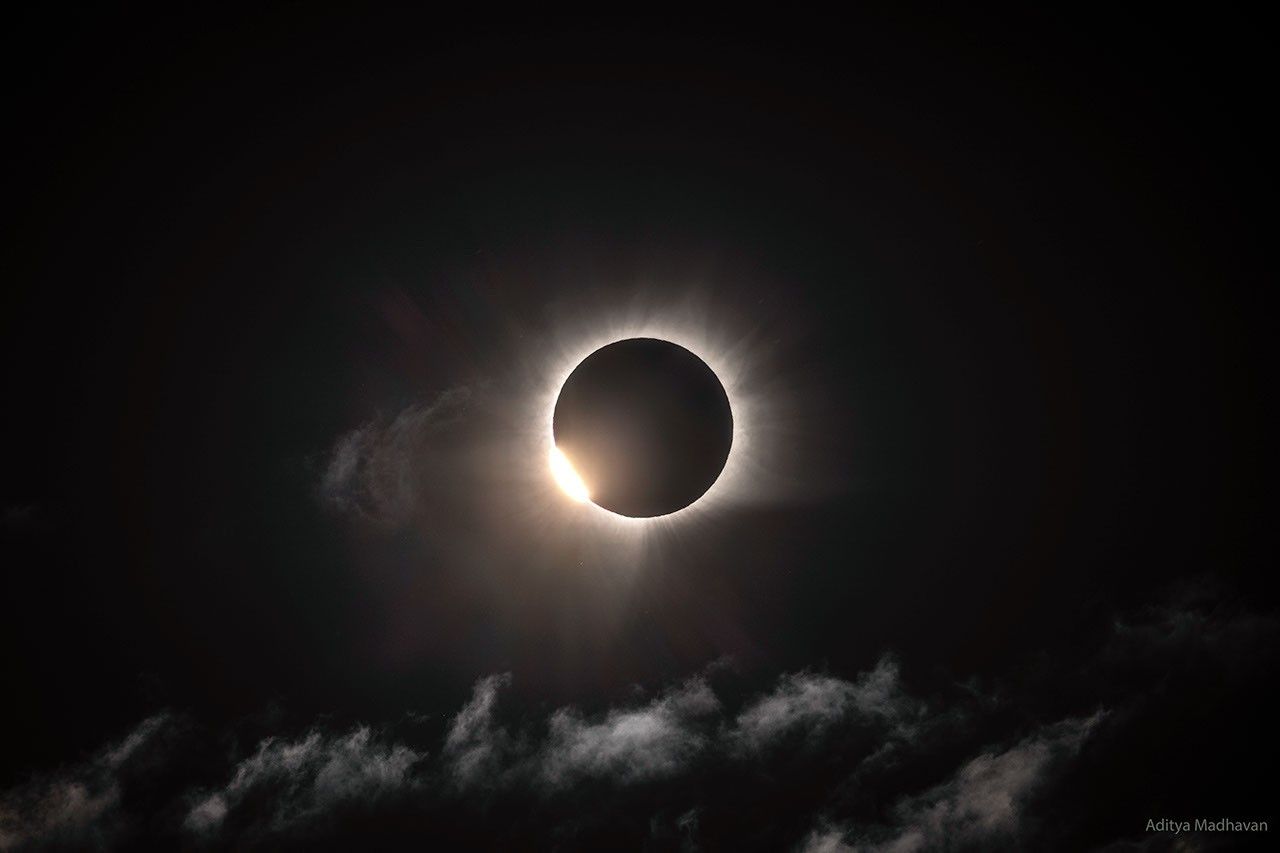
On Wednesday, August 12, 2026, the Moon moved into precise alignment between Earth and the Sun, casting its umbral shadow across a narrow corridor stretching thousands of kilometers. The path of totality first crossed Greenland and Iceland, clipped remote stretches of northern Russia, swept across the North Atlantic, and finally reached the Iberian Peninsula. In Spain, towns including San Millán de los Caballeros experienced full totality — a brief but complete blackout of the solar disk, during which the Sun's outer atmosphere, the corona, became visible to the naked eye against a darkened sky.
The geometry behind a total solar eclipse is unforgiving: the Moon's apparent diameter must equal or exceed that of the Sun as seen from Earth's surface, a condition met only within the narrow totality corridor. Outside that band, observers saw only a partial eclipse, with the lunar disk covering a fraction of the Sun. This geometric precision is why any given location on Earth experiences totality only rarely — sometimes separated by centuries.
ESA broadcasts from Javalambre, NASA documents the full arc
In Spain, the Observatorio Astrofísico de Javalambre, located in the highlands of Teruel province, served as a primary observation hub. The European Space Agency (ESA) organized a live broadcast from the site, allowing viewers across Europe and beyond to follow the event in real time. ESA also released a musification of the eclipse — a data-driven sonic rendering of the astronomical measurements recorded during the event. The project blends scientific outreach with artistic interpretation, reflecting a broader shift in how space agencies communicate complex phenomena to general audiences.
The NASA Astronomy Picture of the Day program featured eclipse imagery on both August 13 and August 14, presenting photographs taken from Spain and Greenland respectively, each accompanied by explanations from professional astronomers. Together, these images capture the full geographic and visual sweep of the 2026 eclipse, from first contact through the final moments of totality.
Scientific value beyond the spectacle
Total solar eclipses remain among the most scientifically productive natural events accessible from Earth's surface. With the photosphere blocked, researchers can examine the corona — the Sun's tenuous outer atmosphere — in ways that space-based coronagraphs can only approximate. International teams positioned along the totality path collected data on coronal dynamics, solar magnetic field structure, and the still poorly understood mechanisms driving coronal heating, a central open question in solar physics.
For the broader public, the August 12, 2026 eclipse marks a generational moment. No total solar eclipse is expected to cross Western Europe for several decades, making the views from Spain — and the more remote vantage points across Greenland and the Arctic — especially significant for the observers fortunate enough to be in the right place at the right time.