APOD: more than a pretty picture each morning
The NASA Astronomy Picture of the Day program has been running since 1995, delivering a daily image of the universe alongside commentary written by a working astronomer. The selection process is deliberate: each image is chosen to reflect something meaningful about our current understanding of space, whether it comes from a billion-dollar space telescope or a photographer who drove to a remote desert and waited for the right sky. Three consecutive releases between November 24 and 26, 2026, illustrate just how wide that range can be.
APOD remains one of NASA's most widely followed public outreach channels, drawing millions of visitors daily across its various platforms. In an era when space agencies communicate through short-form video and social media, its format — one image, one explanation, one day — holds a quietly countercultural appeal.
SPHEREx: seeing what optical telescopes cannot
The November 25 selection featured imagery from SPHEREx, NASA's near-infrared spectroscopy mission launched in 2025. The telescope surveys nearly the entire sky across 96 spectral bands, giving it the ability to detect water ice and organic molecules locked inside dense clouds of interstellar dust — material that is completely opaque at visible wavelengths but becomes transparent when observed in the infrared.
The image highlighted this capability directly. Where a conventional optical telescope would record only a dark, featureless wall of dust, SPHEREx resolves internal structure: filaments, density gradients, and embedded sources that speak to the conditions in which stars — and potentially planetary systems — are assembled. With the mission's first public science data now reaching the research community, the APOD feature served as a timely introduction for a broader audience to what the instrument is actually producing.
Galactic collisions and a Brazilian sky
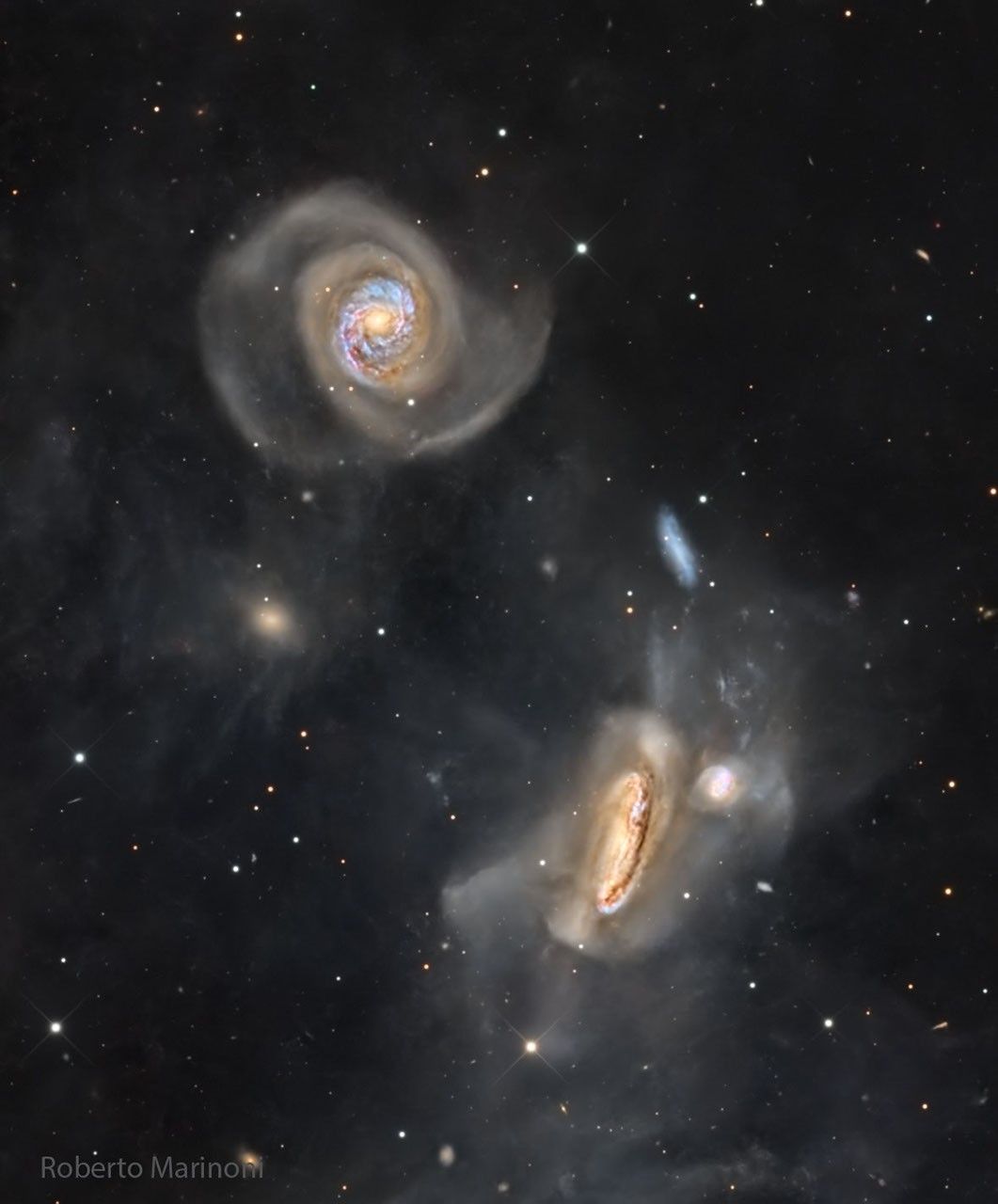
On November 24, the program turned its attention to the NGC 7771 group, a compact collection of interacting galaxies located roughly 200 million light-years away in the constellation Pegasus. The gravitational interplay between group members is written plainly across their shapes: distorted spiral arms, bridges of stellar material stretching between galaxies, and pronounced episodes of accelerated star formation known as starbursts. These features are textbook signatures of tidal forces operating across timescales of hundreds of millions of years, and they make systems like NGC 7771 valuable natural laboratories for understanding how galaxies grow and change through mergers.
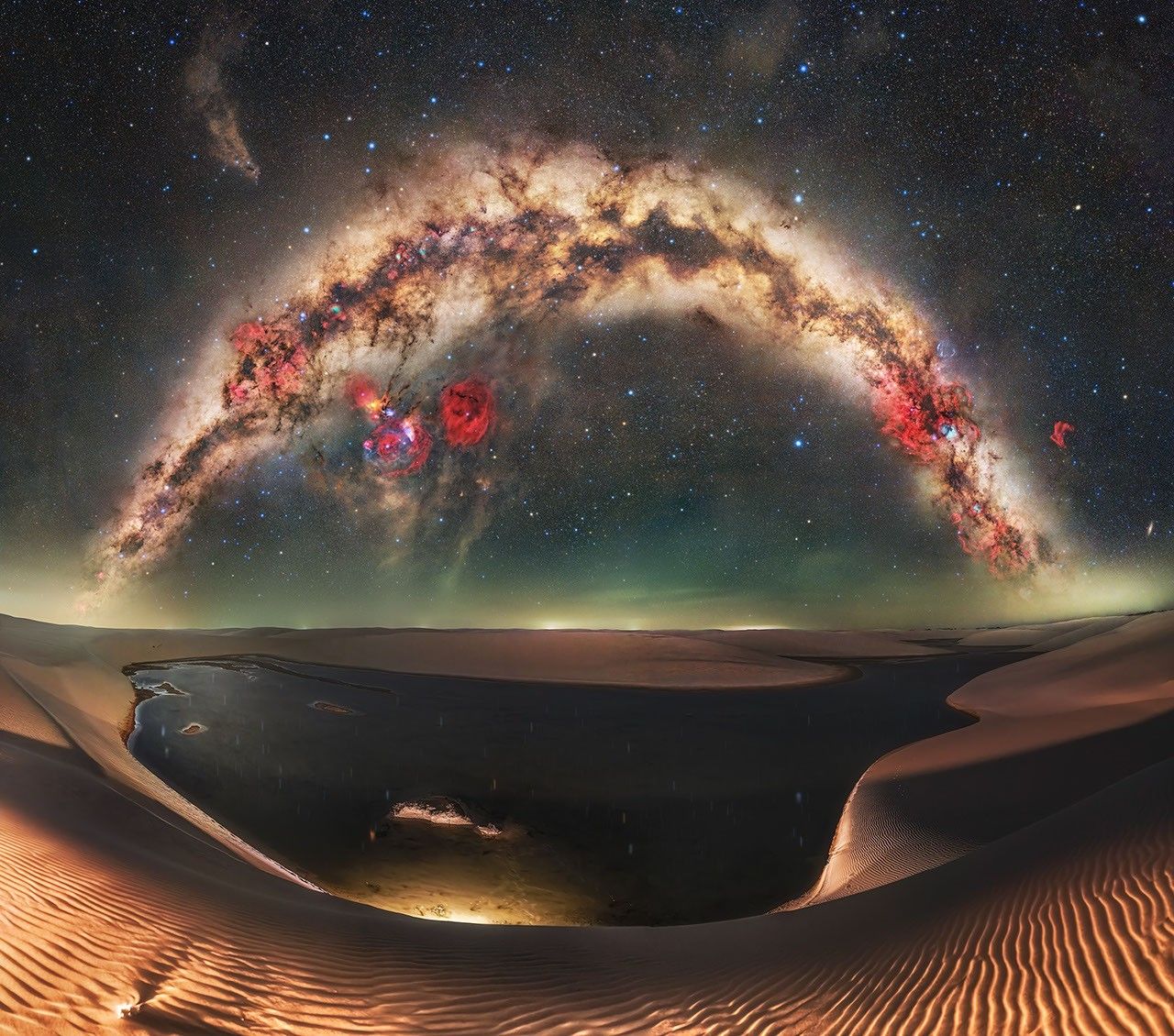
Two days later, the tone shifted entirely. The November 26 image showed the Milky Way rising above the Lençóis Maranhenses, a national park in northeastern Brazil known for its white sand dunes and freshwater lagoons. The site offers some of the darkest skies in South America: a flat, open horizon, minimal humidity during the dry season, and virtually no artificial light pollution for hundreds of kilometers. The photograph brought together terrestrial geography and cosmic depth in a way that reminded viewers that some of astronomy's most compelling images require no space agency at all — just patience, skill, and a genuinely dark sky.
Three images, one discipline
Taken together, these three selections reflect something true about contemporary astronomy: it operates simultaneously at wildly different scales of investment and instrumentation. SPHEREx is the product of years of institutional development and substantial federal funding. The Lençóis photograph demonstrates what a dedicated amateur astrophotographer can achieve from a well-chosen location. And NGC 7771 sits somewhere between the two — accessible to ground-based observatories of moderate size, yet scientifically rich enough to occupy professional researchers for decades. By curating across these registers every morning, APOD continues to do something genuinely useful: keeping the gap between cutting-edge science and public curiosity as narrow as possible.