A signal from the edge of everything
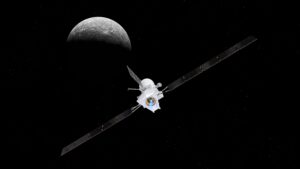
On November 17, NASA's Astronomy Picture of the Day featured an image that stopped many readers in their tracks: a visual tribute to the Voyager probe, still alive and still talking to Earth after nearly half a century in space. What began as a mission to survey Jupiter and Saturn has become something far more enduring — a crossing into interstellar space that no human-made object had ever achieved before.
Voyager now travels beyond the heliosphere, the vast magnetic envelope generated by the Sun's solar wind. Out there, its remaining instruments continue to sample the properties of interstellar plasma, magnetic fields, and cosmic rays. Every data packet takes more than twenty hours to reach the antennas of NASA's Deep Space Network — a delay that, in itself, conveys the true scale of the solar system more vividly than any textbook diagram.
The Voyager program comprises two spacecraft: Voyager 1 and Voyager 2, both still partially operational. Neither was originally designed to last this long. Their survival is a testament to engineering margins built into an era when space exploration demanded conservative design and long-term thinking. That philosophy is worth reflecting on as Washington debates the future of the agency that made it possible.
Capitol Hill and the annual budget reckoning
The week of November 22–29, 2026 brought both the House and Senate back to one of their recurring responsibilities: sorting out the fiscal priorities that determine what NASA can and cannot do in the years ahead. The specifics of those deliberations remain subject to the usual legislative uncertainty, but the broader pressures are well known.
NASA's Artemis lunar program continues to face scheduling delays and cost overruns that have drawn scrutiny from both sides of the aisle. At the same time, commercial providers — SpaceX most prominently, alongside United Launch Alliance and a growing roster of newer entrants — are reshaping how the agency procures launch services and low-Earth orbit capabilities. These shifts complicate traditional budget categories and force lawmakers to ask hard questions about what only a government agency can do versus what the market will eventually supply.
International competition adds further urgency. China's CNSA has laid out an ambitious lunar and deep-space roadmap, and India's ISRO has demonstrated credible planetary science capabilities at relatively modest cost. Partner agencies like ESA and JAXA, whose own programs are partly synchronized with NASA commitments, watch the congressional process with considerable interest.
What fifty years of patience teaches
The juxtaposition of Voyager's longevity and Washington's budget cycle is not merely poetic. It carries a practical lesson. Voyager exists because a succession of administrations and Congresses chose to keep funding it, year after year, even as its scientific returns became harder to explain to a general public focused on closer horizons.
The decisions being made on Capitol Hill this November will shape whether future generations have an equivalent to point to — a mission that outlived its planners, surprised its critics, and kept transmitting long after anyone expected. That is not a small thing to get right. Voyager did not reach interstellar space by accident; it got there because someone, decades ago, decided that the long game was worth playing.