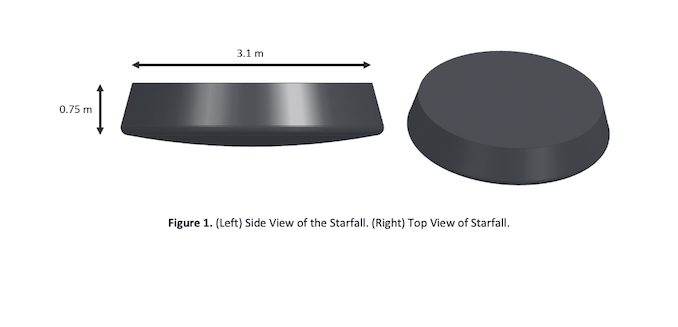
Note: Mission profile and payload details are TBD. Demonstration mission for SpaceX’s Project Starfall, which aims to mass-produce reentry capsules designed to autonomously transport valuable customer experiments and other payloads safely back from space to Earth, including for in-orbit manufacturing. Starfall is a cylindrical shaped capsule approximately 0.75 meters tall with a diameter of 3.1 meters, weighing approximately 2100 kilograms, and capable of carrying 1000 kilograms of payload. It is designed to be carried on Starship flights.
← Lancements
SpaceX
Falcon 9
Project Starfall Demonstration Mission
Live tracking
T-0 (UTC)10:53 UTC
LanceurFalcon 9
Probabilité95%
T-0 (UTC)23 juin 2026 à 10:53 UTC
LanceurFalcon 9
Pas de tirSpace Launch Complex 40
PaysUSA
TypeTechnology
Couverture
Sur cette mission

SpaceX launches secretive Starfall reentry demo mission
SpaceX launched the first test flight of its Starfall reentry capsule June 23, but the mission remained as secretive as the program itself. The post SpaceX launches secretive Starfall reentry demo mission appeared first on SpaceNews.

Launch Preview: Pegasus XL to launch amongst Falcon 9 and Chinese missions
This week’s launch manifest includes six orbital launches worldwide, including the first Pegasus XL launch… The post Launch Preview: Pegasus XL to launch amongst Falcon 9 and Chinese missions appeared first on NASASpaceFlight.com.
Live coverage: SpaceX to launch reentry capsule demo mission called ‘Starfall’
The mission is the debut of a new reentry capsule developed by SpaceX that weighs about 2,100 kg (4,600 lbs). Liftoff from pad 40 at Cape Canaveral Space Force Station is scheduled for 6:43 a.m. EDT (1043 UTC).

SpaceX to test upcoming Starfall reentry vehicle with demonstration mission on Tuesday
SpaceX is set to launch a demonstration mission for its Starfall reentry vehicle early on… The post SpaceX to test upcoming Starfall reentry vehicle with demonstration mission on Tuesday appeared first on NASASpaceFlight.com.

Launch Preview: 10 launches scheduled from sites across the world
A very busy launch manifest is expected in the upcoming week, with 10 launches scheduled… The post Launch Preview: 10 launches scheduled from sites across the world appeared first on NASASpaceFlight.com.