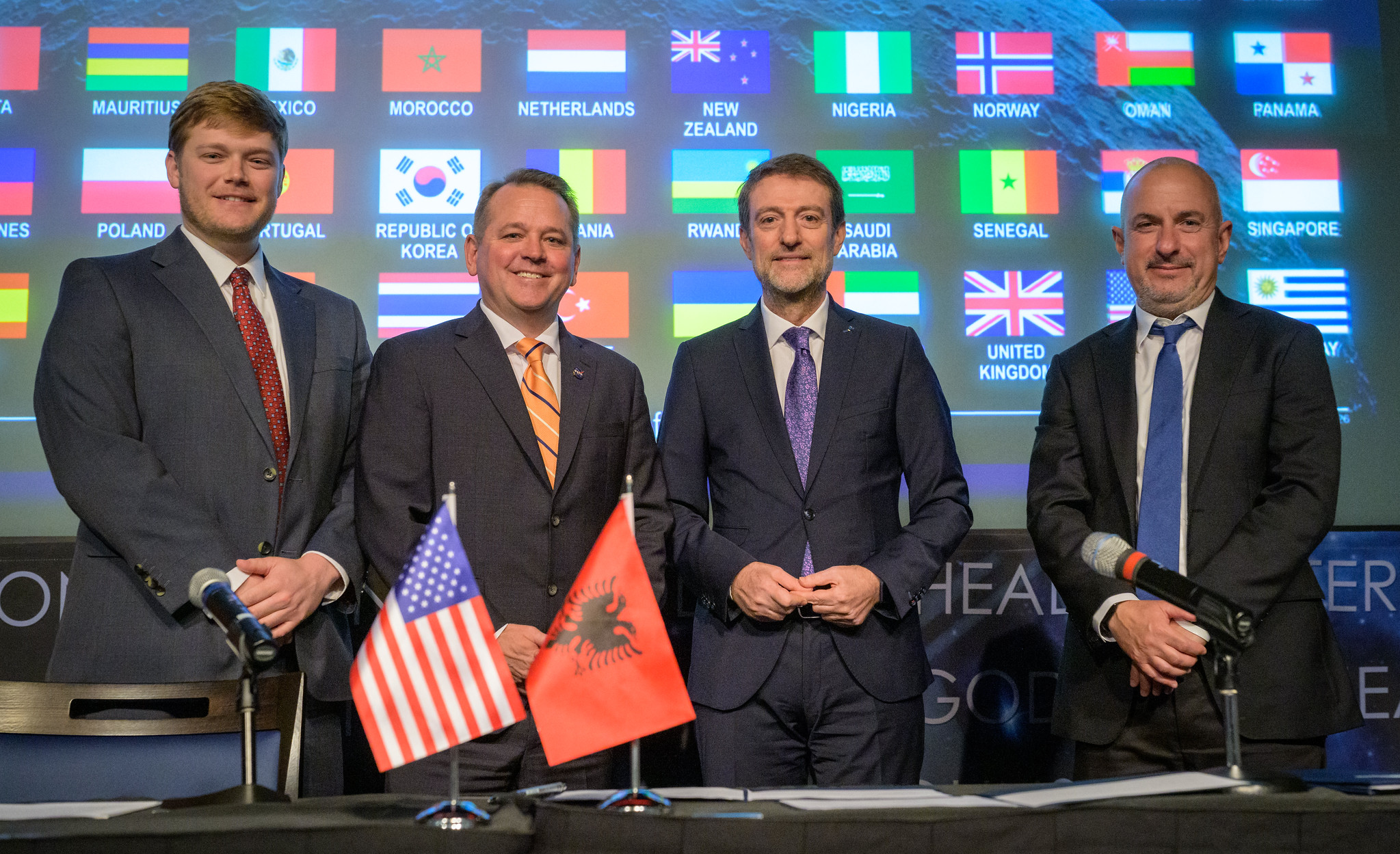
The Republic of Albania signed the Artemis Accords on Monday, September 21, 2026, at a ceremony held at NASA headquarters in Washington, D.C. The signing makes Albania the 73rd country to formally endorse the multilateral framework that outlines principles for peaceful, open, and responsible civil space exploration.
High-level delegations on both sides
Albania was represented by Ferit Hoxha, the country's Minister for Europe and Foreign Affairs, alongside the Albanian Ambassador to the United States. Matt Anderson, NASA's Deputy Administrator, presided over the ceremony on behalf of the agency. In his remarks, Anderson emphasized that each new signatory strengthens a collective commitment to ensuring that outer space remains a domain governed by shared norms rather than unilateral agendas.
The event once again highlighted how Artemis has evolved well beyond a lunar exploration program into one of the more active instruments of American space diplomacy. By bringing together nations with vastly different space capabilities — from established agencies to countries with minimal institutional presence in the sector — the Accords have become a platform through which Washington projects influence across an increasingly contested domain.
What the Artemis Accords actually establish
Launched in 2020 by NASA in coordination with the U.S. Department of State, the Artemis Accords set out a series of behavioral norms for nations and organizations engaged in civil space activities. Key provisions address transparency in operations, scientific data sharing, the preservation of historically significant space heritage sites, responsible orbital debris management, and the peaceful extraction and use of space resources. The Accords draw heavily from the spirit of the 1967 Outer Space Treaty, though they carry no binding treaty-level legal obligations.
Since their introduction, the list of signatories has grown steadily. Early participants included major space-faring nations such as Japan (JAXA), Canada (CSA), the United Kingdom, and Australia. In more recent years, the roster has expanded to include India (ISRO), numerous Eastern European states, and several nations across Latin America, Africa, and Asia. Albania's accession follows this broader pattern of engagement from countries that view the Accords as a gateway to international scientific cooperation, even absent a fully developed national space program.
What this means for Albania — and for the coalition
For Albania, the signing carries clear political weight. The country is an active candidate for European Union membership and has been working to deepen its integration into Western-led multilateral frameworks. Aligning with the Artemis Accords fits that broader foreign policy trajectory, signaling ambitions in high-technology diplomacy alongside the more traditional accession talks.
Membership in the Accords does not translate directly into a seat on Artemis missions themselves. Crewed lunar flights remain the domain of a limited set of deeply integrated partners — most notably the European Space Agency (ESA), JAXA, and CSA. What the Accords do provide is a structured basis for bilateral and multilateral cooperation with NASA and other signatory agencies, including access to scientific data exchanges, training opportunities, and joint mission planning at various levels.
With 73 countries now on board, the Artemis Accords represent a significant share of United Nations member states. NASA is expected to continue its diplomatic outreach in parallel with preparations for upcoming crewed lunar missions, and further signatories could be announced before the end of 2026.