Four astronauts, one Orion, two landers to test
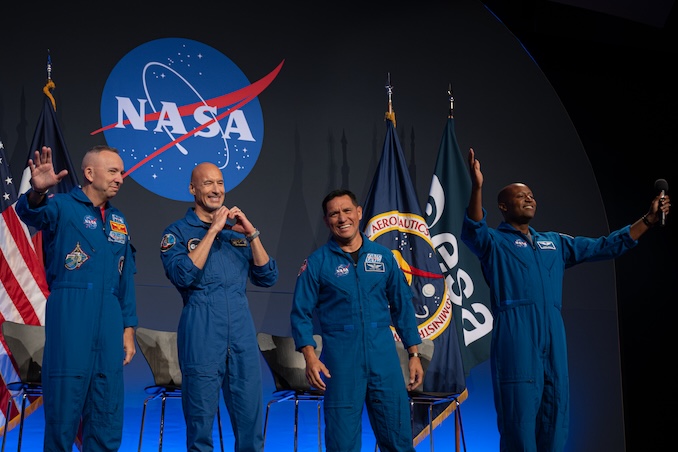
On June 9, 2026, NASA formally introduced the four-person crew assigned to the Artemis 3 mission during a ceremony held at Johnson Space Center in Houston. The lineup brings together NASA astronauts Andre Douglas, Randy Bresnik, and Frank Rubio, alongside ESA (European Space Agency) astronaut Luca Parmitano. Notably, this mission will not attempt a lunar landing — it will take place entirely in low Earth orbit.
The primary purpose of Artemis 3 is to put integrated operations between the Orion spacecraft and next-generation lunar landers through their paces in orbit. Two commercial partners are developing those landers: SpaceX, whose Human Landing System is derived from the Starship architecture, and Blue Origin, with its Blue Moon vehicle. Verifying the rendezvous and docking sequences between Orion and each system is considered a mandatory milestone before any crewed lunar surface attempt can be scheduled.
An all-male crew draws immediate scrutiny
The announcement drew rapid criticism given one of Artemis's founding promises: to land the first woman on the Moon. With no female astronaut included in the Artemis 3 crew, NASA's administrator felt compelled to address the matter publicly at an event held the day after the reveal at Johnson Space Center. The full substance of that defense had not been released in detail at the time of publication.
For the international spaceflight community, Luca Parmitano's inclusion carries its own significance. The Italian astronaut, a two-time International Space Station veteran, would become the first ESA-affiliated crew member to fly on an Artemis mission, reinforcing the agency's partnerships with its European allies.
A program rebuilding momentum, step by step
Artemis 3 fits within a broader sequencing strategy that NASA has been refining since the uncrewed Orion test flight in late 2022. Artemis 2, which is intended to carry astronauts around the Moon without landing, has yet to fly at the time of writing. The agency's approach appears to prioritize incremental technical validation over accelerated timelines, even as public and political pressure mounts.
The gender representation question, however, is unlikely to fade. Several women remain active in NASA's astronaut corps — including Christina Koch, who had previously been assigned to a different Artemis slot — and their absence from this particular crew will continue to draw scrutiny. NASA has not offered a detailed public rationale for why no female astronaut was selected for Artemis 3, leaving a gap that critics and observers will not easily overlook.