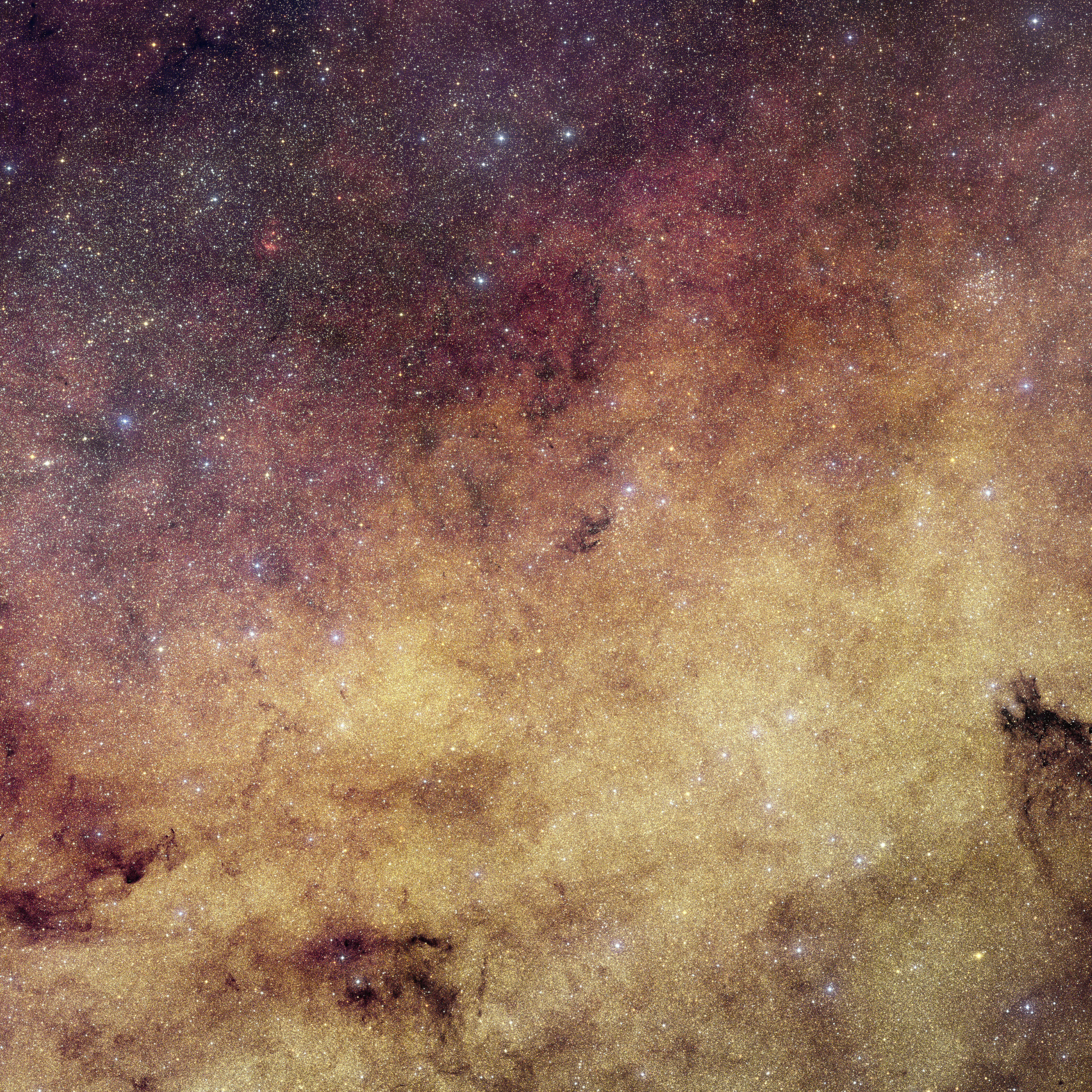
On 23 March 2025, ESA's Euclid space telescope turned its instruments toward the galactic bulge — the dense, luminous central region of our galaxy — and captured a sweeping mosaic in visible light. Released publicly on 24 June 2026, the image has been confirmed as the largest high-resolution visible-light photograph ever taken of the Milky Way's core, a record that underscores just how much observational power Euclid brings to bear beyond its primary cosmological mission.
More than 60 million stars in a single frame
The sheer number of stellar objects crammed into the image — upward of 60 million — is not merely a striking statistic. Each of those stars is a potential scientific target. By tracking minute fluctuations in their brightness over time, astronomers can identify exoplanets using a technique known as gravitational microlensing. When a planet and its host star happen to drift into precise alignment with a more distant background star, the planet's gravity temporarily bends and amplifies the background light in a characteristic way. This method is particularly powerful because it can reveal planets that never transit their star and thus remain invisible to most other detection techniques.
The galactic center is an ideal hunting ground for such signals: the extraordinary density of stars dramatically increases the odds of a useful alignment occurring at any given moment. Euclid, built primarily to chart dark matter and dark energy across billions of light-years, proves here that its instrumentation is well-suited for closer, more intimate work within our own galaxy.
A direct handoff to NASA's Roman Space Telescope
The strategic significance of this observation extends well beyond the image itself. The region Euclid surveyed overlaps substantially with the area that NASA's Nancy Grace Roman Space Telescope is slated to study as part of its dedicated core survey — a program focused heavily on detecting exoplanets through microlensing. Roman is expected to launch in the summer of 2026, and scientific teams are already working with Euclid's data to refine their observing plans before Roman even reaches orbit.
Roman will combine a field of view roughly 100 times wider than Hubble's with comparable resolution, enabling it to monitor millions of stars simultaneously for microlensing events. Having a detailed, pre-existing stellar catalog of the galactic center in hand — courtesy of Euclid — will meaningfully accelerate the earliest phases of Roman's operations, allowing researchers to focus quickly on candidate events rather than spending time building baseline reference data from scratch.
Transatlantic collaboration as standard practice
The interplay between Euclid and Roman reflects a broader shift in how major space observatories are conceived and operated. NASA contributed infrared detector arrays to the Euclid mission, and American scientists are embedded in its data analysis pipelines. In return, ESA's observational work is actively enabling the scientific return of a future NASA flagship. This kind of layered, cross-agency collaboration is increasingly the norm rather than the exception in space science.
Together, the two telescopes could reshape what we know about exoplanet populations in one of the most extreme environments in the galaxy — a region long considered too crowded and complex to survey effectively. That work is now, clearly, well underway.