Mapping a Sea of Stars for the Roman Space Telescope
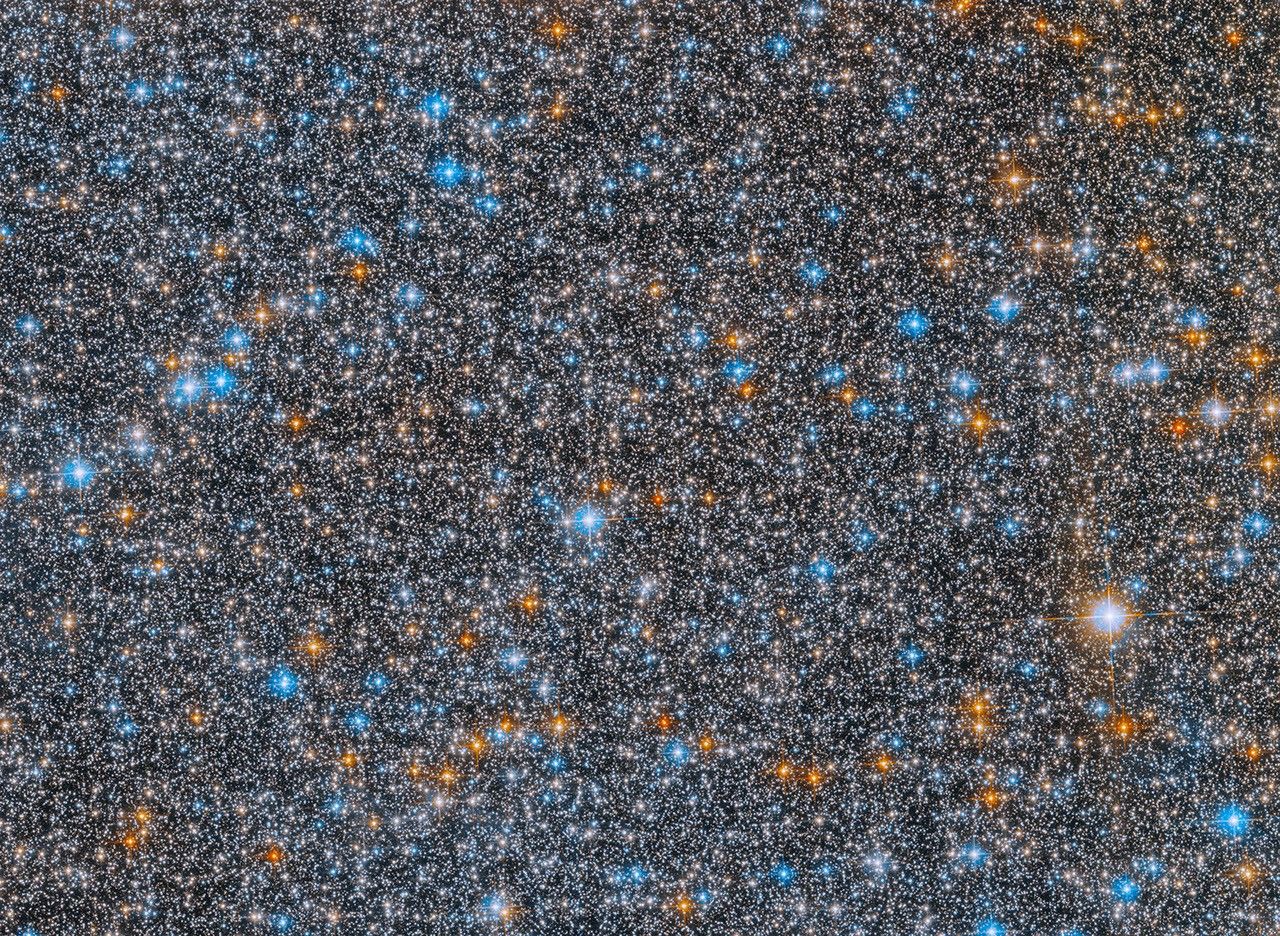
One of Hubble's latest observational campaigns takes aim at one of the most crowded regions of the Milky Way, where stars are packed so densely that separating individual sources becomes a genuine technical challenge. This is not simply an exercise in imaging — the data collected will serve as a critical calibration baseline for the upcoming Nancy Grace Roman Space Telescope, which NASA is preparing to launch in the coming years.
Roman is designed to survey vast swaths of sky in a single pointing, covering areas that would require dozens of separate Hubble exposures to document. That wide-field capability is a major asset, but it also demands careful preparation. When Roman begins scanning the galactic bulge for exoplanets using the gravitational microlensing technique — a method that detects distant worlds by observing the temporary brightening of a background star as a massive object passes in front of it — astronomers will need a detailed map of the stellar population already in place. That is precisely what these Hubble observations are building.
The galactic bulge is considered one of the most promising regions for microlensing surveys because of its extraordinary stellar density. Thousands of planetary detections could be within Roman's reach once it begins operations. But extracting those signals reliably from a crowded field requires knowing what is already there — which stars, at what brightness, and with what natural variability. Hubble is laying that foundation now.
A Clearer Look at the Barred Galaxy NGC 4394
The second recent release shifts focus from the depths of our own galaxy to a structure some 55 million light-years away. NGC 4394 is a barred spiral galaxy located in the constellation Coma Berenices and is a member of the Virgo Cluster, the nearest major galaxy cluster to our own Local Group.
What makes the new Hubble image noteworthy is the precision with which the instrument captures the galaxy's defining feature: its central bar. This elongated structure of stars cuts across the galactic nucleus, with the spiral arms winding outward from each end. Galactic bars are not merely structural curiosities — they play an active role in a galaxy's evolution by funneling gas toward the center, potentially driving star formation or fueling activity in the nucleus. NGC 4394's bar is unusually well-defined, making it a valuable case study for researchers trying to understand how these structures influence galactic dynamics over time.
The observation also illustrates how revisiting known targets with Hubble's most capable current instruments can yield meaningfully improved data. Archives built over decades remain a cornerstone of comparative astronomy, and updated measurements help close gaps left by older detectors operating under tighter constraints.
A Telescope That Bridges Generations
Taken together, these two releases reinforce a point that is sometimes overlooked in discussions about next-generation observatories: Hubble is not simply waiting to be replaced. It is actively contributing to the scientific infrastructure that Roman, and to some extent the James Webb Space Telescope — already operational since late 2021 — will depend on.
Launched in April 1990 and kept current through a series of Space Shuttle servicing missions, Hubble remains operationally unique. No other facility currently in orbit combines its ultraviolet sensitivity, its spatial resolution in visible light, and its decades-long archive of the same patches of sky. With no further servicing missions possible, every additional observation it completes carries genuine scientific weight — and in the case of the Roman preparatory survey, it is performing work that only it can do at this stage.
How long the telescope will continue to function reliably remains uncertain, but its current productivity shows no sign of slowing. For the global astronomical community, that is welcome news.