A conjunction and a meteor shower open the month
November began with a visually striking celestial alignment on the 12th, when the Moon, Venus, and the blue-white giant Spica gathered in a tight apparent grouping across the evening sky. While the three objects share no physical connection — separated by vastly different distances — their convergence in the same field of view offered an accessible entry point for observers learning to navigate the winter sky. Astrophotographers worldwide captured the scene before the Moon continued its nightly eastward drift.
Three nights later, the Leonid meteor shower put on its annual display against the backdrop of Orion. Produced by debris shed over centuries by Comet 55P/Tempel-Tuttle, Leonid meteors enter Earth's atmosphere at roughly 71 kilometres per second, among the fastest of any annual shower. NASA's Astronomy Picture of the Day (APOD) programme highlighted a composite image showing multiple bright streaks etched across the familiar silhouette of Orion's belt and sword — a visual contrast between fleeting solar system debris and ancient stellar light.
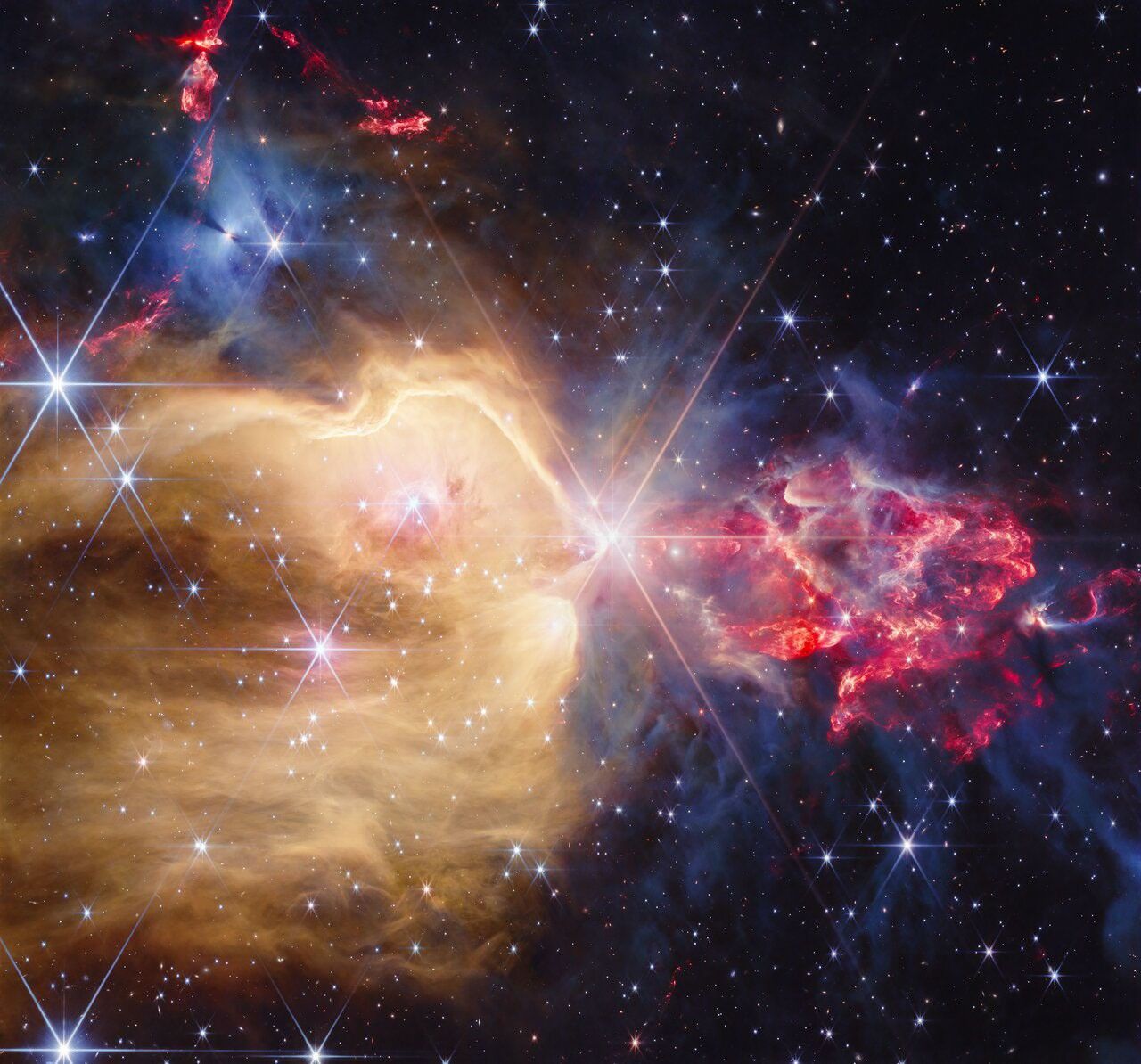
James Webb peers into a stellar nursery in NGC 7129
The scientific centrepiece of this mid-November imaging sequence arrived on the 16th, with an APOD image dedicated to NGC 7129, a reflection nebula and young open cluster roughly 3,300 light-years away in the constellation Cepheus. The James Webb Space Telescope — operated by NASA, ESA, and the Canadian Space Agency — captured the region in infrared, revealing bipolar jets streaming from protostars still deeply embedded in their natal cocoons of gas and dust.
These jets, classified as Herbig-Haro objects where they collide with surrounding interstellar material, are diagnostic signatures of active accretion onto very young stars. Webb's infrared sensitivity allows it to cut through the dense, opaque clouds that blocked optical observatories from witnessing these early stellar phases. NGC 7129 hosts approximately forty young stellar objects, making it a compact natural laboratory for probing conditions analogous to those that gave rise to our own solar system some 4.6 billion years ago.
Andromeda's star clouds and NASA Ames recognitions
On November 13th, the APOD spotlight fell on NGC 206, identified as the largest concentration of young, hot stars within the Andromeda Galaxy (M31), our nearest spiral neighbour at 2.5 million light-years. The association, visible under dark skies through a modest telescope, underscores that vigorous star formation is not a Milky Way peculiarity but a process unfolding across the local galactic neighbourhood.
On the institutional side, NASA's Ames Research Center recognised three members of its Science Directorate for November 2026. Steve Howell, a noted expert in exoplanet science and high-angular-resolution astronomy, was honoured alongside Alyssa Villanueva, a space biosciences engineer, and Samuel LeBlanc, whose work focuses on terrestrial atmospheric physics. The acknowledgements reflect the breadth of disciplines that underpin NASA's broader scientific mission, from planetary atmospheres to stellar astrophysics.
Taken together, November 2026 weaves together the transient — a meteor's brief arc, a planetary conjunction that dissolves within days — and the enduring questions of how stars and solar systems are born. The month serves as a reminder that amateur observers and research observatories alike share the same sky, each finding meaning at their own scale.