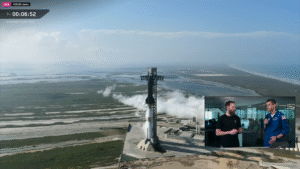
A scrub, then a successful liftoff
The road to Starship V3's first flight was not entirely smooth. During the initial launch attempt, a series of technical issues emerged with under a minute remaining on the countdown clock, forcing SpaceX to call a scrub and stand the vehicle down at its Boca Chica, Texas facility. Ground teams worked through the night to resolve the faults before trying again.
Twenty-four hours later, on May 22, 2026, the vehicle cleared the pad and climbed toward space. It was the twelfth flight in the Starship test campaign and the first ever for the V3 configuration — a meaningfully updated variant of the integrated launch system that had powered the previous eleven flights in earlier form.
What sets V3 apart
Full technical specifications for the V3 build had not been released by SpaceX at the time of publication, but the new version represents a substantial evolution from its predecessor. Changes are understood to affect both the Super Heavy booster and the upper-stage Starship spacecraft, continuing the company's iterative development approach in which hardware is revised aggressively between flight series rather than refined primarily through ground testing.
The flight profile for this twelfth test was suborbital, consistent with the trajectory used in most earlier missions. Available reporting indicates that the majority of the objectives set for the flight were met, a result that SpaceX engineers and NASA program managers alike will view as a positive data point.
High stakes for a vehicle with large ambitions
Starship sits at the center of some of the most consequential contracts in the current space industry. NASA has selected SpaceX to provide the Human Landing System for the Artemis program's crewed lunar surface missions, a deal worth several billion dollars that depends entirely on Starship reaching operational readiness on schedule. That schedule remains under pressure, and every test flight carries weight well beyond SpaceX's own development goals.
Beyond the Moon, SpaceX has articulated plans to use Starship for commercial satellite deployment in low Earth orbit, eventually succeeding the Falcon 9 and Falcon Heavy families. With a theoretical payload capacity far exceeding anything currently flying in a reusable configuration, the vehicle could reshape launch economics — if and when it transitions from development to routine operations.
The first flight of V3 does not resolve open questions about certification timelines or the pace of operational readiness. What it does confirm is that SpaceX continues to accumulate flight experience at a pace no other launch provider currently matches, building toward a system whose scope remains unmatched in the broader history of spaceflight.

