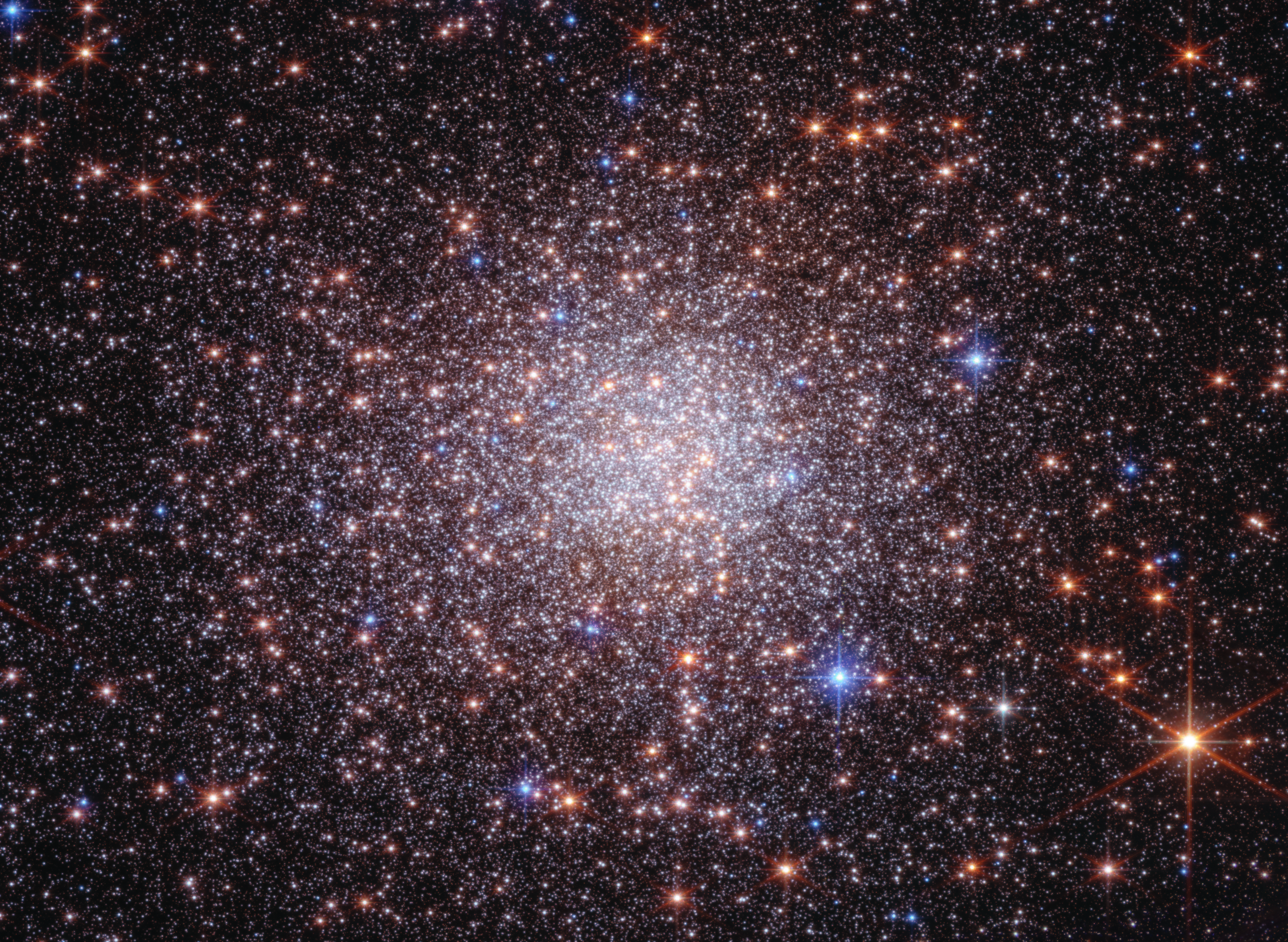
For decades, Terzan 5 sat quietly in astronomical catalogues, labelled as a globular star cluster — one of those compact, ancient stellar spheres that pepper the outskirts and inner regions of galaxies. That classification has now been definitively overturned. Using the combined power of the NASA/ESA/CSA James Webb Space Telescope and the NASA/ESA Hubble Space Telescope, a team of researchers has established that Terzan 5 belongs to an entirely different category of object, one so rare it required a new name.
Two stellar populations, billions of years apart
The defining characteristic of a globular cluster is its stellar uniformity: all its stars form in a single burst from the same gas reservoir, sharing nearly identical ages and chemical compositions. What Webb and Hubble have revealed about Terzan 5 breaks that rule entirely. The object contains at least two distinct stellar populations separated by several billion years of history. One group of stars coalesced roughly twelve billion years ago; another formed significantly later. That kind of temporal gap points to multiple, separate episodes of star formation — a hallmark that is structurally incompatible with classical globular cluster behaviour.
Webb's infrared sensitivity allowed researchers to peer deep into the densest regions of Terzan 5, cutting through the dust that obscures the galactic bulge. Hubble's optical resolution, meanwhile, provided a precise spatial map of the two stellar populations. Neither telescope alone would have been sufficient; the discovery is a direct product of their complementary capabilities working in tandem.
A fossil fragment of galactic assembly
To account for what they observed, researchers have introduced a new classification: bulge fossil fragments. The proposed scenario holds that Terzan 5 is the surviving core of a primitive proto-galactic system that was captured and absorbed by the early Milky Way billions of years ago. Compressed into the galaxy's dense central bulge, this remnant managed to endure the gravitational turmoil of cosmic time, preserving within it a record of conditions that existed when the Milky Way was still assembling itself from smaller building blocks.
That hierarchical growth process — large galaxies forming by accreting smaller structures — is a cornerstone of modern cosmological models. What makes Terzan 5 significant is that it appears to offer direct, observable evidence of this process preserved in our own galactic backyard, rather than inferred from distant galaxies or theoretical simulations.
A prototype for future searches
The reclassification of Terzan 5 carries implications beyond a single object. It establishes a concrete prototype against which other misidentified clusters could be re-evaluated, both in existing survey data and in future observations with next-generation instruments. Neither NASA nor ESA has announced additional confirmed candidates at this stage, but the criteria are now sharper. Astronomers studying the Milky Way's bulge have a new lens through which to examine structures that may have been hiding in plain sight.
What was once a modest entry in a star cluster catalogue has become something considerably more consequential: a twelve-billion-year-old witness to the birth of the galaxy we live in, preserved well enough that two space telescopes could finally read its story.