A tale of two clusters
Within the span of a week, NASA released two distinct Hubble Space Telescope images centered on galaxy clusters — each telling a different story about how the universe organizes itself on the grandest scales. Far from being static collections of galaxies, these structures are among the most dynamic and scientifically productive environments astronomers can study.
The first target, catalogued as CL0016+1609 and also designated MACS J0018.5+1626, has a long history in astrophysical research. The cluster ranks among the most thoroughly observed objects in both X-ray and radio wavelengths, and it is that X-ray scrutiny that yielded a pivotal finding: what appears in optical light as a single dense system is, in fact, two separate clusters undergoing a head-on merger along our line of sight. Such collisions are cosmologically significant events. As the clusters collide, the superheated intra-cluster gas emits intense X-ray radiation, while the dark matter halos pass through one another largely undisturbed — providing a natural test bench for understanding how this invisible component of mass behaves under extreme gravitational conditions.
MACS0329-0211: nature's own magnifying glass
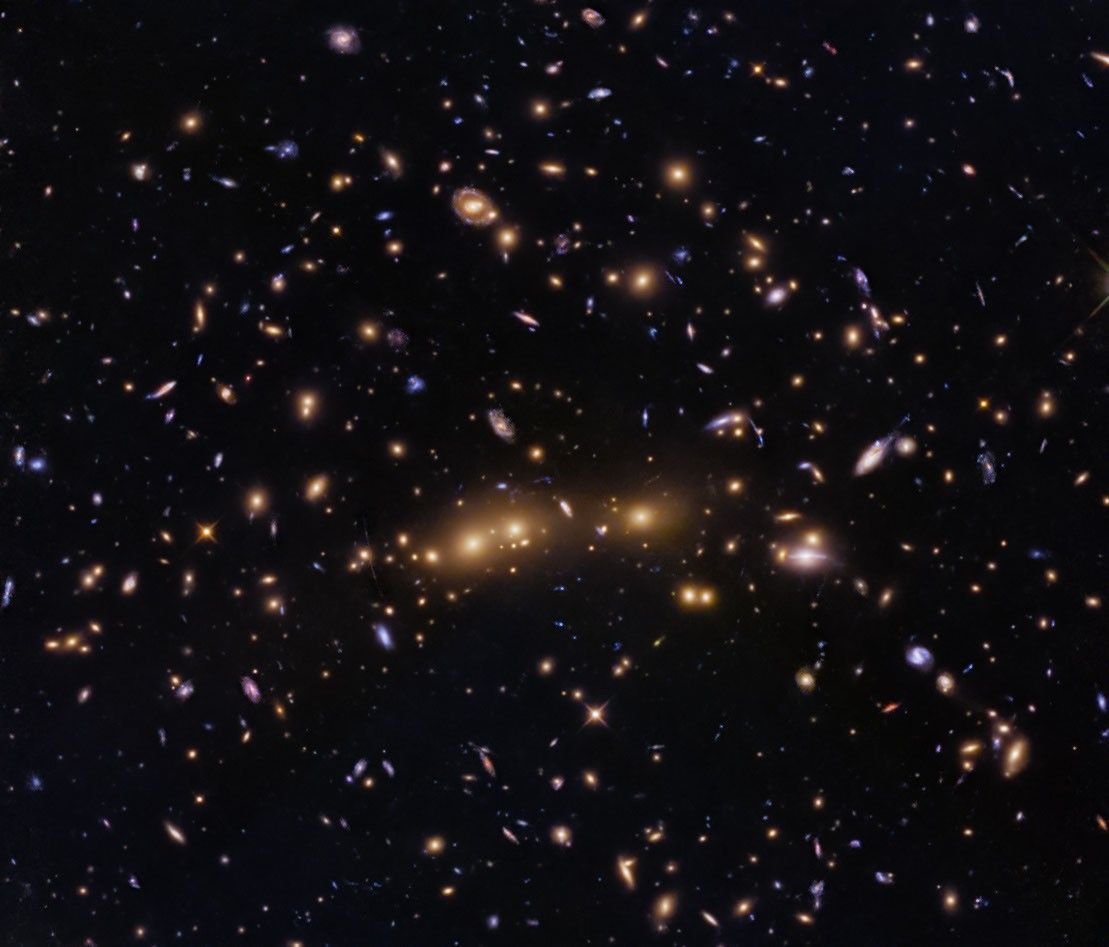
The second image, released on June 12, 2026, features the galaxy cluster MACS0329-0211. Visually, the scene resembles a dense swarm of luminous points converging toward a common center — hundreds of galaxies packed into a compact region of sky. But the scientific value of this cluster extends well beyond its striking appearance.
Like all sufficiently massive clusters, MACS0329-0211 warps the fabric of spacetime around it. The result is gravitational lensing: light from galaxies lying far behind the cluster is bent, stretched, and in some cases amplified into arcs visible in Hubble's imagery. First described theoretically through Einstein's general relativity, gravitational lensing has become one of observational astronomy's most powerful tools. It grants access to distant objects that would otherwise fall below the detection threshold of any telescope, and it allows researchers to map the distribution of mass within the cluster — including the dark matter that accounts for the majority of that mass but emits no light.
Mapping the architecture of the cosmos
Taken together, these two observations reflect a broader effort to trace how large-scale cosmic structure has assembled over billions of years. Galaxy clusters serve as milestones in that story: their masses, temperatures, merger histories, and gravitational profiles encode information about the cosmological conditions that prevailed at different epochs.
Hubble, now well into its fourth decade of operation, continues to generate foundational data across optical and near-infrared wavelengths. Its images routinely complement observations from the James Webb Space Telescope, the flagship observatory launched in late 2021 through a partnership between NASA, the European Space Agency, and the Canadian Space Agency. The two telescopes cover complementary spectral ranges, enabling multi-wavelength studies with a depth and breadth that neither instrument could achieve alone.
The physics of merging clusters and gravitational lenses remains an active area of inquiry. Each new Hubble image adds a data point to an ongoing effort to understand how matter — visible and dark alike — behaves at the largest scales the universe provides. The answers, researchers suggest, will have implications not just for astrophysics, but for fundamental physics as a whole.