A galaxy above the geysers
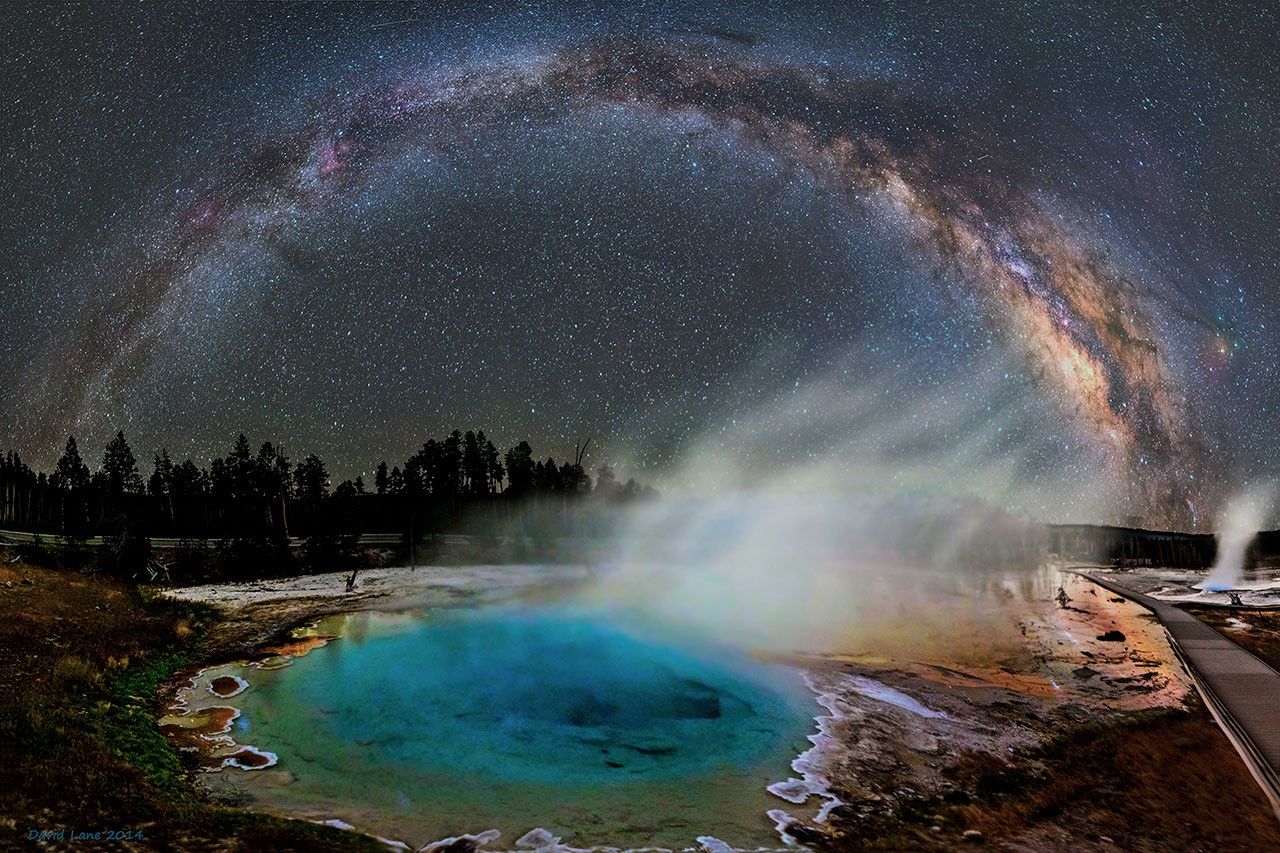
On 16 August 2026, NASA's long-running Astronomy Picture of the Day (APOD) programme featured a striking night photograph taken above Yellowstone National Park in Wyoming. In it, the diffuse band of the Milky Way stretches across a dark sky, its glow reflected loosely in the steam rising from the park's hydrothermal vents. The image, explained as usual by a professional astronomer, is both a scientific document and a reminder of what skies looked like before electrification changed the night.
For astronomers, photographs like this one double as data on light pollution — or rather on its absence. Research based on photometric surveys suggests that more than 80 percent of the world's population can no longer see the Milky Way from where they live. Protected natural areas such as Yellowstone represent some of the last reservoirs of genuinely dark sky in North America, making them valuable not just for biodiversity but for naked-eye astronomy as well.
The juxtaposition at work in the image carries its own quiet power: geothermal columns produced by volcanic processes millions of years in the making rise toward starlight that has itself traveled decades or centuries to reach the camera sensor. Two deep timescales, caught in a single frame.
ESA's window on a week of space activity
Meanwhile, the European Space Agency published its regular Week in Images compilation covering 10 to 14 August 2026. These weekly roundups, produced consistently over several years, serve as a compact visual record of everything happening across ESA's portfolio — from Earth observation data captured by the Sentinel satellite family to deep-space measurements and ground-based mission preparation.
The specific content of this particular edition was not detailed beyond its publication at the time of writing, but the format itself is worth noting. By aggregating visuals from multiple missions into a single weekly release, ESA gives both specialist audiences and curious newcomers a structured entry point into its current operations. It is a communication model that has proven durable precisely because it does not attempt to explain everything at once.
Why the image still matters
Taken together, these two publications — one from NASA, one from ESA — reflect a broader truth about how space agencies communicate with the public. Since the first photographs returned by the Apollo missions, and arguably since the earliest telescopic drawings of the Moon, images have carried scientific knowledge further and faster than text alone.
APOD, which has run continuously since 1995, is among the most visited science pages on the internet, not because it publishes breaking news but because each entry offers something self-contained and visually immediate. ESA's weekly digest operates on a similar logic, just across a broader institutional canvas.
As the major agencies press forward with programmes of growing ambition — crewed lunar return under Artemis, Mars exploration, the expansion of satellite constellations — there is value in pausing over a photograph of a galaxy above a geyser field. It connects the largest possible scale to a landscape that exists on this planet, in this moment. That connection is not incidental to space science. In many ways, it is the point.