A robotic platform built for the most demanding orbital environment
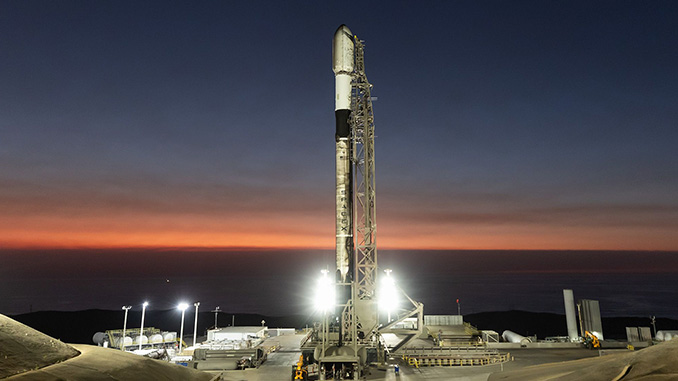
On July 21, 2026, a SpaceX Falcon 9 rocket is scheduled to lift off from Launch Complex 40 at Cape Canaveral Space Force Station in Florida, carrying one of the most technically ambitious commercial payloads in recent memory. The Mission Robotic Vehicle (MRV-1), developed by Northrop Grumman, is designed to operate in geosynchronous orbit (GEO) — roughly 36,000 kilometers above Earth — and to service satellites that were never built with maintenance in mind. The four-hour launch window opens at 5:15 p.m. EDT (2115 UTC).
The spacecraft's core capability comes from its Robotic Servicing of Geosynchronous Satellites (RSGS) payload, a system jointly developed by the U.S. Naval Research Laboratory and DARPA. This technology allows MRV-1 to approach, inspect, and potentially repair third-party satellites already operating in GEO — a region of space that hosts a significant portion of the world's telecommunications, weather monitoring, and strategic surveillance infrastructure.
What makes this mission technically demanding is the nature of GEO itself. Unlike low Earth orbit, where servicing demonstrations have already taken place, geosynchronous orbit presents far stricter constraints: communication delays, precise proximity maneuvering requirements, and the need to handle spacecraft that were not designed to receive external assistance.
DARPA's years of robotics research put to the test
The RSGS program has been in development for years within DARPA and the Naval Research Laboratory, focusing on autonomous rendezvous and robotic manipulation in space. MRV-1 carries robotic arms and autonomous navigation systems capable of matching the orbit and attitude of a target satellite before initiating close-proximity operations.
Servicing so-called non-cooperative satellites — those with no dedicated docking interface or pre-planned servicing protocol — is among the hardest problems in orbital mechanics and robotics. Engineers must account for residual tumble rates, structural variations between satellite models, and the risk of debris generation during any contact operation.
Northrop Grumman has prior experience in the field. The company's Mission Extension Vehicle (MEV) program demonstrated the ability to dock with aging satellites and extend their operational life by taking over propulsion functions. MRV-1 goes a step further, targeting active technical interventions rather than passive life extension.
A ten-year mission with implications well beyond a single spacecraft
MRV-1 is designed for a mission lasting approximately a decade. That timeframe reflects the commercial logic underpinning the project: if robotic servicing proves reliable in GEO, it changes the financial calculus for satellite operators worldwide. Extending a satellite's service life by even a few years can represent enormous savings against the cost of building and launching a replacement.
The involvement of DARPA and the U.S. Navy also points to a strategic dimension. Maintaining government and military satellites in working order for longer periods — and having a credible on-orbit intervention capability — carries significant national security value at a time when space is increasingly contested.
Whether MRV-1 will deliver on its promises depends on what unfolds during its first rendezvous and inspection sequences. If the RSGS payload performs as intended, the mission could serve as a blueprint for a broader market in commercial orbital services — one that is still taking shape, but whose potential is drawing serious attention from both government and private stakeholders.