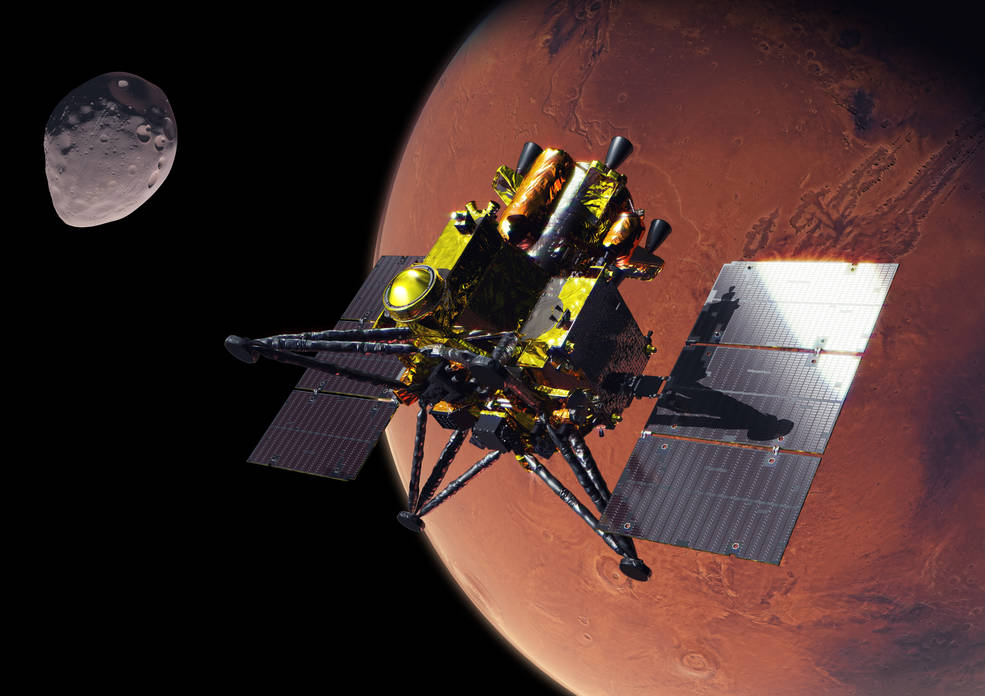
MMX: Chasing Phobos alongside Japan
The JAXA MMX (Martian Moons eXploration) mission is on the verge of departure. Liftoff from the Tanegashima Space Center in southern Japan is scheduled for October 19, 2026 (Eastern time), marking the opening of one of the most ambitious planetary science campaigns of the decade. NASA announced a media teleconference on October 15 to outline its specific role in the mission ahead of launch.
At its core, MMX is designed to answer a question that has lingered in planetary science for generations: where did Phobos and Deimos actually come from? The two small moons of Mars may be captured asteroids, ancient debris from a massive impact, or something else entirely. MMX aims to resolve that mystery by collecting physical samples from the surface of Phobos and returning them to Earth — an unprecedented feat. The full scope of NASA's contribution has not yet been publicly detailed, but the agency has confirmed it will be spelled out during the October 15 briefing.
The mission fits into a broader pattern of U.S.-Japan collaboration in deep space exploration. While JAXA's Hayabusa2 mission was a predominantly Japanese endeavor, it benefited from scientific exchanges with American researchers. NASA's involvement in MMX appears more formally integrated, though the precise instruments or systems it is providing remain to be confirmed.
LISA: All-glass optics for detecting cosmic tremors
On an entirely different scientific frontier, NASA has announced a significant development in its contribution to LISA — the Laser Interferometer Space Antenna — a space-based gravitational wave observatory led by the European Space Agency. LISA is designed to detect gravitational waves from space, the minute distortions in space-time produced by cataclysmic events such as supermassive black hole mergers, neutron star binaries, or even signals from the early universe.
NASA has contracted L3Harris Technologies to design, assemble, and integrate a fully glass telescope designated as the Engineering Test Unit. This is not the final flight model but a prototype intended to validate the optical and structural design choices before the definitive instrument is built. The decision to use an all-glass architecture — rather than conventional metallic structures — is driven by the need for exceptional thermal stability and optical precision, both of which are critical for the laser interferometry measurements at the heart of LISA's science.
LISA is not expected to launch until the mid-2030s at the earliest. NASA and ESA have been coordinating on the project for years, with NASA focused primarily on optical components and laser metrology systems. The Engineering Test Unit represents a concrete, hardware-level milestone in that long arc of development.
A shared playbook: science through collaboration
Taken together, these two announcements reflect a deliberate posture that NASA has adopted in recent years. Facing sustained budgetary uncertainty and congressional scrutiny, the agency has increasingly chosen to anchor itself in international partnerships rather than pursue all major missions independently. Contributing to JAXA's MMX and ESA's LISA allows NASA to maintain scientific presence across planetary science and fundamental physics without bearing the full financial and programmatic weight of either mission.
For the broader scientific community, this model has become the norm rather than the exception. The outstanding question is whether the political and funding commitments underpinning these partnerships will hold steady through the years — and in some cases decades — that separate today's engineering tests from tomorrow's discoveries.