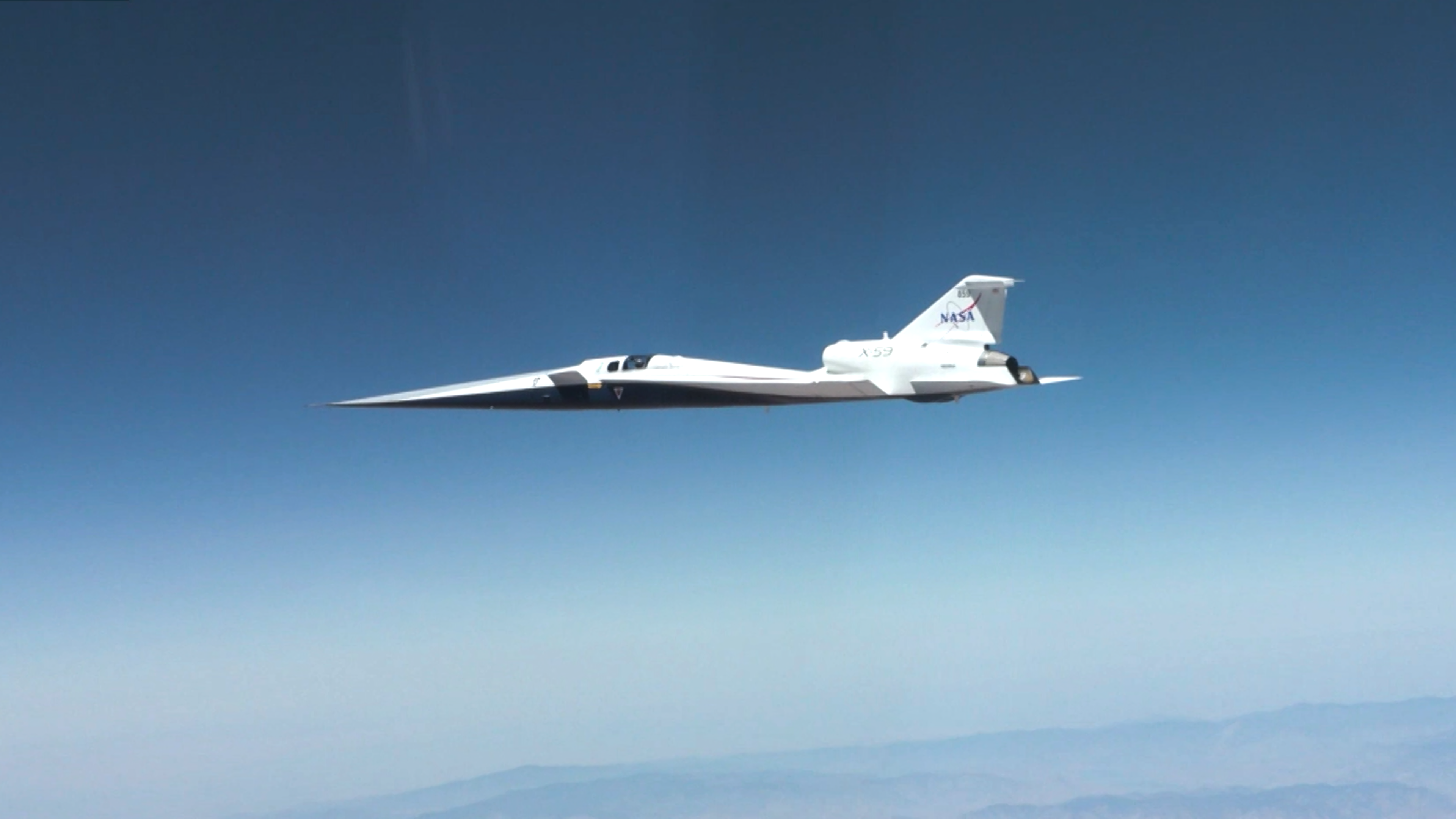
For more than half a century, supersonic flight over populated land has been effectively banned — a consequence of the disruptive sonic booms produced by aircraft travelling faster than sound. That restriction grounded Concorde's successors before they ever flew and has kept commercial supersonic travel out of reach. NASA's X-59, built around the premise that a supersonic aircraft does not have to be a loud one, reached a defining moment on June 5, 2026, when it exceeded the speed of sound for the first time.
Eighty-one minutes over the Mojave
NASA test pilot Jim "Clue" Less lifted off from Edwards Air Force Base in California's Mojave Desert at 11:08 a.m. Pacific time. Over the course of an 81-minute flight, the aircraft climbed to an altitude of approximately 43,400 feet and reached a top speed of around Mach 1.1 — roughly 713 miles per hour. The mission was structured to evaluate handling characteristics across both subsonic and supersonic flight regimes before returning to Edwards for an uneventful landing.
This first supersonic run was not intended to measure noise levels on the ground. The priority was to verify that the aircraft performs as modelled when pushed beyond Mach 1, and to gather flight data that will inform subsequent test phases. In that sense, June 5 was a systems-validation exercise as much as a speed record.
Designing silence into supersonic flight
The X-59 is the centrepiece of NASA's QueSST (Quiet SuperSonic Technology) programme, developed in partnership with Lockheed Martin Skunk Works. The aircraft's defining feature is its geometry: a fuselage stretching roughly 99 feet with a wingspan of only 29 feet, capped by a needle-like nose more than 30 feet long. This shape is engineered to break up and redistribute the shock waves that, on a conventional supersonic jet, merge into a sharp, thunderous boom. NASA expects the X-59 to produce a sound closer to a muffled thud — comparable to a car door closing heard from inside a house — rather than the crack that once rattled windows across entire cities.
If upcoming acoustic tests validate that prediction, NASA intends to share the data with aviation regulators including the FAA and the International Civil Aviation Organization. A favourable regulatory response could eventually lift long-standing restrictions on overland supersonic flight, opening a market that private companies such as Boom Supersonic are already positioning themselves to serve.
A programme years in the making
The road to this milestone was not smooth. The X-59 was originally expected to fly as early as 2022, but a series of technical challenges and schedule revisions pushed its first subsonic flight to January 2024. Reaching supersonic speed required an additional eighteen months of work. The programme's timeline is a reminder of how demanding experimental aeronautics can be, even when the underlying physics are well understood.
The next phase will involve refining supersonic performance across a range of altitudes and speeds before moving to the acoustic demonstration flights that represent the programme's ultimate purpose. Those overland passes — currently expected to take place above volunteer communities in the United States from late 2026 onward — will determine whether the X-59's quiet boom is genuinely quiet enough to change the rules of the sky.