A milestone flight for Europe's heavy-lift workhorse
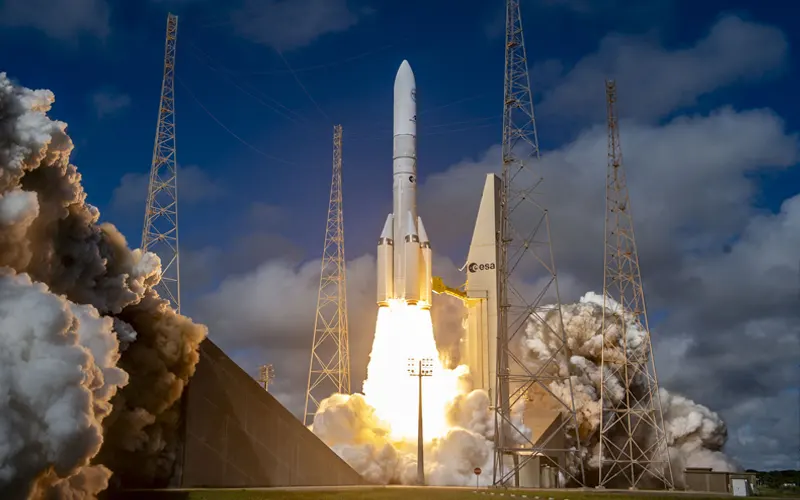
Arianespace conducted its third Ariane 6 launch of 2026 on June 17, with liftoff occurring at 12:21 UTC from the ELA-4 launch pad at the Guiana Space Centre in Kourou, French Guiana. The Ariane 64 variant — configured with four solid rocket boosters — carried 36 satellites bound for Amazon's Kuiper low Earth orbit broadband constellation. What made this particular mission stand out, however, was not just its payload: it marked the operational debut of the upgraded P160C solid-fuel boosters, a new generation of strap-on motors designed to push the launcher's performance envelope.
The P160C boosters deliver greater thrust than the previous design, giving Ariane 6 additional capability for heavier payloads or more demanding orbital insertion profiles. For Arianespace and the European Space Agency, successfully qualifying this upgrade on a commercial mission represents a meaningful step toward a more competitive and versatile launcher.
Amazon Kuiper and the commercial logic behind the partnership
This flight is part of a broader launch agreement between Arianespace and Amazon, under which the European operator has committed to deploying a substantial share of the Kuiper constellation. With another three dozen satellites now in low Earth orbit, Amazon continues to build out the infrastructure for its future broadband service, though the company has not publicly confirmed a specific timeline for full commercial availability.
The Kuiper contract carries strategic weight for Europe's launch industry. In a market where SpaceX's Falcon 9 has become the default choice for satellite operators worldwide, securing a long-term agreement with a major technology company provides Ariane 6 with both commercial revenue and a regular cadence of operational missions to refine its processes.
Launch rate remains the central challenge for ESA
Technical progress aside, the European Space Agency faces a more structural question: how to significantly increase Ariane 6's annual launch rate. According to reporting by SpaceNews, ESA is currently evaluating several options to ramp up production and flight frequency, though no formal decisions have been made public yet.
Three launches in roughly six months is a pace that still falls well short of what would be needed to compete head-to-head with SpaceX's Falcon family, which routinely executes dozens of orbital flights per year. Reaching a higher cadence is critical not only for fulfilling existing contractual obligations, but also for driving down per-launch costs through economies of scale — a prerequisite for long-term competitiveness in the commercial launch market.
For now, the successful debut of the P160C boosters offers a concrete reason for confidence. Ariane 6 is demonstrating that it can evolve technically while delivering on its commercial commitments. Whether that momentum can translate into the sustained, high-tempo operation that customers increasingly expect remains the defining question for Europe's launcher program in the years ahead.