A vast portrait of a stellar nursery next door
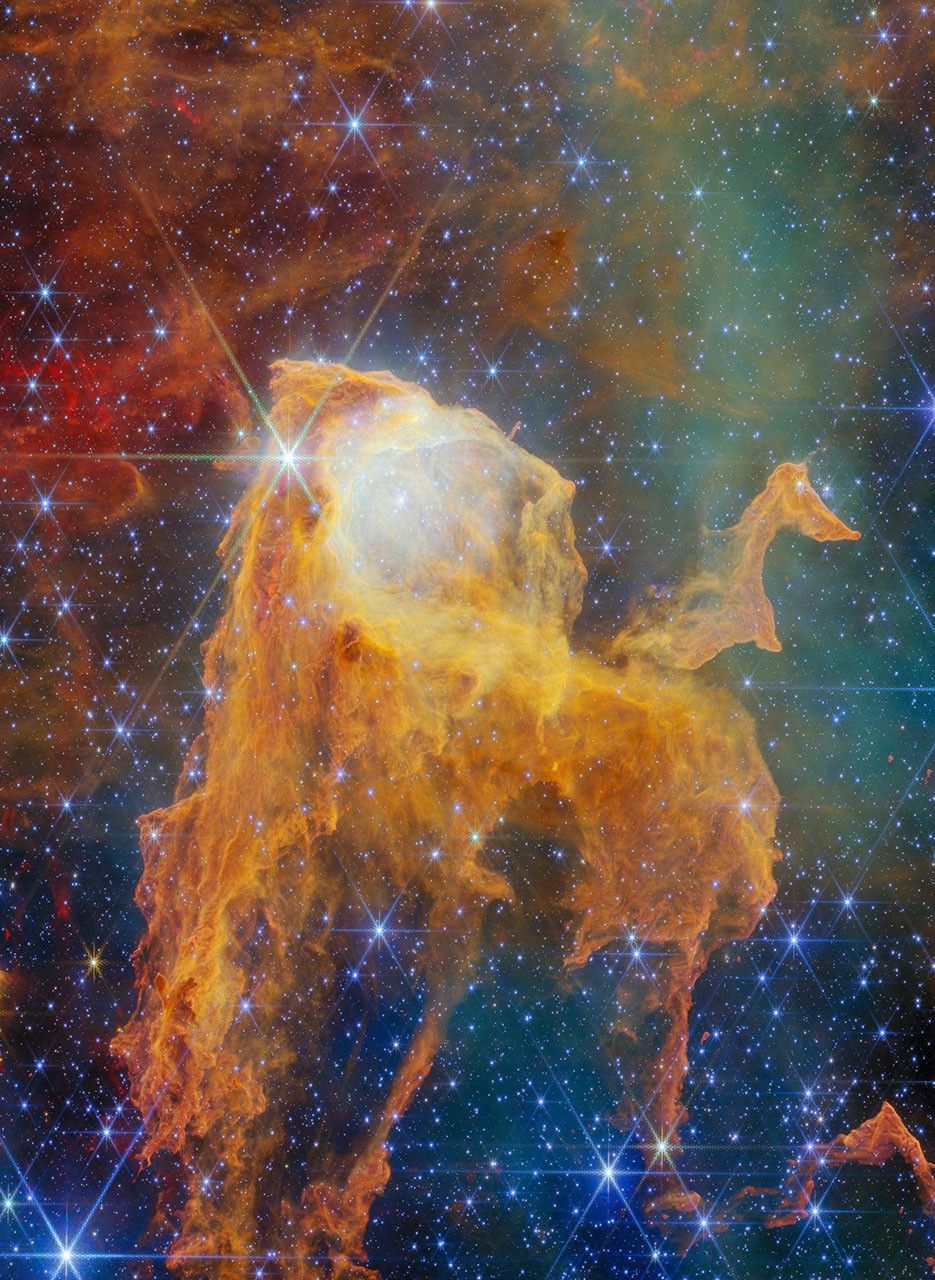
Located roughly 1,000 light-years away in the constellation Perseus, IC 348 is one of the closest and most thoroughly observed star-forming regions in the Milky Way. On September 15, 2026, the NASA/ESA/CSA James Webb Space Telescope team released one of the widest mosaics the observatory has produced to date, offering an unprecedented infrared view of this young stellar cluster. Webb's Near Infrared Camera (NIRCam) captures light that is invisible to the human eye, cutting through layers of dust and gas to expose the inner workings of a region where stars are still being born.
The image reveals an intricate tapestry of glowing filaments, dispersing dust clouds and hundreds of stars at various stages of development. Beyond its visual impact, however, the panorama serves as the backdrop for a targeted scientific investigation aimed at one of astronomy's more elusive populations of objects.
Brown dwarfs at the edge of what we can detect
The headline finding from this observing campaign centers on brown dwarfs — objects that occupy an ambiguous middle ground between the smallest stars and the largest gas-giant planets. They lack sufficient mass to sustain hydrogen fusion in their cores, which is what makes stars shine, yet they are far more massive than any planet in our solar system. The lower mass boundary of this category has long been a subject of debate among astrophysicists.
Using Webb's sensitivity to faint infrared sources, the research team identified brown dwarfs with masses as low as approximately two times that of Jupiter. These are the least massive brown dwarfs ever characterized within a star-forming region, pushing the known floor of the brown dwarf mass spectrum to a new low. The discovery raises a fundamental question that remains open: do objects in this mass range form through the same gravitational collapse of molecular cloud material that produces stars, or through a process more closely related to how giant planets assemble within protoplanetary disks?
Spectroscopic data gathered by Webb will allow astronomers to probe the atmospheric chemistry of some of these objects in the coming months, providing additional clues about their origin and physical properties.
From IC 348 to the Carina Nebula — Webb's broader canvas
The timing of this release coincided with NASA's selection of related imagery for its Astronomy Picture of the Day (APOD) program on September 17, 2026, which also featured imagery from the Carina Nebula — a region of massive, violent star formation driven by the intense radiation of hot, young stars. The contrast between the two environments is instructive: IC 348 represents a relatively compact and quiescent cluster, while the Carina Nebula is a turbulent, high-energy landscape shaped by stellar winds and ultraviolet radiation that sculpt surrounding gas into dramatic pillars and arcs.
Together, these observations underscore the versatility of Webb as a tool not just for peering at the distant universe, but for dissecting the physics of star and planet formation unfolding within our own galaxy — at distances close enough to be resolved with a level of detail that previous space telescopes could not match.
How many more low-mass, sub-stellar objects remain hidden in IC 348 and similar regions is a question Webb is uniquely positioned to answer. The data pipeline from this campaign is still being processed, and further analysis is expected to refine mass estimates and shed new light on the conditions under which the smallest gravitationally bound objects in the cosmos come into being.