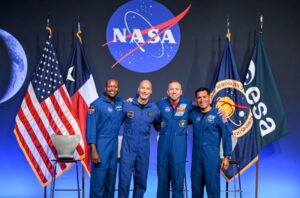
On June 9, 2026, NASA announced the four astronauts who will fly the Artemis III mission: agency veterans Randy Bresnik, Frank Rubio, and Andre Douglas, joined by Luca Parmitano of the European Space Agency. The formal crew designation marks a concrete step forward for a program that has faced sustained scrutiny over its pace and direction.
A mission redefined around low Earth orbit
Unlike what earlier Artemis planning envisioned, Artemis III as currently configured will not attempt a lunar landing. Instead, the mission will operate in low Earth orbit with the primary goal of testing integrated procedures between the Orion spacecraft and associated systems. NASA describes this phase as operationally essential before committing crew to a surface landing attempt.
This represents a meaningful shift from the program's original architecture, in which Artemis III was slated to be the first crewed Moon landing since Apollo 17 in 1972. The agency has not formally confirmed a launch date for the mission at the time of publication, and the broader lunar landing timeline remains subject to ongoing programmatic review.
Four astronauts, four distinct trajectories
The crew brings together a range of backgrounds and experience levels. Frank Rubio returned from the International Space Station in September 2023 after spending more than 371 consecutive days in orbit — at the time, the longest single spaceflight by a NASA astronaut. Randy Bresnik, a former Marine Corps aviator, flew two previous missions and logged multiple spacewalks during his ISS expedition in 2017. Andre Douglas, selected in NASA's 2021 astronaut class, will be making his first spaceflight with Artemis III. Luca Parmitano, one of ESA's most seasoned astronauts, has completed two long-duration ISS missions and commanded Expedition 61, accumulating significant experience in complex operations and extravehicular activity.
Parmitano's inclusion reflects the structural role ESA plays within Artemis: the agency supplies the European Service Module that powers and propels the Orion capsule, and securing a crew seat for one of its astronauts is a direct expression of that partnership.
Momentum amid uncertainty
Artemis has weathered years of delays, cost overruns, and shifting political priorities on Capitol Hill. Successive administrations have adjusted the program's scope, and the current reconfiguration of Artemis III's objectives is partly a consequence of those pressures. Questions persist about the long-term funding commitment needed to sustain a credible return-to-Moon roadmap, particularly given competing demands on NASA's budget from commercial partnerships, Mars exploration ambitions, and Earth science programs.
Against that backdrop, the naming of a crew carries real symbolic and institutional weight. Training pipelines activate, systems integration schedules tighten, and four individuals begin preparing in earnest for a mission that now has their names attached to it. Whether Artemis ultimately delivers astronauts to the lunar surface — and when — will depend on technical readiness, sustained funding, and political will in roughly equal measure.
For now, the crew is named. The next steps remain to be written.