Thirty-six years and counting
On September 19, 2026, NASA's Hubble Space Telescope quietly crossed a milestone that few spacecraft ever reach: its 200,000th orbit around Earth. Launched in April 1990, Hubble has now logged more than five billion miles of travel around our planet over a 36-year operational life — a cumulative distance that comfortably exceeds the gap between Earth and Pluto. Along the way, the observatory has racked up more than 1.7 million individual observations, a number that speaks to the remarkable longevity of a telescope originally conceived for a far shorter run.
What makes this figure especially telling is that Hubble remains scientifically productive. NASA's scheduling teams continue to assign demanding programs to the telescope, which retains capabilities in visible and ultraviolet light that its successor, James Webb, was not designed to replicate. The two observatories are complementary rather than redundant.
A galaxy cluster as a natural magnifying glass
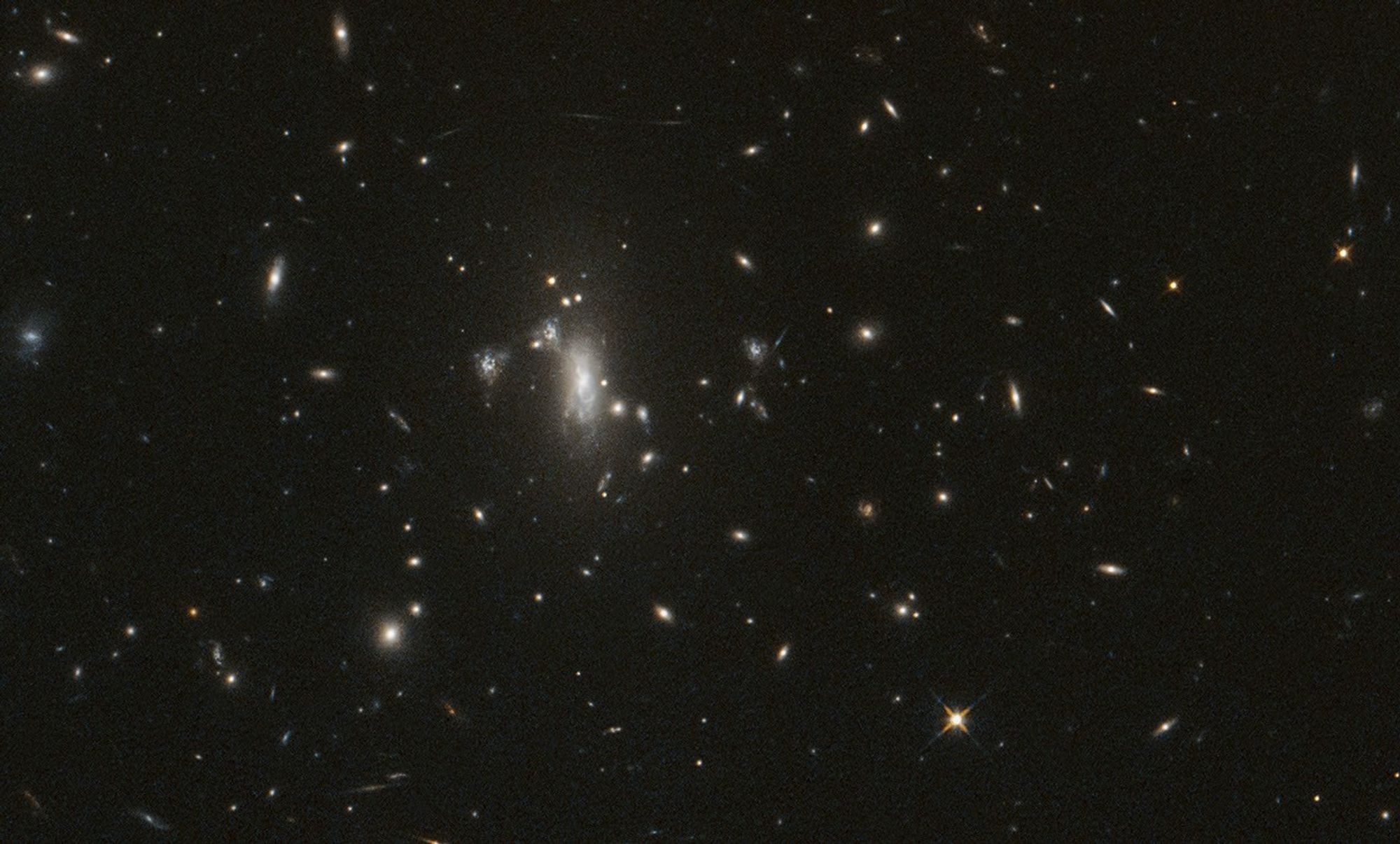
The observation carried out on the day of the 200,000th orbit was not a ceremonial snapshot. Hubble's cameras were locked onto MACS J0417, a massive galaxy cluster that acts as a gravitational lens — its enormous collective mass warps spacetime to bend and amplify light from objects lying far behind it along our line of sight.
This geometry is precisely what makes the cluster a target of interest right now. In 2025, NASA's James Webb Space Telescope detected a distant stellar explosion catalogued as Supernova Athena. Because a gravitational lens can split a supernova's light along multiple paths of different lengths, the same explosion can appear to an observer at different times depending on which route its photons have taken. Calculations derived from the 2025 detection predict that a new image of Supernova Athena should emerge somewhere in the vicinity of MACS J0417 between now and sometime in 2027. Hubble is watching.
Webb finds it, Hubble watches for it
This joint campaign offers a clear illustration of how NASA's two flagship space telescopes can work in sequence. James Webb, with its 6.5-meter primary mirror and deep infrared sensitivity, was ideally suited to pick up the original signal from Supernova Athena across cosmic distances. Hubble now provides the monitoring coverage in optical and ultraviolet wavelengths, sustained over months, that no single observatory could deliver alone.
A confirmed reappearance would be scientifically significant beyond the spectacle. Precise timing of lensed supernova images allows researchers to independently constrain the Hubble constant — the rate at which the universe is expanding — a value that remains under active debate. The so-called Hubble tension, a persistent discrepancy between measurements derived from the early universe and those based on nearby distance markers, is one of the central open questions in cosmology. Every new observational handle on the expansion rate carries weight.
NASA has not announced a formal end-of-mission date for Hubble, and the telescope's long-term operational status remains uncertain. For now, however, it continues to earn its place in orbit — one revolution at a time.