A ten-sided structure where none was expected
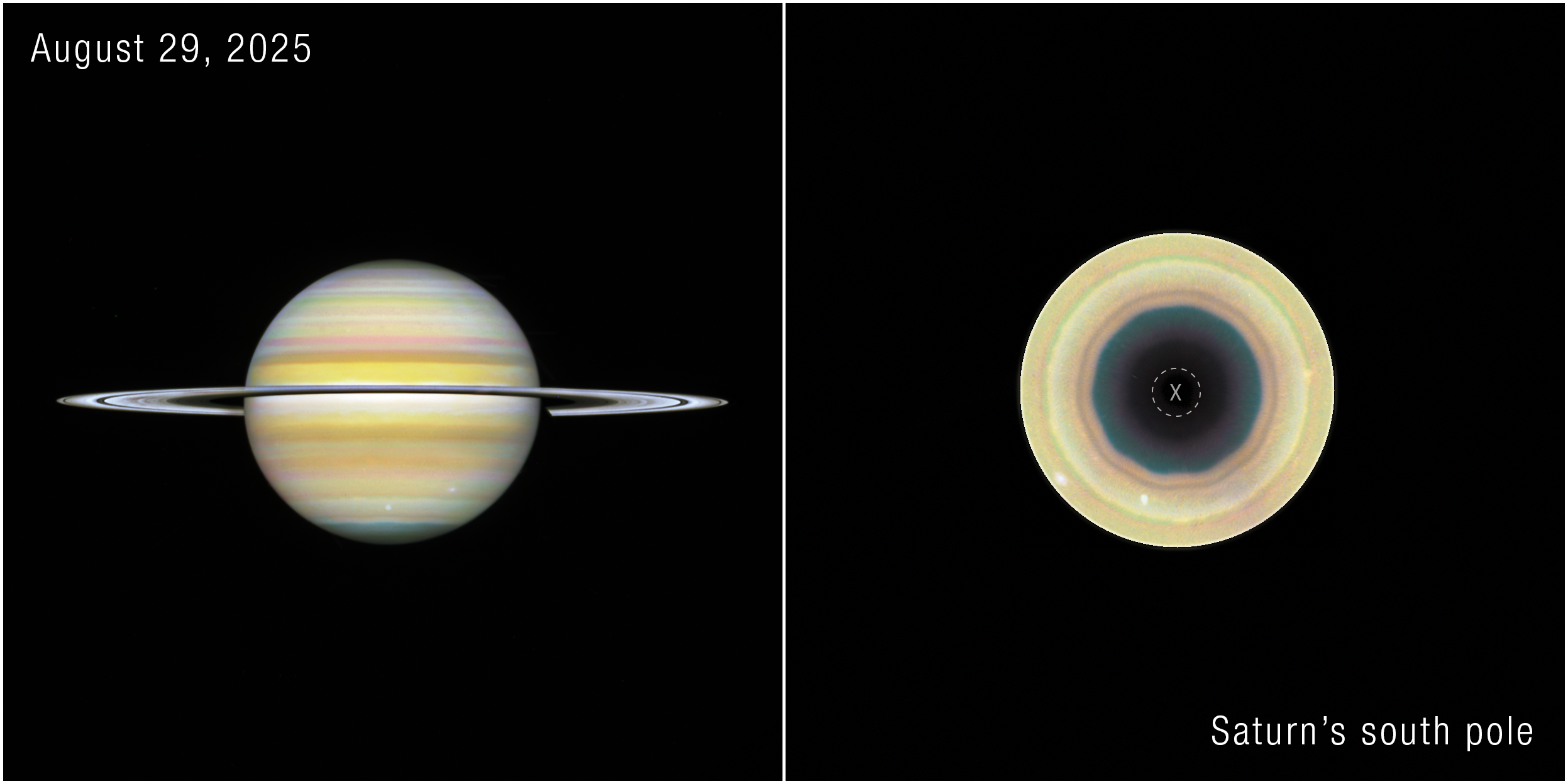
Saturn has long been known for its northern polar hexagon — one of the solar system's most photographed geometric curiosities. Now, the NASA/ESA Hubble Space Telescope has revealed something equally striking on the opposite end of the planet: a vast, ten-sided atmospheric wave encircling Saturn's south pole. Scientists describe this decagonal structure as the first large-scale, regular-sided jet pattern ever documented in the planet's southern hemisphere, making it a genuinely novel entry in the catalogue of planetary atmospheric phenomena.
Hubble's sustained monitoring program, combining its long operational history with sharp optical precision, proved essential in capturing the feature. The structure is not static — it is actively evolving, which adds both complexity and scientific value to the observation. Its ten-sided geometry holds with a regularity that immediately draws comparisons to the northern hexagon, even as the differences between the two remain just as significant.
Similar to the northern hexagon, yet clearly distinct
Saturn's northern hexagonal jet stream was first spotted by the Voyager probes in the early 1980s and later studied extensively by NASA's Cassini spacecraft during its thirteen-year mission in orbit around Saturn, which ended in 2017. That hexagon has proven to be a remarkably durable feature — a six-sided vortex roughly 30,000 kilometers across that has remained largely unchanged over decades of observation.
The newly identified southern decagon shares the same broad category of phenomenon — a structured geometric wave in a polar jet stream — but differs in shape, with ten sides instead of six, and in behavior, appearing more dynamic and less settled than its northern counterpart. Researchers suggest this contrast may reflect genuine hemispheric differences, potentially tied to seasonal solar exposure, distinct atmospheric chemistry, or interactions with deeper circulation layers. Saturn's long orbital period means its seasons stretch across multiple Earth years, further complicating any direct comparison between the two poles.
What a decagon on Saturn can teach us
Beyond its visual appeal, the southern decagon opens a valuable observational window. Watching a large-scale geometric atmospheric feature develop in near-real time on a gas giant is a rare opportunity — one that could yield meaningful insights into how such structures form, persist, or dissipate in massive planetary atmospheres.
The implications extend beyond Saturn. Atmospheric modeling of giant planets, including Jupiter, Uranus, and Neptune, as well as the growing catalog of giant exoplanets, could benefit from a better understanding of the physical mechanisms driving these structured polar waves. Why do jet streams in some cases lock into stable geometric patterns rather than producing the irregular turbulence typically associated with large-scale atmospheric motion?
Hubble, now in its fourth decade of operation under joint NASA and ESA management, remains one of the few assets capable of long-term planetary monitoring in the current era — a role that has grown more critical in the absence of any active orbiter at Saturn since Cassini's controlled deorbit. Scientists caution that while the decagon's existence is well established by the new data, its underlying physics will require further observations and modeling before firm conclusions can be drawn.