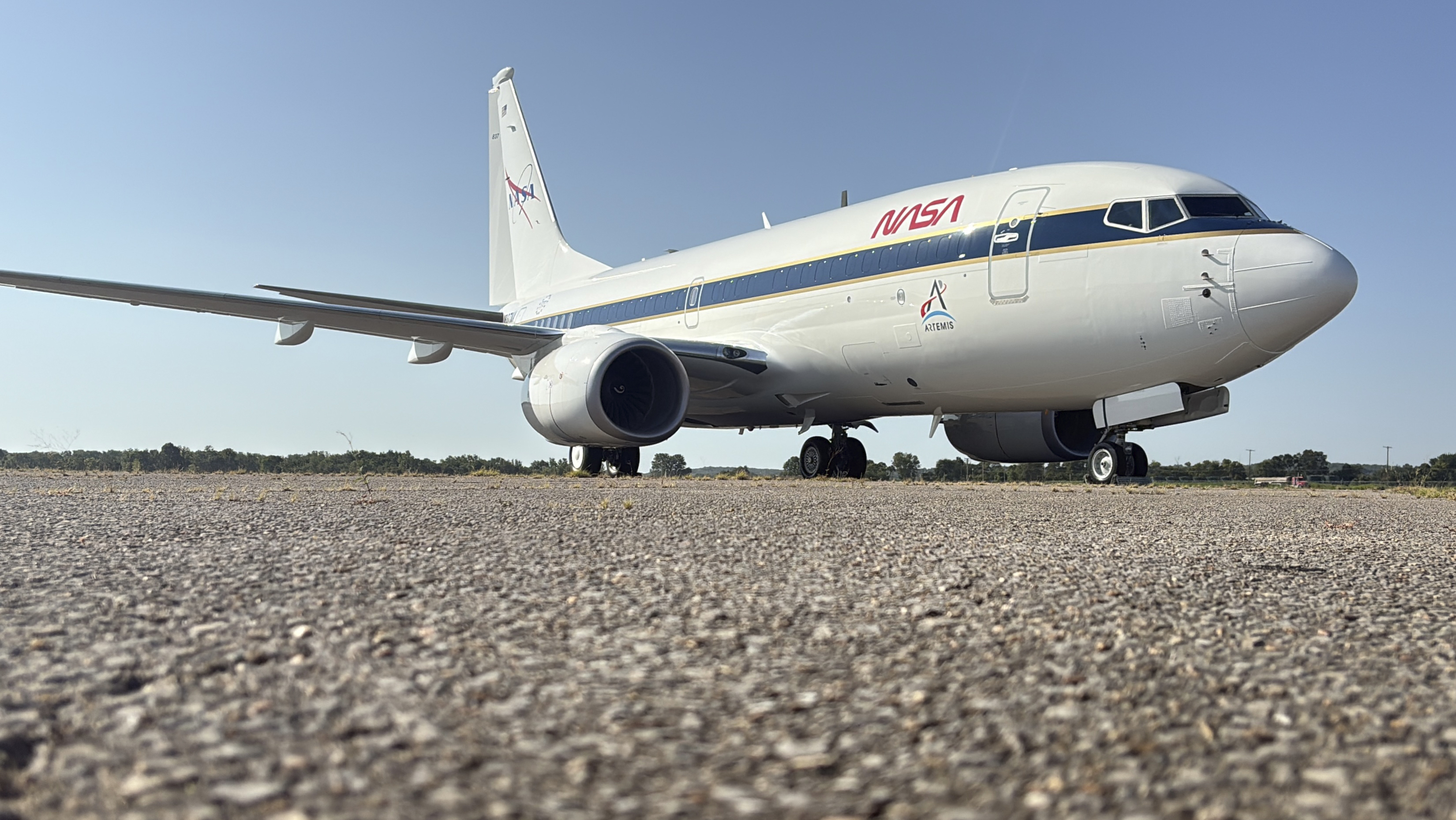
From military service to a flying laboratory
A Boeing 737 once operated by the United States Air Force is being given a new purpose under NASA oversight. This week, the aircraft emerged from a paint facility in Oklahoma wearing the agency's updated livery — a visible milestone in what is, beneath the surface, a far more technical transformation.
NASA's Armstrong Flight Research Center, located at Edwards Air Force Base in California, formally took custody of the aircraft from the Air Force in June. The center, long established as one of the agency's primary hubs for aeronautical research and experimental flight, is leading the aircraft's conversion into a dedicated reduced-gravity research platform.
Parabolic flight tailored to the Moon's pull
Once the modification work is complete, the 737 will fly carefully designed parabolic trajectories that replicate the gravitational environment found on the lunar surface. The Moon exerts roughly one-sixth the gravitational pull of Earth — a figure that sits between terrestrial conditions and the near-weightlessness of orbital flight.
Achieving that intermediate state during an atmospheric flight requires precise piloting. Aircraft fly a steep arc upward and then nose over into a controlled descent; during the downward phase, passengers, crew, and any onboard equipment briefly experience the target gravity level. These sequences typically last between 20 and 40 seconds and can be repeated multiple times per flight.
What sets this 737 apart from more conventional parabolic platforms is its specific calibration for lunar gravity. Standard reduced-gravity aircraft, such as those historically used for astronaut training or microgravity research, are more commonly set up to replicate near-zero-g conditions. A platform precisely tuned to one-sixth g offers a more targeted tool for Moon-focused mission preparation.
Supporting Artemis and the return to the Moon
The primary purpose of these flights is to validate hardware and operational procedures intended for crewed lunar missions. Under the Artemis program, NASA is working toward returning humans to the Moon's surface for the first time since the Apollo 17 mission in December 1972. That ambition demands exhaustive ground and in-flight testing of every system that astronauts will rely on in the lunar environment.
NASA has not yet released a detailed schedule for when the aircraft will begin its parabolic flight campaign, nor has the agency specified which equipment will be evaluated during initial sorties. The program remains in its modification phase, with the fresh paint job serving as a public marker of steady progress.
The decision to repurpose an existing military airframe rather than procure a purpose-built aircraft reflects a broader approach within the agency: leveraging available assets to reduce cost and development time. By adapting what the Air Force no longer needed, NASA gains a capable research platform without the lead time or expense of a new acquisition.
Lunar readiness, it turns out, begins at altitude — well before any rocket leaves the ground.


