A celestial clock you can set your calendar by
Around the second week of August each year, Earth's orbit carries it through the stream of dust and rocky fragments shed over centuries by comet 109P/Swift-Tuttle, first catalogued in 1862. These particles, most no larger than a grain of rice, slam into the upper atmosphere at roughly 60 kilometres per second. The resulting friction burns them up almost instantly, producing the brief streaks of light known as meteors. At the shower's peak, a single observer under a dark, moonless sky can count close to one hundred meteors per hour — a rate that makes the Perseids one of the most productive displays in the annual calendar.
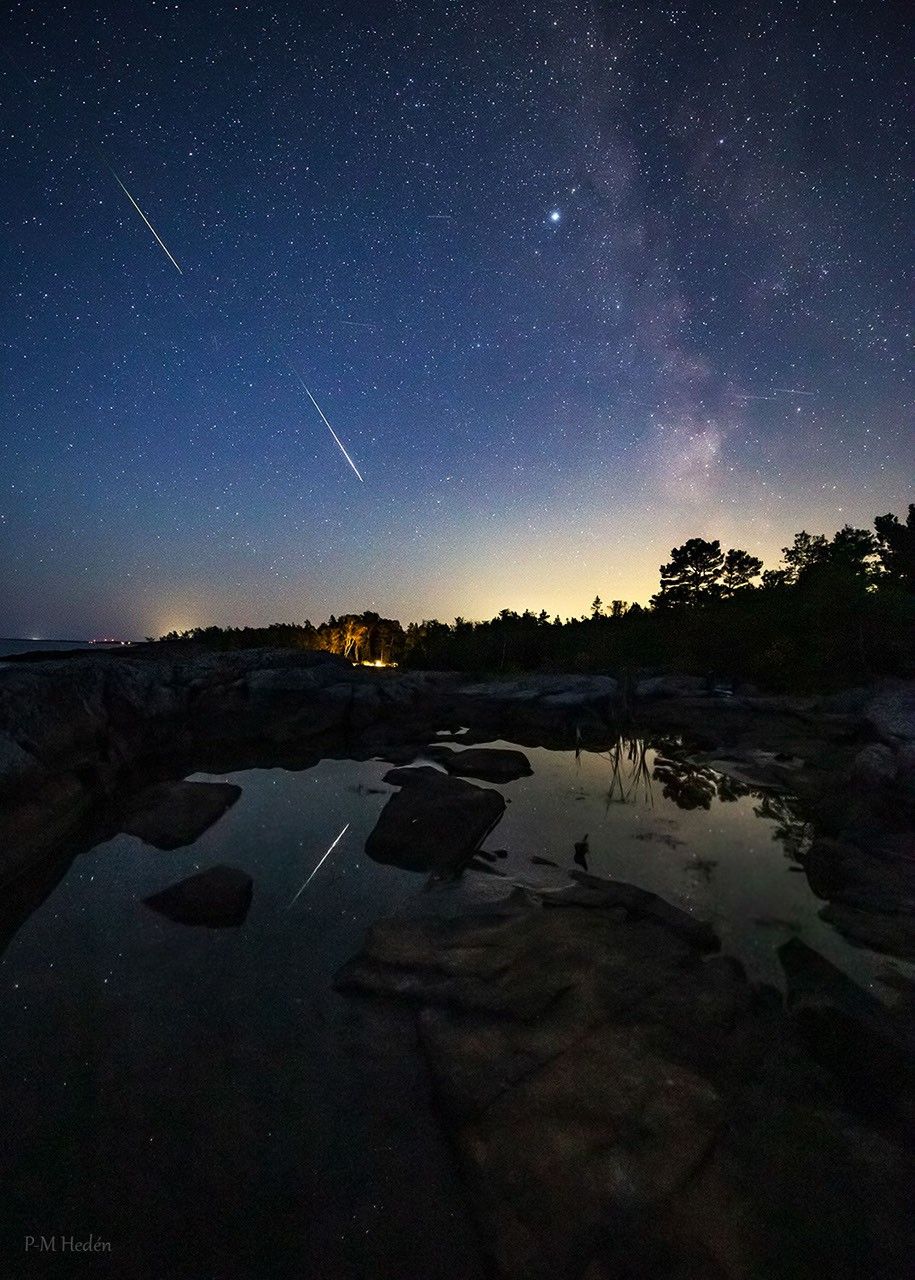
In 2026, an unusually stable high-pressure system settled over Scandinavia during the critical nights around August 12, handing photographers and amateur astronomers a rare window of cloudless darkness. From multiple locations across Sweden, observers captured fireballs of notable brightness, several leaving glowing ionisation trails that persisted for a few seconds after the meteor itself had faded. NASA selected one of these Swedish photographs as its Astronomy Picture of the Day (APOD) for August 15, 2026 — a daily feature that pairs a striking astronomical image with a concise explanation authored by a professional astronomer.
Why Sweden made the difference
Location matters considerably when it comes to meteor observing. Northern latitudes in August offer a useful combination of relatively dark rural skies and a Perseid radiant — anchored in the constellation Perseus — that climbs high enough above the horizon for extended photographic exposures. The images highlighted by NASA show multiple luminous trails converging toward that vanishing point in the northeast, set against the faint band of the Milky Way and, in some frames, thin wisps of noctilucent clouds. These high-altitude ice formations, found at the edge of the mesosphere, are themselves a hallmark of summer nights at northern latitudes and add a distinctly boreal character to the photographs.
The European Space Agency also spotlighted the shower in its weekly Week in Images roundup, published on August 14 and covering the period from the 10th to the 14th of the month. The ESA series, released every Friday, gathers the most visually compelling frames from Europe's space activities over the preceding week, ranging from satellite imagery and mission operations to ground-based natural phenomena.
From spectacle to science
The Perseids are more than a summer light show. Every visible meteor represents a measurable physical event: entry velocity, atmospheric trajectory, chemical composition of the incoming fragment. Across Europe, networks of automated all-sky cameras operated by universities and amateur astronomy associations record these events continuously, generating orbital data that can, in some cases, help trace recovered meteorites back to their point of origin in the solar system.
For agencies like NASA and ESA, dedicating editorial resources to annual events of this kind — APOD selections, social media campaigns, image digests — serves a purpose that goes beyond outreach. At a time when public funding for space science is subject to persistent scrutiny in many countries, keeping the general public connected to the night sky is both a cultural mission and a strategic one. The Perseids, requiring no telescope and no specialist knowledge, remain among the most democratic entry points into astronomy that the solar system has to offer.