Juno's microwave eye turns toward Io
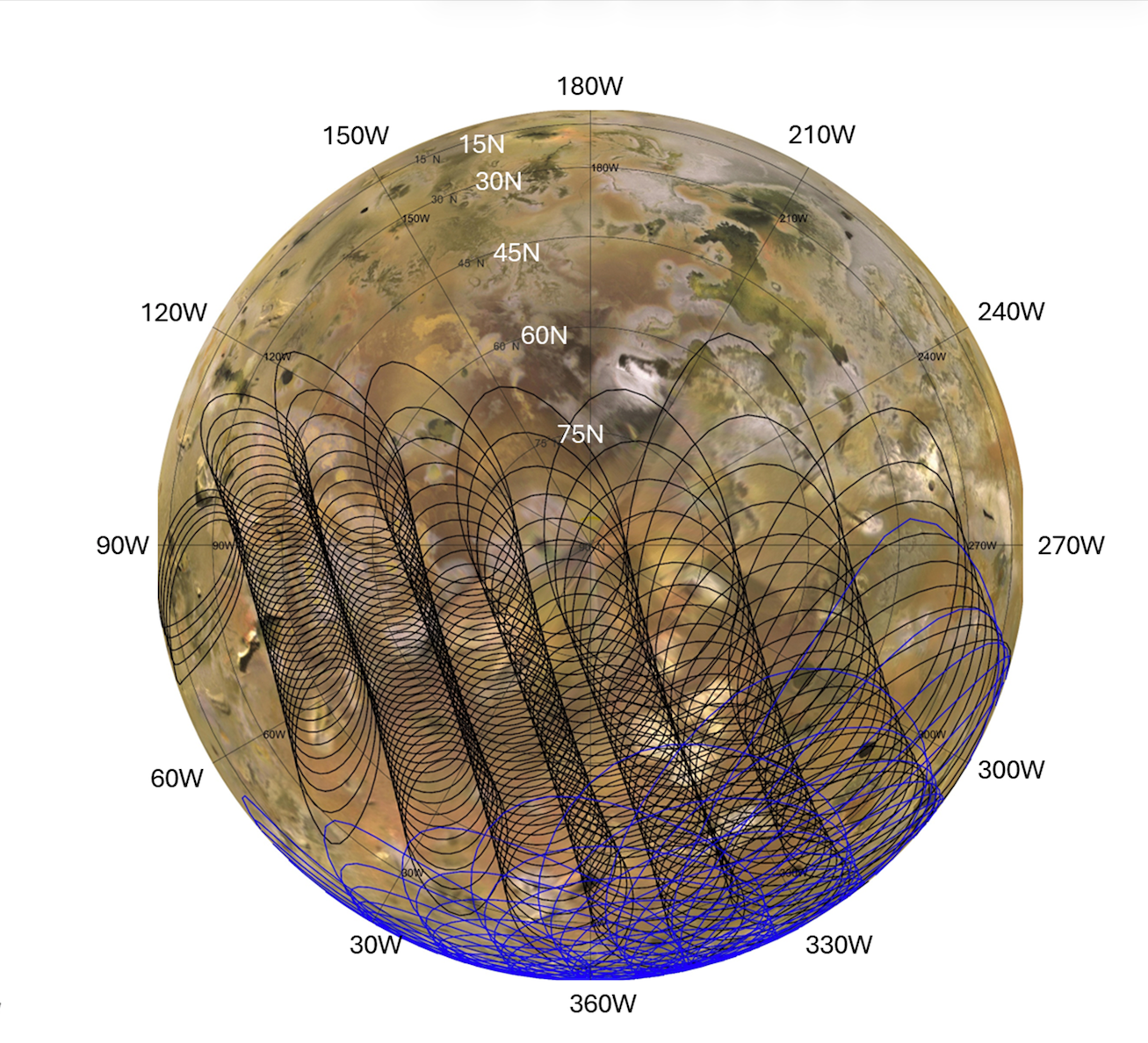
Originally designed to peer deep into Jupiter's atmosphere, the Microwave Radiometer (MWR) aboard NASA's Juno spacecraft has been repurposed in a striking way: mapping the thermal emissions radiating from the surface and subsurface of Io, Jupiter's innermost large moon and the most volcanically active body in the solar system. During two dedicated close flybys — Perijove 57 on December 30, 2023, and Perijove 58 shortly after — the instrument traced overlapping swaths across Io's surface, with the first pass concentrating on the northern hemisphere and the second extending coverage southward.
Together, the two observation footprints build a complementary thermal mosaic. Scientists hope this data will shed light on a long-standing question: how does the intense tidal energy generated by Jupiter's gravitational pull actually distribute itself within Io's interior? Surface volcanism is the obvious expression of that energy, but the pathways heat takes through the crust remain poorly constrained. The MWR's ability to sense thermal radiation below the visible surface — rather than just what lies on top — gives researchers a new layer of information that conventional imaging cannot provide.
Full analysis of the MWR data will take several more months, according to the Juno science team. Global thermal maps with reliable coverage are not yet available. Still, the instrument has already demonstrated that it can function effectively as a geological probe of a planetary surface it was never explicitly built to study — a reminder that flexibility in instrument design pays scientific dividends.
Imaging exoplanet continents: the optical VLBI ambition
On a far more speculative — though rigorously grounded — frontier, NASA is backing research aimed at something that sounds almost impossible: resolving surface features on an Earth-sized planet orbiting a nearby star, observed in visible light. The project, led by researchers at Brookhaven Science Associates, draws its core concept from radio astronomy's most powerful technique — Very Long Baseline Interferometry, or VLBI — and attempts to translate it into the optical domain.
The challenge is staggering. A rocky exoplanet reflects roughly ten billion times less light than its host star. Any direct imaging attempt is immediately overwhelmed by stellar glare. To address this, the team is developing a new class of instrument called a dynamic hierarchical nulling interferometer. The design combines signals from multiple telescope apertures in a way that selectively cancels the starlight while preserving the far fainter planetary signal — a precise and technically demanding form of destructive interference.
The second stage of the project focuses on image reconstruction. Using the interference patterns collected across telescope baselines potentially spanning large distances, algorithms would work backward to produce a spatially resolved image of the planet's disk. The stated goal is to distinguish broad surface structures — landmasses, ocean regions, atmospheric patterns — rather than simply detecting the planet's existence or characterizing its bulk atmosphere.
Two projects, one cartographic imperative
Juno's repurposed radiometer and the proposed optical interferometry concept operate at opposite ends of the distance spectrum — one a few hundred kilometers above a moon, the other reaching toward stars light-years away. Yet both reflect the same underlying drive: extracting spatial information from places and objects that conventional instruments cannot read directly.
Neither effort will yield definitive results quickly. Io's thermal maps require months of continued data processing, and the exoplanet interferometry concept is still in the feasibility and design phase, with no hardware yet deployed. But in both cases, the scientific reasoning is sound, and the incremental progress being made points toward a future where planetary cartography is no longer confined to our own solar neighborhood.