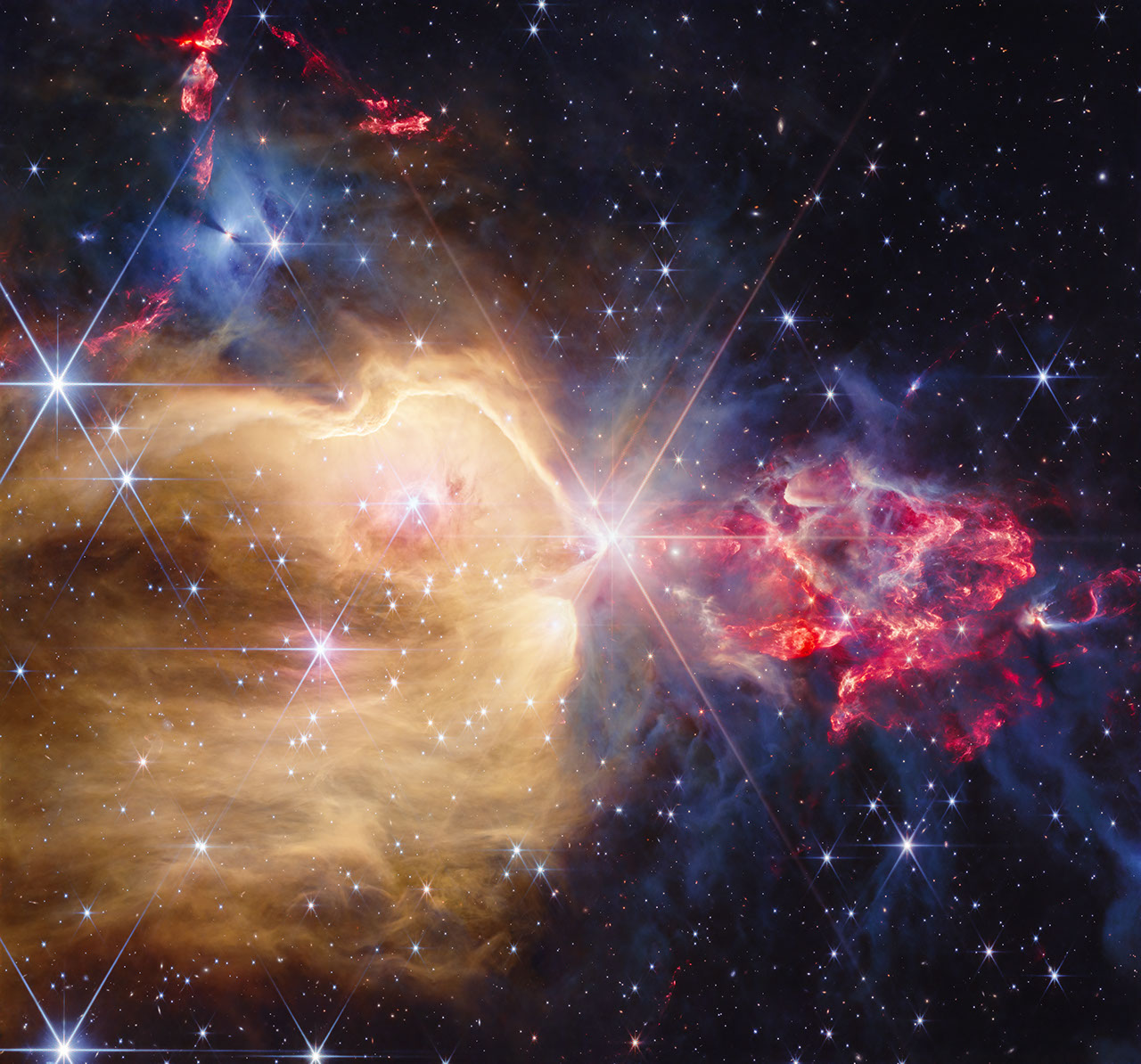
Some 3,300 light-years from Earth, in the direction of the constellation Cepheus, a star-forming region called NGC 7129 has long eluded detailed study. Dense clouds of gas and dust shrouded its interior from optical telescopes, leaving much of its stellar population uncharted. That changed with the release of a new image from the James Webb Space Telescope, a joint endeavor by NASA, ESA, and the Canadian Space Agency, which peers through that obscuring material using its powerful infrared instruments.
Infrared vision cuts through the cosmic fog
Webb's ability to detect near- and mid-infrared light is what makes observations like this possible. Where conventional optical telescopes encounter an impenetrable wall of dust, Webb resolves individual young stellar objects still wrapped in their natal envelopes of gas and debris. The new image of NGC 7129 brings dozens of these proto-stars into view for the first time, each at an early and turbulent stage of its evolution.
Among the most striking features are the Herbig-Haro objects scattered across the field — bright knots and arcs produced when powerful jets of material, ejected by young stars at high velocity, slam into the surrounding interstellar medium. These jets are a hallmark of the earliest phases of stellar life, driven by a combination of magnetic fields, disk accretion, and bipolar plasma outflows. Their interaction with the ambient cloud sculpts the nebula into the dynamic, layered structure now visible in Webb's data.
What young star clusters reveal about cosmic origins
Regions like NGC 7129 serve as natural laboratories for stellar formation theory. By studying the geometry, velocity, and composition of jets and outflows, astrophysicists can test and refine models that describe how a rotating cloud of molecular gas collapses, heats, and ultimately ignites into a star. These early phases — spanning tens of thousands of years — are brief on cosmic timescales but critical for determining whether a forming star will also give rise to a planetary system.
Webb's resolution in this context is a genuine leap forward. Structural details such as shock fronts, warm gas filaments, and cavities carved by jet activity were previously either unresolved or entirely undetected at this distance. The data gathered from NGC 7129 will support research teams for years, requiring cross-referencing with radio and submillimeter observations to fully decode the region's physical conditions. Some interpretations of specific features remain preliminary pending that broader analysis.
A telescope redefining its field, one nebula at a time
Since beginning full science operations in 2022, the James Webb Space Telescope has progressively reshaped what astronomers can observe and how they think about the universe. Its portfolio now spans the atmospheres of exoplanets, the earliest galaxies to emerge after the Big Bang, and — increasingly — the star-forming regions within our own Milky Way.
NGC 7129 joins a growing catalog of stellar nurseries examined in detail by Webb, alongside iconic targets like the Orion Nebula Complex and the Carina Nebula. Each observation adds a new chapter to the understanding of how stars form, age, and eventually seed the galaxy with the heavy elements essential to chemistry and, ultimately, to life.
What Webb continues to demonstrate, image after image, is that the universe's most generative processes unfold in places that are, by their very nature, hidden from plain sight. NGC 7129 is another reminder that the cosmos rewards those willing to look beyond the visible.