Catching a rare visitor at just the right moment
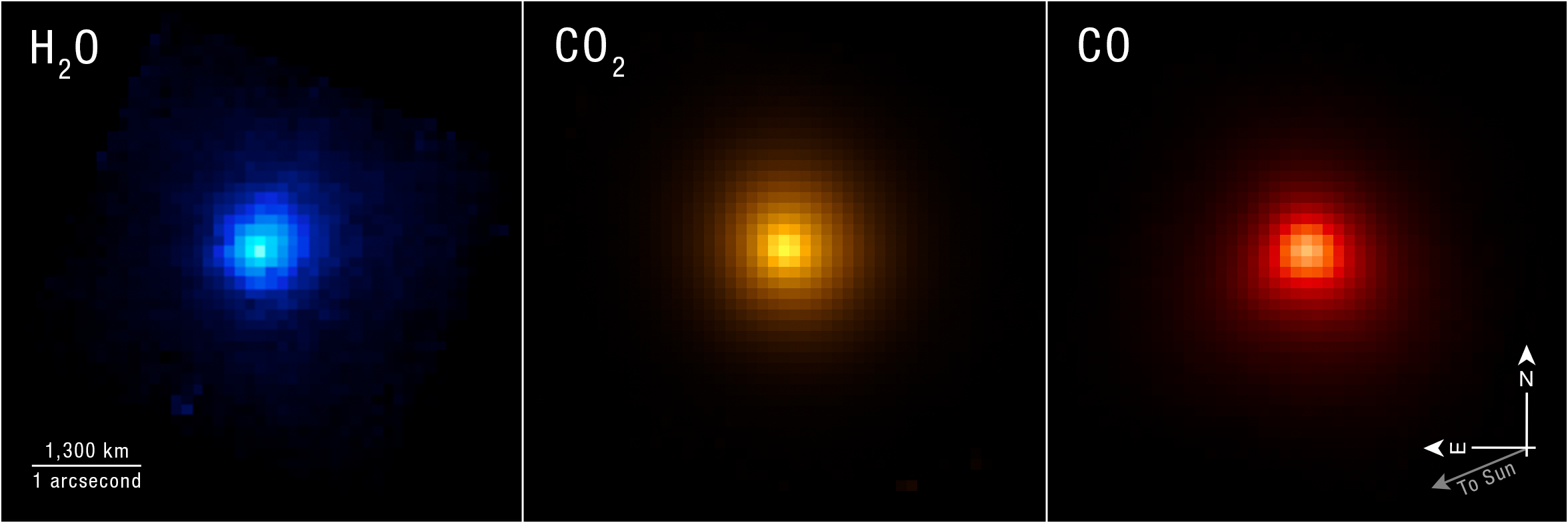
As interstellar comet 3I/ATLAS pulled away from the Sun in December 2025, astronomers seized a narrow opportunity to point the James Webb Space Telescope directly at it. The timing proved critical: having just completed its closest solar approach, the comet was actively shedding gases as its ancient ices warmed and sublimated. That outgassing gave Webb's instruments a clear spectroscopic view of molecules that had been locked away since the object's formation, potentially billions of years ago in a distant stellar system.
3I/ATLAS is only the third interstellar object confirmed to have passed through our Solar System, following 1I/'Oumuamua in 2017 and 2I/Borisov in 2019. Unlike the ambiguous 'Oumuamua, it displays a well-developed coma, which made chemical analysis far more straightforward and allowed scientists to directly identify the gases being released.
A chemical fingerprint unlike anything local
Webb's observations point to a molecular composition that diverges notably from what astronomers typically measure in comets originating within our own Solar System — whether from the Oort Cloud or the Kuiper Belt. Ratios between key volatile compounds, including carbon- and nitrogen-bearing ices, fall outside the ranges commonly associated with native Solar System bodies.
Those differences imply that 3I/ATLAS formed under physical and chemical conditions quite unlike those that shaped our local cometary population. The precise nature of its birth environment remains an open question: researchers are cautious about speculating on whether it originated in a young stellar disk, an unusually element-rich nebula, or some other galactic setting.
What the data does make clear is that the protoplanetary disks scattered across the Milky Way may vary considerably in their chemistry. Does our Solar System represent a typical outcome, or something of an outlier? For the first time, that question is being addressed not just through theory, but through direct observation of material from another system.
A new tool for comparative planetary science
Beyond its intrinsic fascination, 3I/ATLAS illustrates the broader scientific value of interstellar comets as preserved chemical samples from distant protoplanetary environments. Each one that passes through our neighborhood carries a record of conditions frozen in place long before any planets fully formed around its parent star.
Both NASA and ESA, as partners in the Webb mission, have highlighted the significance of these findings for models of planetary formation. If 3I/ATLAS accurately reflects the chemistry of its home system, then future detections of interstellar comets could gradually build a galactic atlas of protoplanetary disk compositions.
Three objects, however, do not yet constitute a statistically meaningful sample. As wide-field survey facilities such as the Vera C. Rubin Observatory come into full operation, the detection rate for interstellar visitors is expected to climb substantially, giving Webb and next-generation telescopes a growing library of extrasolar samples to examine.