When Earth-bound infrastructure becomes a mission risk
Space exploration depends on a chain of assets that extends far beyond launchpads and spacecraft. Ground stations — the massive antenna complexes that relay commands and data across hundreds of millions of kilometres — are just as critical, and far less mobile. That reality came into sharp focus in late July 2026, when wildfires advancing through central Spain threatened two facilities that are irreplaceable nodes in humanity's deep-space communications network.
The first is NASA's Madrid Deep Space Communications Complex, one of only three sites worldwide that form the Deep Space Network (DSN). Alongside Goldstone in California and Tidbinbilla in Australia, the Madrid complex keeps continuous contact with missions operating far beyond Earth orbit — from the Voyager probes, now in interstellar space, to active Mars rovers and outer-planet explorers. Any prolonged outage at one of these three sites narrows communication windows for dozens of missions simultaneously.
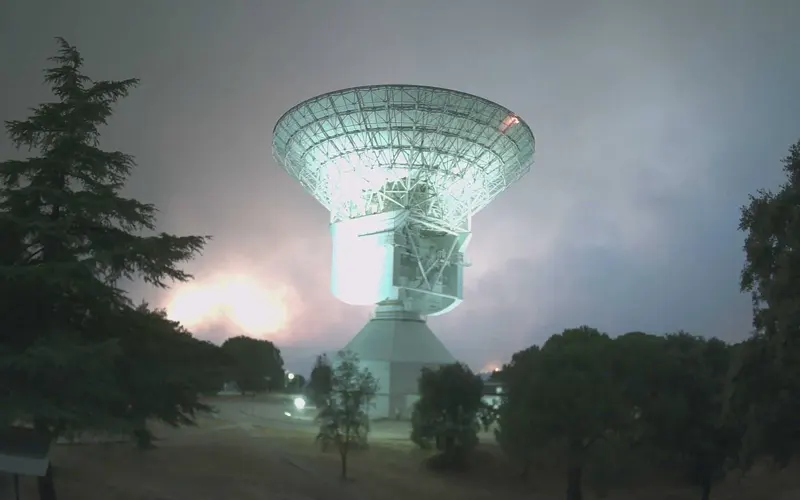
The second facility at risk was the Cebreros deep-space ground station, operated by the European Space Agency. Home to a 35-metre dish antenna, Cebreros serves as a primary link for ESA missions including Solar Orbiter, BepiColombo — currently en route to Mercury — and Juice, the Jupiter Icy Moons Explorer launched in 2023.
Cebreros evacuated, inspected, and back online
As fire fronts approached the area around Cebreros, ESA personnel were evacuated from the site as a precautionary measure. In the days that followed, technical teams returned to conduct a thorough assessment of the facility: the antenna structure, electronics, power supply infrastructure, and support buildings were all examined for damage caused directly by fire or indirectly through heat and smoke exposure.
On 26 July, ESA Director General Josef Aschbacher confirmed that all checks and tests had been completed successfully and that the station had been cleared to return to normal operations. No structural or equipment damage was reported. The announcement marked the end of what had been a tense standby period for mission controllers across Europe who rely on Cebreros for routine and time-sensitive contacts with active probes.
A vulnerability the space sector rarely discusses
The incident draws attention to a category of risk that tends to receive less scrutiny than launch failures or satellite anomalies: the physical exposure of ground infrastructure to natural disasters. A spacecraft in orbit can, to some extent, be commanded into a safe mode. A several-thousand-tonne antenna embedded in the Spanish countryside cannot be relocated.
The geographic clustering of deep-space assets near Madrid — a consequence of the Iberian Peninsula's favourable latitude for sky coverage — amplifies the systemic risk should a major local disaster strike. As southern Europe experiences more frequent and intense wildfire seasons, the adequacy of protective measures around ground stations is likely to attract growing attention from both NASA and ESA planners. The close call in July 2026 offered a reminder that some of the most consequential links in the chain of space exploration are firmly rooted in the ground.