The Black Eye Galaxy through two telescopes at once
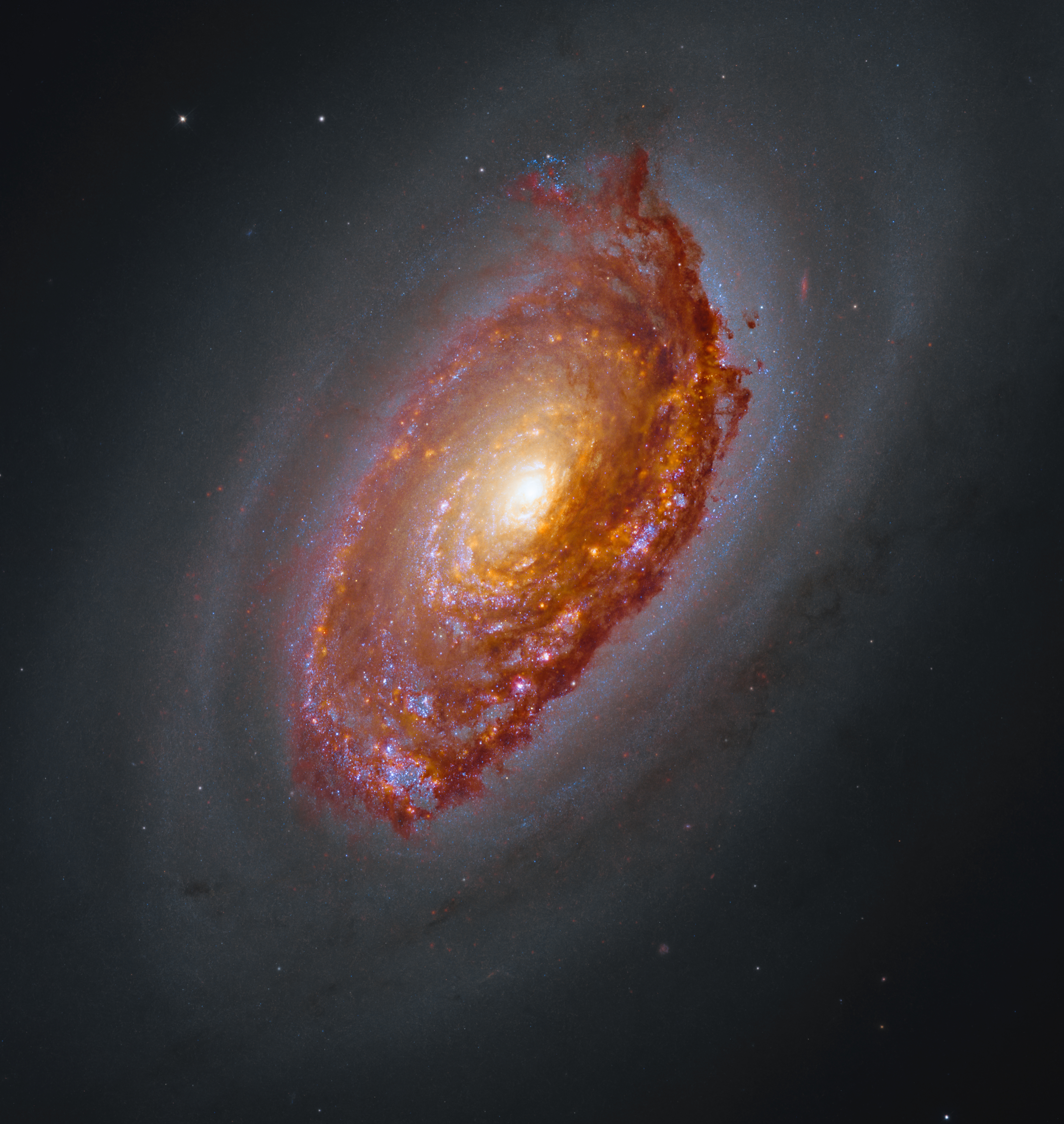
On March 20, 2026, NASA's scientific teams directed both the Hubble Space Telescope and the James Webb Space Telescope toward Messier 64, the galaxy informally known as the Black Eye Galaxy. The composite image released on June 12 merges data from both observatories, producing a multi-wavelength portrait that neither instrument could have generated on its own.
Hubble's contribution spans the ultraviolet, visible, and near-infrared portions of the spectrum, tracing the light of both young and aging stellar populations within the galaxy. Webb extends that view further into the near- and mid-infrared range, mapping cold dust and molecular gas that remains entirely opaque to optical instruments. Together, the two telescopes transform the galaxy's signature dark band — the feature that earned Messier 64 its nickname — from a simple dust lane into a complex, layered structure where material at vastly different temperatures and densities coexists.
Located roughly 17 million light-years away in the constellation Coma Berenices, Messier 64 has long attracted scientific attention because of an unusual kinematic property: its outer disk rotates in the opposite direction from its inner core. This counter-rotation is widely interpreted as the remnant signature of a past galactic merger. Researchers expect the new Webb infrared data to place tighter constraints on the models describing that event and its aftermath.
MACS0329-0211: a galaxy cluster as both target and tool
On the same day, NASA published a separate Hubble image centered on the galaxy cluster MACS0329-0211. The field is visually crowded with dozens of galaxies spanning a range of morphologies — ellipticals, spirals, and irregular systems — all bound together by mutual gravitational attraction.
Galaxy clusters rank among the most massive gravitationally bound structures in the observable universe. Current estimates suggest that roughly 85 percent of their total mass consists of dark matter, an invisible component that reveals itself only through its gravitational influence. That influence is strong enough to measurably warp spacetime, producing gravitational lensing effects predicted by Einstein's general theory of relativity. Light from galaxies lying far beyond the cluster is bent and amplified as it passes through the cluster's gravitational field, effectively turning the cluster into a natural telescope that extends the reach of instruments like Hubble.
MACS0329-0211 is one of a number of clusters used by astronomers precisely for this purpose, as a lens to probe the early universe. Hubble, now in its fourth decade of operation, continues to deliver scientifically valuable data on such targets despite the age of its hardware.
A two-telescope strategy reshaping observational astronomy
The simultaneous release of these two images reflects a deliberate observational approach that NASA, together with its partners at the European Space Agency and the Canadian Space Agency, has developed since Webb began full science operations in 2022. Rather than treating the two observatories as competing platforms, mission planners increasingly coordinate them to cover a far broader slice of the electromagnetic spectrum than either could sample independently.
Hubble provides angular resolution in the ultraviolet and visible bands; Webb contributes thermal sensitivity deep into the mid-infrared. Used in tandem, they allow astronomers to characterize stellar populations, map interstellar dust, reconstruct star-formation histories, and probe large-scale cosmic structure with a level of detail that was previously out of reach. One open question hanging over this partnership is Hubble's long-term future: no servicing mission is currently on NASA's manifest, and discussions about a potential ultraviolet-capable successor are ongoing within the broader astronomical community, though no formal program has been announced.