A planetary flyby with scientific dividends
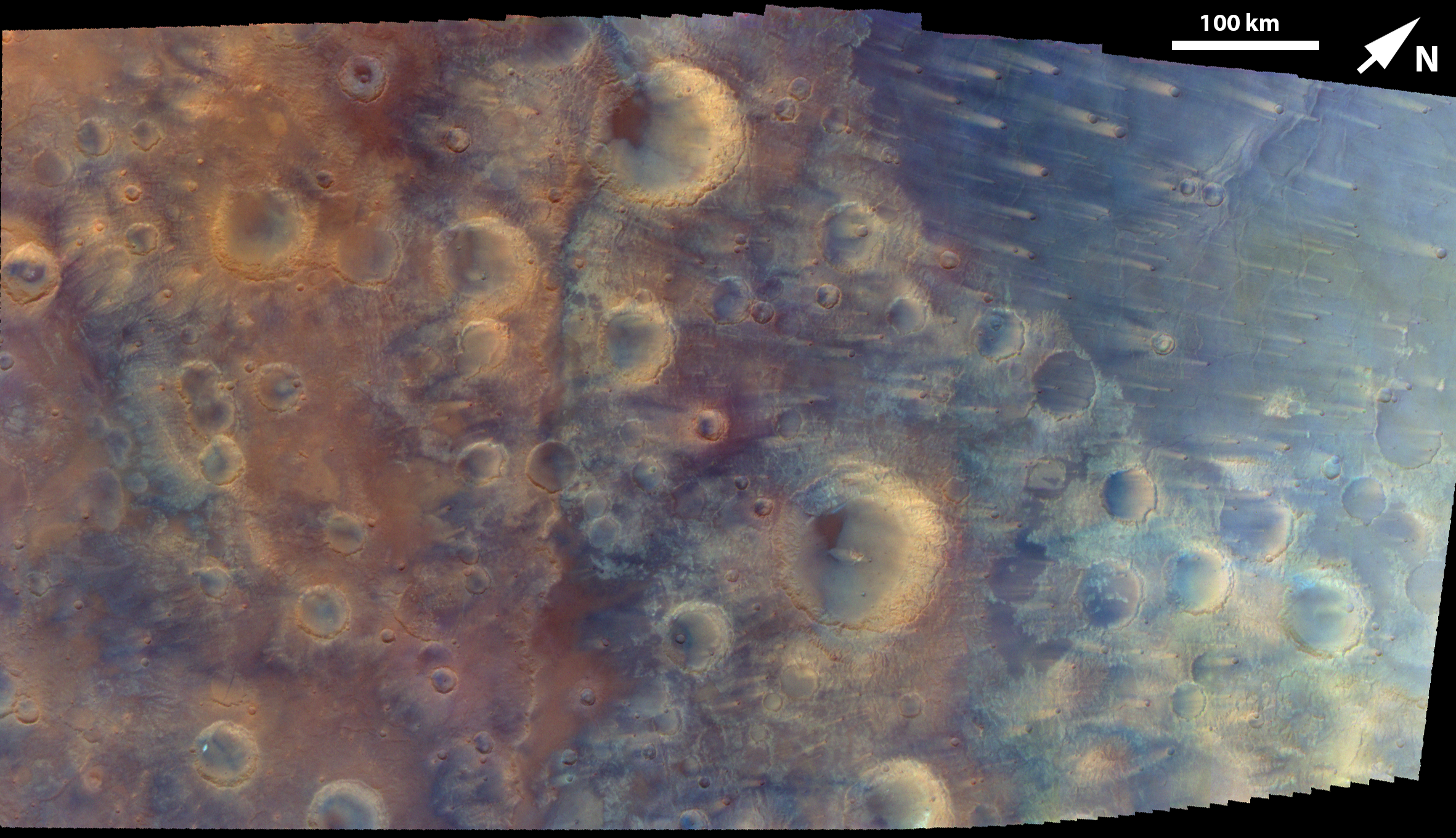
On May 15, 2026, NASA's Psyche spacecraft executed a gravity assist maneuver at Mars, using the planet's gravitational field to reshape its trajectory and build momentum toward the asteroid belt. Such maneuvers are a standard tool in interplanetary mission design, but they also open brief windows for opportunistic science. This time, the spacecraft's multispectral imager took full advantage of the occasion, acquiring four images of the Martian surface over a six-minute sequence.
Those images were combined into an enhanced-color mosaic, released publicly on July 17, 2026. The spacecraft was moving from northeast to southwest relative to Mars during the pass, giving the resulting composite a distinctive oblique viewing geometry. For an instrument built to study a metallic asteroid, the level of surface detail resolved in the mosaic is notable.
What the multispectral imager brings to the table
The multispectral imager aboard Psyche was designed with one target in mind: asteroid 16 Psyche, a large body in the main asteroid belt between Mars and Jupiter. What makes this object scientifically compelling is its composition — it appears to be largely metallic, rich in iron and nickel, and may represent the exposed core of a differentiated protoplanet. Studying it could shed light on how rocky planets, including Earth, developed their metallic interiors.
The instrument operates across multiple wavelength bands, yielding data on surface mineralogy that goes well beyond visible-light photography. When trained on Mars during the flyby, it produced observations that, while secondary to the mission's goals, add a layer of calibration data and potentially complement existing knowledge of Martian geology. NASA routinely capitalizes on these secondary opportunities to extract additional value from a spacecraft already in flight.
Next stop: the asteroid belt, in 2029
The Mars gravity assist was a planned and critical step in Psyche's interplanetary journey. The spacecraft launched in October 2023 aboard a SpaceX Falcon Heavy rocket from Kennedy Space Center. With the Mars flyby now behind it, Psyche is on the trajectory that will carry it toward its namesake asteroid. Orbital insertion at 16 Psyche is currently scheduled for 2029, according to NASA mission data.
In the meantime, the science team will analyze the Mars imagery in detail. Beyond their intrinsic value, these data allow researchers to validate instrument performance in an operational environment — knowledge that will prove useful when Psyche finally reaches its primary destination and begins its systematic survey of the asteroid's surface.
The episode is a reminder that in deep-space exploration, entire planets can serve as waypoints. Mars, one of humanity's most studied neighbors, functioned here as a gravitational stepping stone — and, briefly, as a subject of study in its own right.