For decades, Terzan 5 sat quietly in astronomical catalogues, logged as one of the many globular clusters scattered through the central bulge of the Milky Way. That classification is now obsolete. A team of international researchers, drawing on observations from both the NASA/ESA/CSA James Webb Space Telescope and the NASA/ESA Hubble Space Telescope, has confirmed that Terzan 5 represents something fundamentally different: a bulge fossil fragment, the prototype of a newly defined class of astronomical objects. What it preserves, according to the research team, is nothing less than a direct relic of our galaxy's earliest assembly.
Why Terzan 5 breaks the globular cluster mold
The defining characteristic of a globular cluster is chemical and temporal uniformity: its stars form in a single burst from the same reservoir of gas, sharing near-identical ages and elemental compositions. Terzan 5 violates this principle on both counts. The combined datasets from Webb and Hubble reveal at least two distinct stellar populations, separated by several billion years in age and displaying measurable differences in the abundance of heavy elements. That dual signature — chemical and chronological — points unambiguously to multiple episodes of star formation, a feature that no standard globular cluster model can accommodate.
The researchers propose a more fundamental interpretation: Terzan 5 is the surviving remnant of a primordial proto-fragment, one of the raw building blocks that merged and collided to form the Milky Way more than ten billion years ago. While most such structures were either fully disrupted or absorbed without trace, Terzan 5 endured, retaining an internal record of conditions that would otherwise be inaccessible to observation.
Two telescopes, two complementary vantage points
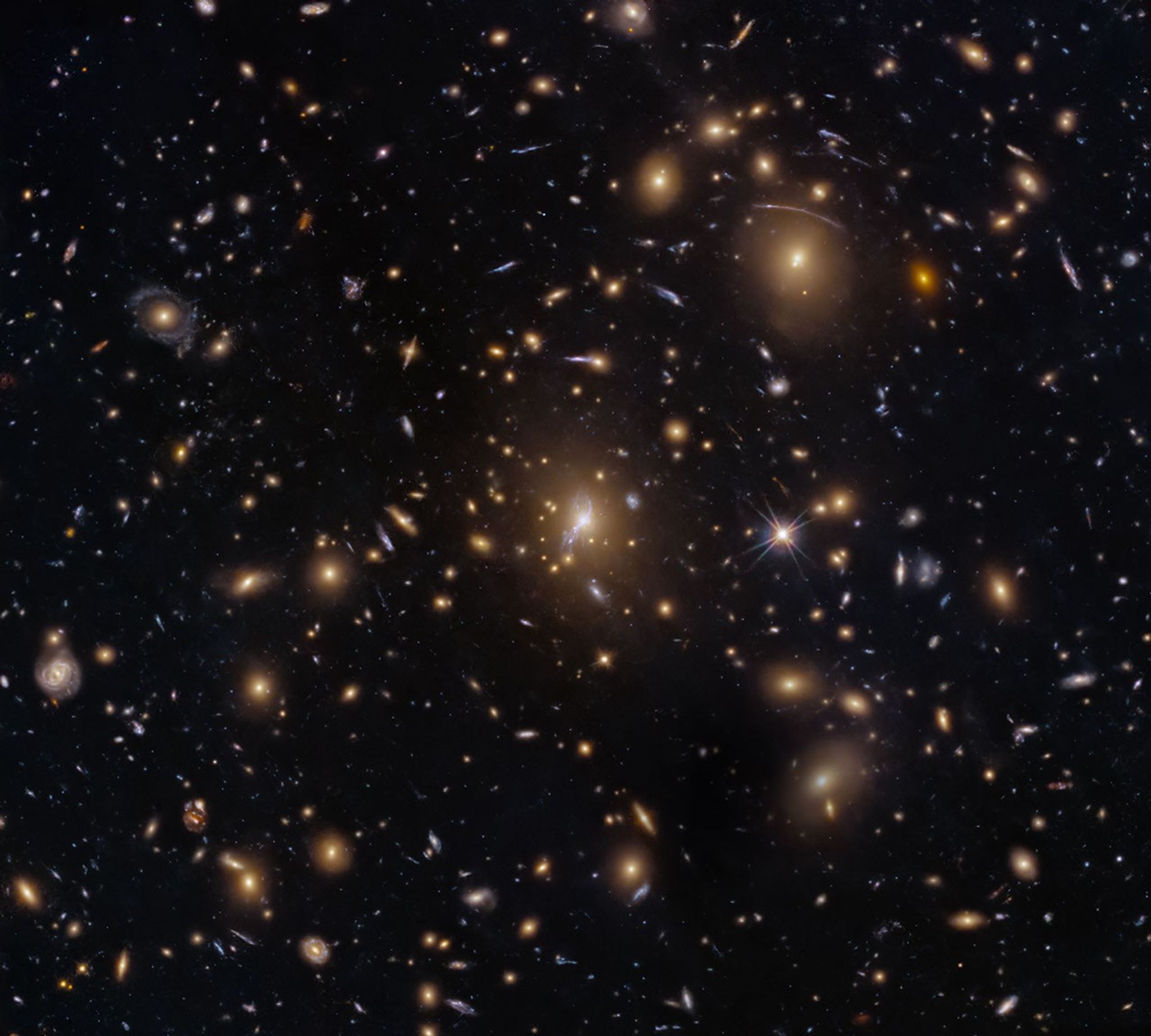
The discovery underlines how much scientific leverage comes from pairing observatories with different capabilities. Hubble, now in its fourth decade of operation, contributed sharp imaging in optical and ultraviolet wavelengths, mapping the spatial distribution of stars within Terzan 5. In mid-June, NASA also released a separate Hubble image of the galaxy cluster MACS0329-0211, a reminder of the telescope's continued relevance across a range of cosmic scales.
Webb's infrared vision proved equally essential. The galactic bulge is heavily obscured by interstellar dust, which blocks optical light almost entirely. By operating at longer wavelengths, Webb penetrated that dust screen and delivered detailed spectroscopic data on the chemical makeup of Terzan 5's stellar populations — data that made the two-generation interpretation definitive rather than merely suggestive.
A new class of objects, and what comes next
Establishing Terzan 5 as the prototype of a new object class raises an immediate question: how many other bulge fossil fragments are still out there, unrecognized and misclassified? The research team considers additional discoveries likely. If such objects can be systematically identified, they would function as surviving archives of the Milky Way's formation process — structural evidence of a chaotic, violent era of galactic assembly that left almost nothing else intact.
The bulge is a challenging environment to survey: dense, dust-laden, crowded with hundreds of millions of stars. Webb is currently the most capable instrument available for this work, combining the infrared reach needed to cut through obscuration with the angular resolution required to resolve individual stars in tightly packed regions. Whether Terzan 5 turns out to be an exceptional survivor or merely the first confirmed member of a broader population remains, for now, an open question.