Tiangong opens its doors to the first non-Chinese crew member
For the first time in the history of China's Tiangong space station, a foreign national has flown aboard a Shenzhou spacecraft. Pakistani astronaut Muhammad Zeeshan Ali lifted off alongside two CNSA taikonauts on Shenzhou-24 on the night of November 24–25, bound for the orbital outpost whose name translates as "heavenly palace." The mission represents a significant milestone in China's deliberate push to internationalize its civil space program.
Since Tiangong reached its complete three-module configuration in 2022, every crew rotation had been exclusively Chinese. Ali's selection signals Beijing's intent to cultivate partnerships with emerging spacefaring nations — a strategy that gains particular significance given that Chinese astronauts remain barred from visiting the International Space Station under U.S. congressional restrictions. Pakistan becomes the first country to send one of its citizens aboard the Chinese station, joining a small but growing list of nations building ties with CNSA outside traditional Western-led frameworks.
The ISS draws two cargo missions almost simultaneously
While Tiangong was preparing for its historic crew handover, the International Space Station was itself the focus of parallel logistics activity. Roscosmos readied Progress MS-36 for launch from the Baikonur Cosmodrome in Kazakhstan — the fourth and final automated Russian resupply flight of 2026. Despite the routine nature of such missions, the launch generated an unexpected media moment: when journalists sought advance details from NASA, the agency declined to provide any and directed questions to Roscosmos, an unusual level of reticence surrounding a standard cargo run.
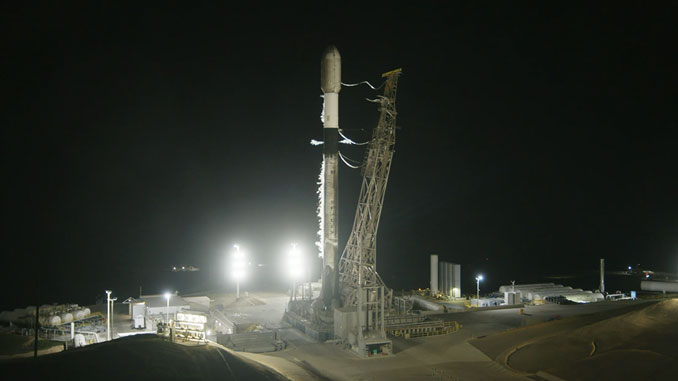
On the American side, Northrop Grumman is moving forward with its CRS-25 mission, which will carry roughly 11,000 pounds of science experiments and station supplies to the ISS. The flight will mark the third use of the Cygnus XL configuration, a larger-capacity variant of the company's solar-powered cargo vehicle. Meanwhile, SpaceX conducted a separate launch from Vandenberg Space Force Base, delivering a classified payload for the U.S. Space Force — the third in a series carrying the "TH" designation in public filings, with no further details disclosed.
Ariane 6 reaches ten flights and sets its next date
European launch activity also made headlines during the same period. Arianespace successfully completed the tenth flight of its Ariane 6 rocket on November 24, lifting off from the Guiana Space Centre in Kourou at 11:14 UTC. The Leo Europe 4 mission placed 36 Amazon Project Kuiper broadband satellites into low Earth orbit — the fourth Ariane 6 mission dedicated to that constellation and the sixteenth Kuiper launch overall. It was also the rocket's sixth and likely final flight of 2026, with the next mission now scheduled for December 17.
The steady cadence reflects Ariane 6's gradual operational maturation, though the launcher still faces intense pressure from SpaceX's Falcon 9, which continues to dominate the commercial market through sheer launch frequency and competitive pricing. Arianespace's ability to sustain and grow its manifest will be closely watched as the year closes out.
Taken together, this cluster of missions within a single week draws a vivid picture of how human and robotic spaceflight has evolved: two competing space stations, rockets flying under very different flags, and geopolitical alignments that look nothing like the Cold War architecture that first sent humans into orbit.