A New Kind of Customer for Falcon Heavy
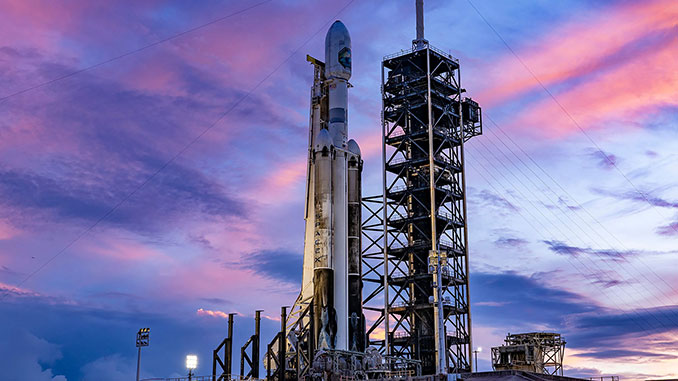
Launch Complex 39A at NASA's Kennedy Space Center has hosted Falcon Heavy many times before, but the mission that lit up the Florida sky on the night of October 1, 2026 broke new ground. With a planned liftoff at 11:53 p.m. EDT, SpaceX's triple-booster heavy-lift vehicle carried a classified payload for the National Reconnaissance Office — the U.S. government agency responsible for operating the nation's fleet of intelligence-gathering satellites — for the very first time.
Designated NROL-97, the mission follows the NRO's standard practice of strict information control: no details about the satellite's design, no confirmed final orbit, and no declared payload mass. What has been officially acknowledged is the mission designation itself and the characterization of the target trajectory as a high-energy orbit — a detail that, while brief, carries meaningful technical implications.
What a High-Energy Orbit Actually Means
In launch industry terminology, a high-energy orbit typically refers to destinations that demand significant propulsive performance: geostationary transfer orbit, geosynchronous orbit, or highly elliptical orbits used for persistent wide-area coverage. These trajectories place substantial demands on a launch vehicle's upper stage, requiring extended burn durations in the vacuum of space.
This is precisely where Falcon Heavy's architecture shines. With a combined sea-level thrust approaching 2,300 kilonewtons across its three Merlin-engine cores, and a vacuum-optimized upper stage capable of multiple restarts, the rocket is well-suited to delivering heavy payloads to demanding orbits. Whether the side boosters will be recovered — as has become standard practice — remains to be confirmed, though high-energy profiles often push the expendable boundary for the center core.
SpaceX Deepens Its Role in U.S. National Security Space
NROL-97 represents a notable expansion of SpaceX's relationship with the most sensitive corners of the American national security apparatus. Historically, the NRO relied heavily on United Launch Alliance's Delta IV Heavy for its most demanding missions — a rocket that has since been retired. Falcon Heavy now steps into that legacy role, offering comparable performance at a substantially lower price point.
SpaceX already holds a significant launch manifest for the U.S. Space Force under the National Security Space Launch program, with Falcon 9 handling a broad range of government payloads. Extending that relationship explicitly to the NRO with a Falcon Heavy mission signals growing institutional confidence in SpaceX's operational reliability and security protocols.
For the NRO, diversifying its launch providers is not merely a cost-saving measure — it is a resilience strategy. With geopolitical tensions placing renewed emphasis on assured access to orbit, having a capable, frequently-flying heavy-lift option in its roster strengthens the agency's ability to replenish or augment its on-orbit capabilities on shorter timelines. NROL-97 may be a classified mission, but its broader significance for the U.S. space launch landscape is anything but opaque.