Side by side under one fairing
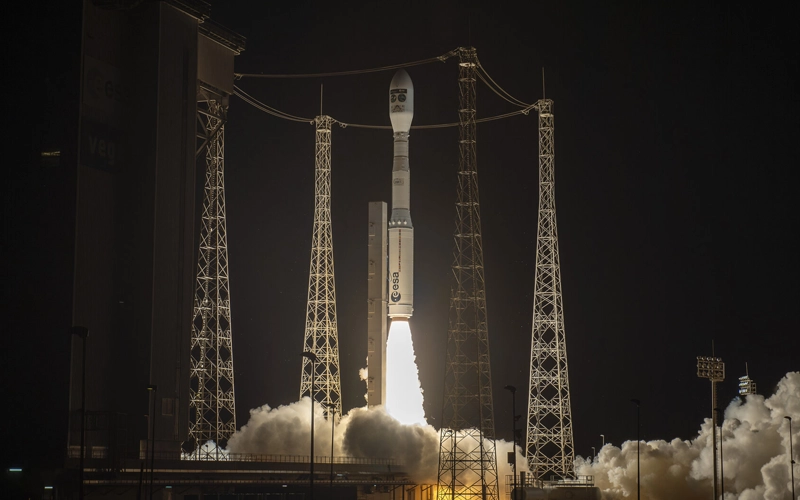
At the Guiana Space Centre in Kourou, French Guiana, ground crews have successfully sealed two European satellites inside the fairing of an Arianespace Vega-C rocket. ESA's FLEX mission and the Copernicus Sentinel-3C satellite will share the same ride to orbit — a dual-manifest configuration that reflects both budgetary pragmatism and a clear scientific rationale. ESA held a dedicated media briefing on 4 September 2026 to walk journalists through the final steps of the campaign.
For Vega-C, developed by Avio under Arianespace's operational responsibility, this launch marks another step in the vehicle's return to regular service. The European launcher family has faced pressure to demonstrate consistent reliability and cadence as global launch competition intensifies, making this mission operationally significant beyond its scientific payload.
FLEX: measuring the glow of photosynthesis
FLEX — short for Fluorescence Explorer — carries a distinction no other satellite currently holds: it is specifically designed to detect the faint glow that plants emit during photosynthesis, a phenomenon known as solar-induced chlorophyll fluorescence. This signal, imperceptible without dedicated instrumentation, offers a direct window into plant metabolic activity rather than simply their structural appearance.
The satellite's core instrument, FLORIS, will scan the Earth's land surface across carefully chosen spectral bands to isolate this weak but telling emission. The scientific payoff is substantial: by mapping vegetation fluorescence on a global scale, researchers expect to gain far more accurate estimates of how terrestrial ecosystems absorb carbon dioxide from the atmosphere. That kind of data carries direct relevance for climate modelling, agricultural monitoring, and forest management. FLEX is part of ESA's Earth Explorer programme, which targets high-priority scientific questions through innovative observation approaches.
Sentinel-3C: strengthening Copernicus coverage
Flying alongside FLEX, Sentinel-3C will join its two operational predecessors — Sentinel-3A and Sentinel-3B — in the Copernicus constellation, the European Union's flagship Earth-observation programme managed jointly by ESA and the European Commission. Adding a third unit to the series improves the system's revisit frequency and guards against service interruption should one of the older satellites degrade or fail.
Sentinel-3C carries a suite of instruments designed to track ocean colour, land and sea surface temperatures, and the precise topography of the ocean surface. These measurements feed directly into operational services relied upon by meteorological agencies, maritime authorities, and environmental scientists around the world on a daily basis.
The pairing of FLEX and Sentinel-3C aboard the same rocket is more than logistical convenience. Researchers anticipate that combining fluorescence data from FLEX with the ocean and land temperature records produced by Sentinel-3C will open new avenues for studying the Earth system as an integrated whole — a prospect that gives this dual launch a significance that extends well beyond the launch pad.