A Midnight Launch Carrying Two Scientific Ambitions
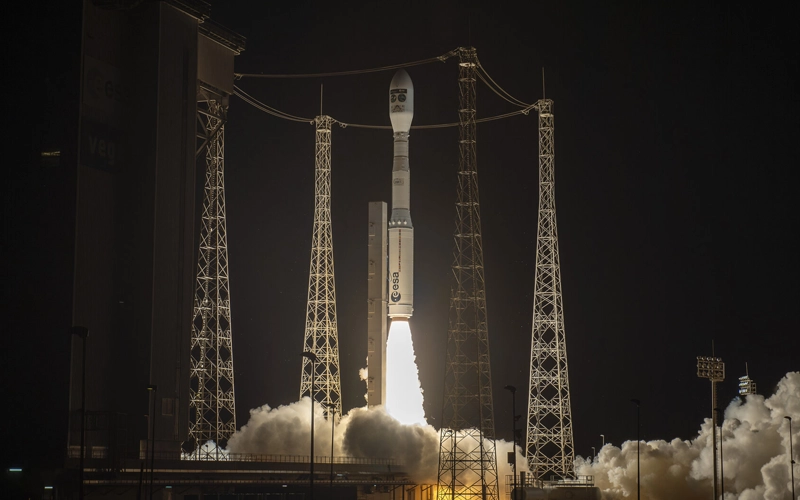
At 01:21 UTC on 15 September 2026, a Vega-C rocket departed the Ensemble de Lancement Vega at Europe's Spaceport in Kourou, French Guiana, carrying a pair of satellites designed to monitor the state of Earth's biosphere and oceans. The mission, designated VV30, was the second Vega-C flight of the year conducted entirely by Italian launch provider Avio, without operational support from Arianespace — a growing mark of the company's increasing independence in launch management.
The rocket's AVUM+ upper stage performed two controlled burns to place each satellite on its designated orbit. The sequence concluded without issue, reinforcing confidence in Vega-C's restored reliability following earlier setbacks in its operational history.
FLEX: Listening to What Forests Are Telling Us
The first of the two payloads, FLEX — short for Fluorescence Explorer — is an ESA Earth Explorer mission with no direct precedent in space. Its primary instrument is built to detect the faint glow of chlorophyll fluorescence emitted by plants during photosynthesis: a signal in the near-infrared spectrum that reveals how efficiently vegetation is converting sunlight into organic matter.
By mapping this signal across the globe, FLEX will provide scientists with a direct, large-scale measure of photosynthetic activity — something that was previously only possible through indirect proxies. The data will help refine carbon cycle models and offer early warning signals for vegetation stress caused by drought, heat or disease. Crucially, FLEX is designed to fly in a coordinated formation with Sentinel-3C, with the two satellites sharing overlapping ground tracks so their measurements can be combined.
Sentinel-3C: Reinforcing Europe's Eye on the Oceans
Sentinel-3C is the third satellite in the Sentinel-3 series, part of the European Commission's Copernicus Earth observation programme. It carries a suite of instruments measuring sea surface temperature, ocean colour, land surface topography and the elevation of polar ice sheets. These observations feed directly into Copernicus operational services relied upon by meteorologists, fisheries managers and climate researchers worldwide.
Adding Sentinel-3C to the constellation strengthens its resilience. With three satellites now in place, Europe can maintain consistent data coverage even if one unit encounters technical difficulties — a key requirement for operational continuity in environmental monitoring.
Avio's Expanding Role in European Launch Services
Beyond the scientific payloads, VV30 carries broader industrial significance. It marks the second consecutive Vega-C mission for which Avio has served as sole launch operator, taking on responsibilities that previously fell under Arianespace's purview. This shift reflects Europe's broader push to consolidate its independent access to space at a time when the global launcher market is undergoing rapid transformation.
Two successful Vega-C flights in 2026 establish a renewed operational baseline for medium-class European launches to polar and sun-synchronous orbits. Whether Avio can sustain and grow that cadence remains an open question, particularly as competitors such as Rocket Lab and SpaceX — through its rideshare programme — continue to attract commercial customers with competitive pricing and high launch frequency.