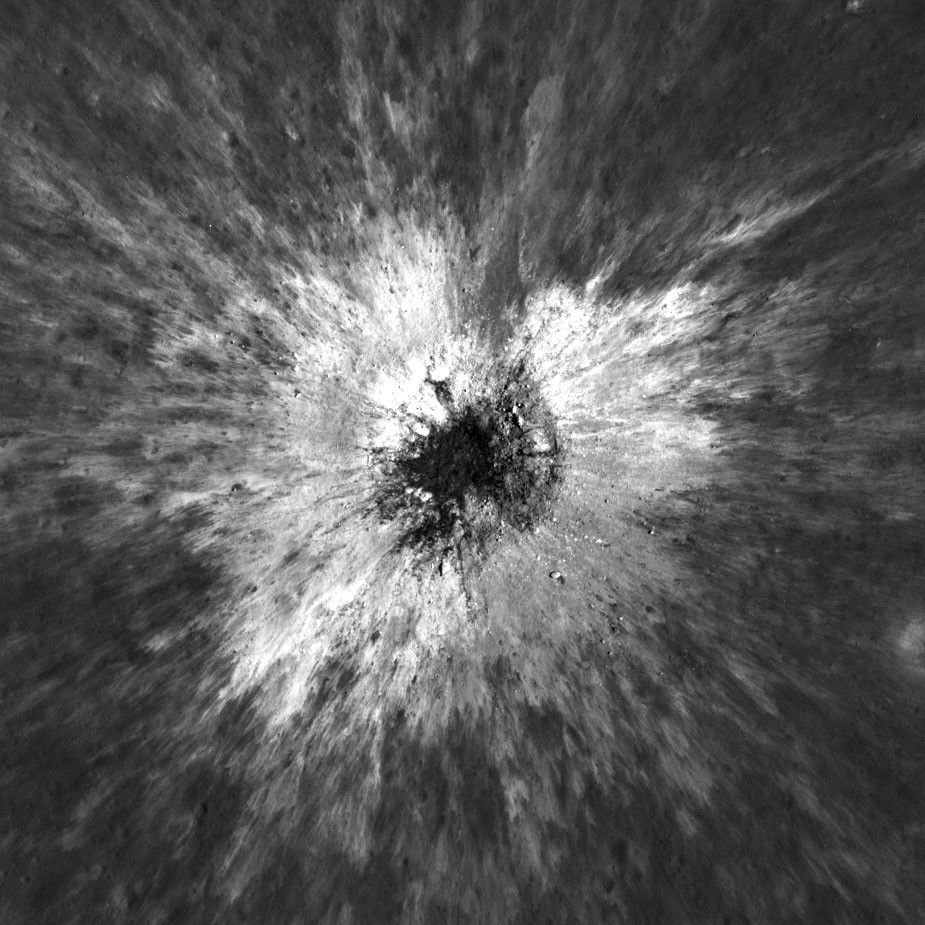
A fresh crater of record-breaking proportions
The Moon may look static from Earth, but its surface keeps changing — and NASA's Lunar Reconnaissance Orbiter (LRO) has just provided a striking demonstration of that fact. A team of scientists has confirmed the discovery of a large impact crater whose formation is considered geologically recent, and whose size surpasses any previously documented crater in that category. The feature has been designated McGetchin, after Thomas McGetchin, an American planetary geologist whose contributions to the study of lunar volcanism were highly influential during the 1970s.
In lunar science, a crater is considered "newly formed" when it came into existence after systematic orbital observation began — roughly from the first robotic lunar missions of the 1960s onward. By that standard, McGetchin stands out sharply: its diameter makes it the largest fresh impact structure identified on the lunar surface to date. LRO's high-resolution cameras and laser altimeter provided the detailed measurements needed to characterize the crater's geometry and confirm its relatively recent origin.
Unexpected heat signatures at the rim
What makes McGetchin particularly compelling to planetary scientists is not only its scale, but also the anomalous thermal emissions detected around its perimeter. LRO's thermal instruments recorded temperature readings during the lunar day-night cycle that do not align with standard models describing how impact ejecta typically cools and behaves over time.
Researchers are currently exploring several possible explanations. The chemical and physical composition of the freshly excavated material — some of it exposed to space for the first time in billions of years — may contribute to the unusual heat retention. The size distribution of ejected boulders around the rim, which store and release heat differently than fine-grained regolith, is another variable under consideration. As of now, no definitive conclusion has been reached, and the thermal phenomenon remains an open scientific question.
What McGetchin tells us about a living lunar surface
The identification of McGetchin is a timely reminder that the Moon continues to be shaped by its environment. Without an atmosphere to slow or burn up incoming objects, the lunar surface is constantly struck by meteoroids and small asteroids. LRO, which has been in orbit since 2009 and remains operational, builds a long-term photographic archive that allows scientists to detect surface changes by comparing images taken years apart — a method that made this discovery possible.
The mission's extended lifespan has yielded scientific returns well beyond its original scope. Its real-time documentation of lunar surface evolution carries particular relevance as NASA, ESA, CNSA, ISRO, and other agencies advance plans for crewed landings and robotic outposts on the Moon. Accurate knowledge of impact frequency and crater formation is directly relevant to assessing the long-term hazards that future lunar infrastructure may face.
On September 23, 2026, NASA featured McGetchin as its Astronomy Picture of the Day, bringing the discovery to a broad public audience — a fitting spotlight for a finding that demonstrates lunar science is far from running out of new ground to cover.