Building a Moon base starts with understanding the surface
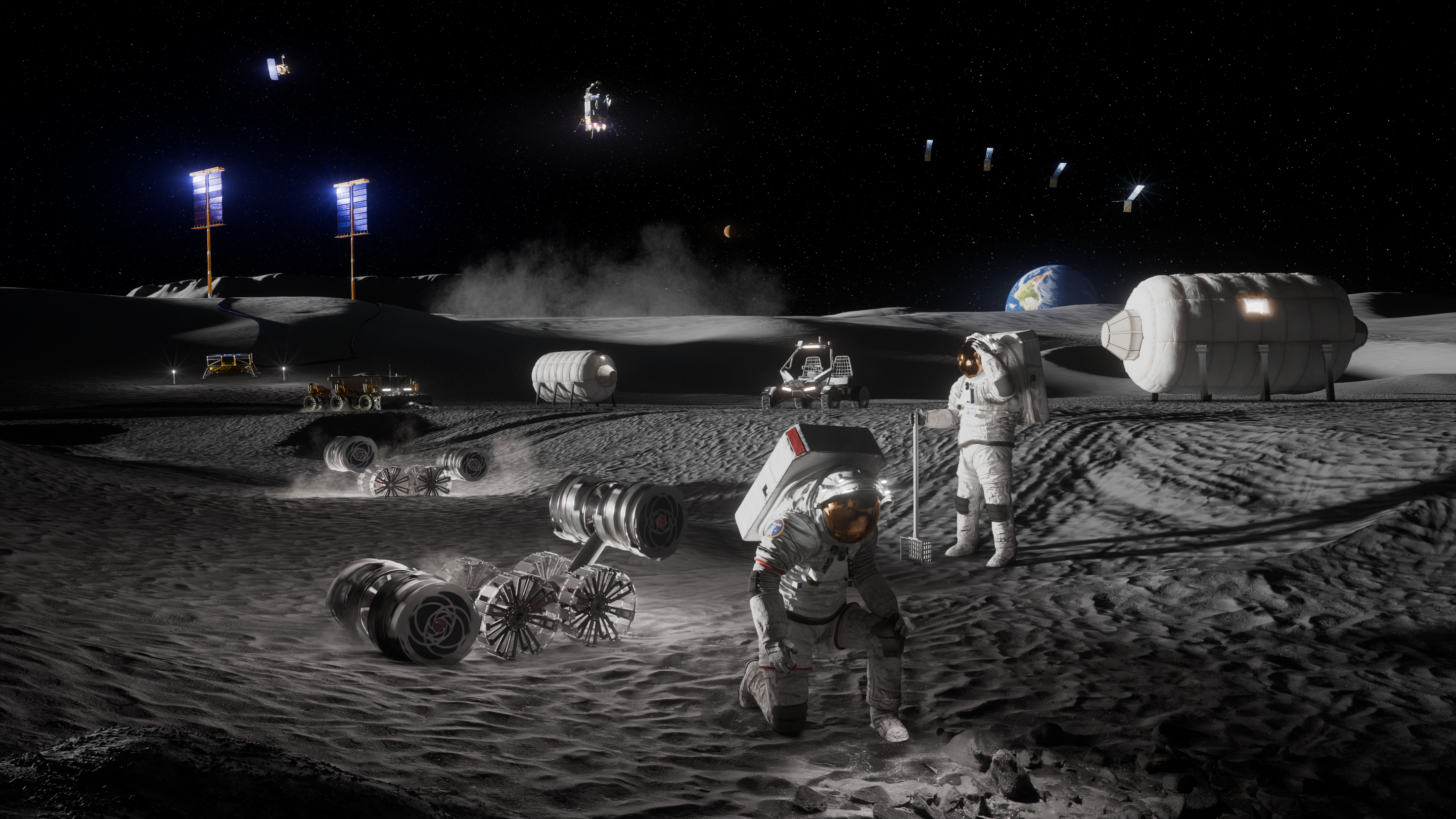
NASA has selected three new scientific investigations to support the long-term goal of establishing a permanent human outpost on the Moon, referred to as Moon Base. The instrument suites were chosen through the agency's PRISM program — Payloads and Research Investigations on the Surface of the Moon — which funds hardware designed to generate the kind of ground-truth data that future habitat and infrastructure designers will depend on.
While the full technical scope of each selected investigation has not yet been published in detail, NASA has indicated that the payloads target key unknowns about the lunar surface environment: regolith behavior, potential in-situ resource utilization, and the cumulative effects of radiation and vacuum conditions on both equipment and human physiology. Each of these factors is a prerequisite for any credible architecture that could sustain human presence beyond short-duration stays.
The announcement arrives as NASA prepares to make its case on the world stage at the 77th International Astronautical Congress in Antalya, Turkey, running from October 5 to 9, 2026. The agency plans to use the forum to reinforce its leadership in human exploration — both lunar and Martian — while promoting the Artemis Accords as the preferred multilateral framework for responsible activity in outer space.
Smile is now watching: a European-Chinese mission eyes the solar wind
Far from the Moon, another milestone quietly arrived. On September 23, 2026, the Smile mission — Solar wind Magnetosphere Ionosphere Link Explorer — was formally declared operational and began collecting science data. A collaborative effort between the European Space Agency and the China National Space Administration, Smile lifted off on May 19, 2026, and settled into its science orbit on June 20 after a commissioning phase conducted in deep space.
The mission's core objective is to build a clearer picture of how Earth's magnetosphere responds dynamically to the stream of charged particles flowing from the Sun. These interactions drive phenomena ranging from geomagnetic storms — which can knock out power grids and satellite systems — to the luminous curtains of auroras at high latitudes. Smile carries a soft X-ray imager along with in-situ plasma instruments, allowing it to observe multiple regions of the Sun-Earth system simultaneously rather than in isolation.
The ESA-CNSA partnership behind Smile is a notable example of scientific cooperation surviving in a period of broader geopolitical friction between the West and China. Space weather research, with its direct relevance to critical infrastructure protection on Earth, has proven to be one domain where institutional boundaries remain permeable to joint work.
The IAC in Antalya: science, commerce, and competing visions
The International Astronautical Congress is the largest annual gathering in the space sector, drawing government agencies, private companies, researchers, and policymakers from across the world. The 2026 edition takes place against a backdrop of intensifying competition — and selective cooperation — among the major spacefaring powers: the United States, China, Russia, and Europe.
NASA's delegation will look to spotlight the Artemis program and its commercial partnerships, with companies such as SpaceX and Rocket Lab expected to feature prominently in industry sessions. ESA, fresh from Smile's operational debut, has a strong card to play as a bridge-builder between blocs. Agencies including ISRO and JAXA may use the platform to refine or announce elements of their own exploration roadmaps for the coming decade.
Taken together, these three developments reflect a space sector in which science, politics, and economics have become inseparable. The question driving the next chapter of exploration is no longer just what humanity can discover beyond Earth — it is who sets the terms for doing so, and on whose behalf.