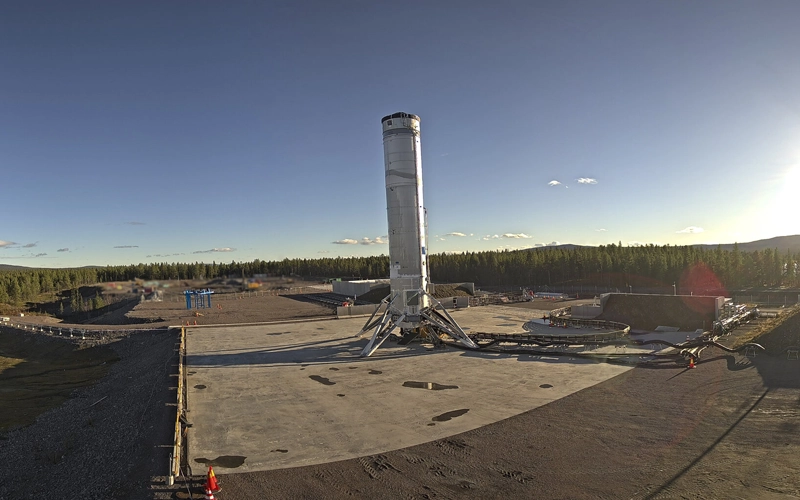
What happened on the pad — and what remains unclear
On May 29, 2026, Blue Origin's New Glenn rocket was destroyed during a pre-launch qualification test at its launch facility on Florida's Space Coast. The incident occurred before any nominal ignition sequence, and early footage raised immediate concerns about damage to the launch infrastructure. Blue Origin indicated that the vehicle had moved partially away from the pad before breaking apart — a detail that may have spared the ground systems from the worst of the blast, though a thorough damage assessment was still underway at the time of publication.
Blue Origin has not yet released a formal technical explanation for what caused the failure. The Federal Aviation Administration is expected to open an investigation, as is standard procedure following any significant anomaly involving a launch vehicle on U.S. soil. Multiple industry observers have suggested that New Glenn's return to flight could take a year or more, depending on the extent of damage to both the rocket and the supporting infrastructure.
A launch market that had little room to absorb the shock
The consequences extend well beyond Blue Origin's own program. The commercial launch market was already operating under structural stress before this incident, with demand — driven largely by the rapid expansion of low-Earth orbit satellite constellations — consistently outpacing available lift capacity. SpaceX's Falcon 9 carries a dominant share of commercial payloads, while United Launch Alliance's Vulcan Centaur is still ramping up. In Europe, Arianespace's Ariane 6 has been working to establish a reliable operational tempo following its own delays.
New Glenn was widely seen as one of the few credible alternatives to SpaceX's near-monopoly on heavy commercial lift. With a low-Earth orbit payload capacity of roughly 45 metric tons, it was positioned to serve both institutional and commercial customers. Its temporary — or potentially permanent — removal from the market creates a gap that existing launchers cannot readily fill on short notice.
- Customers who had booked slots on New Glenn will need to seek alternatives, often within tightly scheduled deployment timelines.
- U.S. government agencies that had incorporated New Glenn into their manifest plans face direct planning disruptions.
- Space insurance underwriters are likely to reassess risk premiums associated with newer launch vehicles across the board.
A credibility test for Blue Origin's industrial ambitions
For Blue Origin, the stakes reach beyond hardware replacement. The company founded by Jeff Bezos had staked much of its commercial identity on New Glenn as its entry into the heavy-lift segment — a domain it had long aspired to despite years of development before achieving flight. The fact that New Glenn had already completed several missions successfully makes this setback particularly significant, both technically and reputationally.
How Blue Origin responds in the coming weeks will matter considerably. The company's ability to communicate transparently about root causes, present a credible return-to-flight timeline, and reassure its customer base will serve as a measure of its industrial maturity. Other launch providers have navigated comparable crises — SpaceX recovered from the Falcon 9 pad explosion in 2016, and Rocket Lab rebuilt confidence after losing an Electron mission — but those recoveries required disciplined post-incident management and clear communication.
The loss of New Glenn is a reminder that developing heavy-lift rockets remains a high-stakes endeavor where setbacks can be sudden and severe. For an industry already struggling to match supply with demand, the core question is not whether Blue Origin will rebuild, but how quickly — and whether the broader market can afford to wait.