A quiet spiral with a turbulent secret
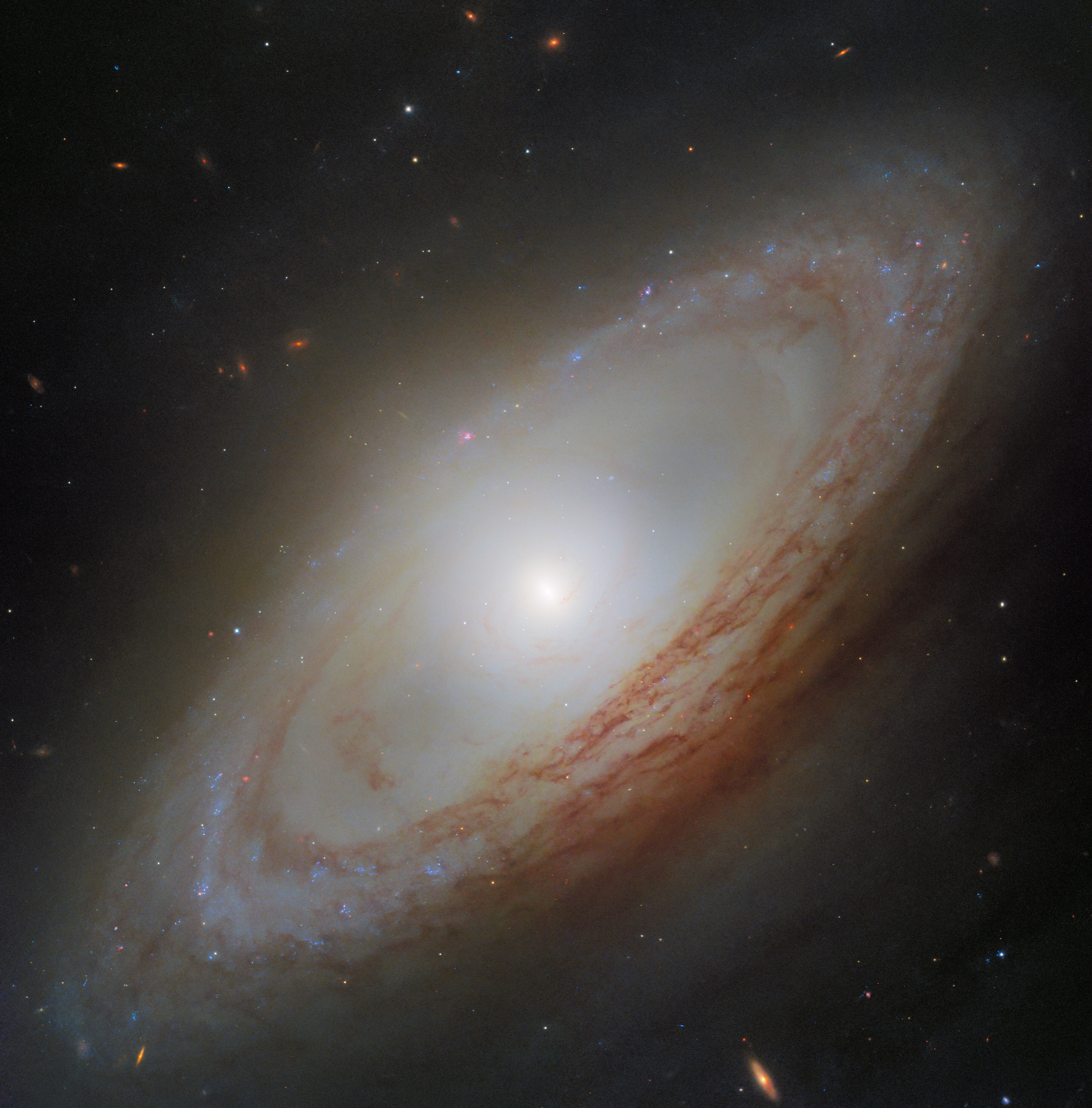
Tucked within the constellation Virgo, at a distance of approximately 55 million light-years, NGC 4698 is one of more than a thousand galaxies held together by gravity in the Virgo Cluster — the largest concentration of galaxies in our immediate cosmic neighbourhood. On the surface, it presents the familiar profile of a spiral galaxy: sweeping arms, a bright central bulge, and an overall sense of order. Nothing about its visual appearance would immediately flag it as unusual.
Yet images released on 18 September 2026 by the NASA/ESA Hubble Space Telescope tell a different story. The data show that the galaxy's inner bulge and its outer rotating disk do not share the same rotational axis. More strikingly, the two components appear to spin in opposite directions relative to each other — a configuration astronomers call counter-rotation.
When a galaxy's history is written in conflicting spins
Counter-rotation is uncommon, and it poses a genuine challenge to standard galaxy formation theory. Under typical conditions, a galaxy coalesces from a single rotating cloud of gas and dust. That shared origin should give every component — disk, bulge, interstellar gas — the same overall angular momentum. When a bulge rotates in direct opposition to the disk surrounding it, the implication is clear: these two structures did not form from the same material at the same time.
Researchers have proposed several mechanisms to account for this kind of misalignment. One widely discussed scenario involves an ancient merger: billions of years ago, NGC 4698 may have absorbed a smaller companion galaxy whose angular momentum was oriented in a different direction. Material from that captured galaxy, incorporated into the bulge, would have retained its original spin. A second hypothesis points to the late-stage accretion of extragalactic gas — cold filaments of matter falling onto the galaxy along a trajectory misaligned with the existing rotation.
Either way, what Hubble is revealing is essentially the dynamical scar left by a past cosmic collision or accretion event, now frozen into the galaxy's very architecture.
Why Hubble's optical precision still matters
Even in 2026, Hubble's resolving power in the optical and near-infrared remains difficult to match for this kind of structural analysis. Separating a galaxy's bulge from its surrounding disk at a distance of tens of millions of light-years requires the sort of angular resolution that Hubble consistently delivers, allowing researchers to map internal kinematics with a level of clarity that many ground-based and even some space-based facilities struggle to replicate.
The observation of NGC 4698 fits within a broader survey of Virgo Cluster galaxies, which serve as a natural laboratory for studying how gravitational interactions, mergers, and gas flows shape galaxies across cosmic time. The cluster's relative proximity to the Milky Way makes it one of the most accessible environments for this kind of detailed morphological work.
NGC 4698 may not draw the eye the way a colliding galaxy pair or a luminous quasar host might. But it illustrates a principle that runs through much of modern astrophysics: the most telling clues about a galaxy's past are often buried in the quiet details of how its components move — and how they fail to agree with one another. The precise event that set this galaxy's heart spinning against itself remains an open question.