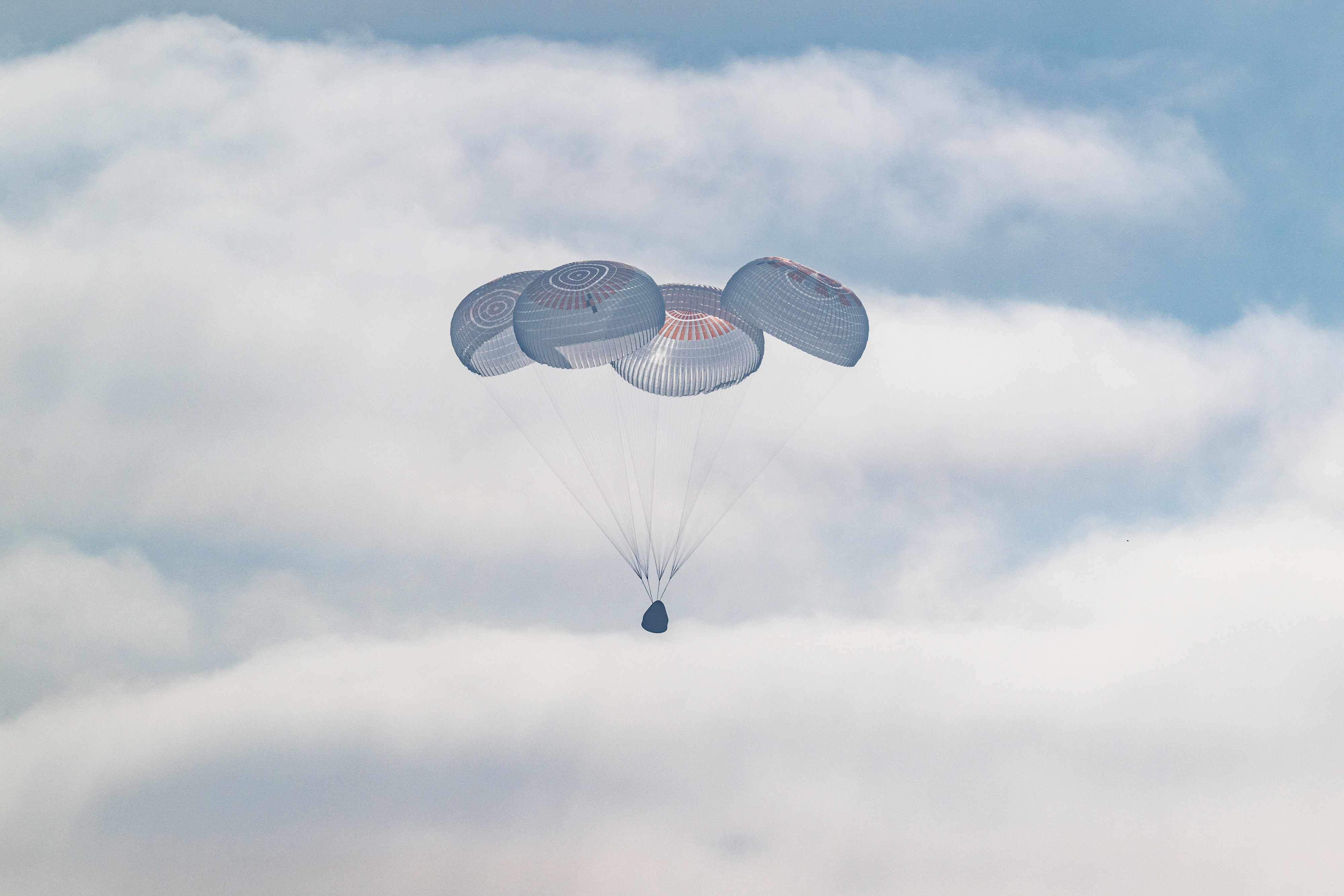
Crew Dragon Freedom splashes down off California
The SpaceX Crew Dragon Freedom capsule completed its descent and splashed down in the Pacific Ocean off the California coast on Wednesday, October 8, 2026, closing out NASA's Crew-12 mission to the International Space Station. The four crew members who stepped out of the capsule — or were recovered from it — represented a broad cross-section of the international partner agencies: NASA astronauts Jessica Meir and Jack Hathaway, ESA astronaut Sophie Adenot, and Roscosmos cosmonaut Andrey Fedyaev.
The mission was conducted under NASA's Commercial Crew Program, with SpaceX providing launch and recovery services using its Crew Dragon vehicle. The precise duration of the crew's stay aboard the ISS had not been formally confirmed by NASA at the time of writing. What is clear is that Freedom performed its role as a reliable crew transport, continuing a string of successful operational flights for the Crew Dragon platform.
For Sophie Adenot — a French flight test pilot selected by ESA in 2022 — this marked her first spaceflight, a milestone that formally opens her career as a mission-experienced astronaut. Jessica Meir, by contrast, was returning from her second long-duration mission, having previously lived aboard the ISS during the 2019–2020 period. Hathaway and Fedyaev completed an experienced and internationally balanced crew.
Sentinel-3C opens its eyes just two weeks after launch
Hours earlier on the same day, the European Space Agency announced that the Copernicus Sentinel-3C satellite had successfully returned its first images and instrument measurements, just a fortnight after reaching orbit. Two of the satellite's primary instruments were confirmed as operational, marking what ESA described as a major early milestone in the spacecraft's commissioning phase.
Sentinel-3C is the latest addition to the Copernicus Earth observation constellation, the joint programme run by ESA and the European Commission. Its mission is to provide persistent, high-quality monitoring of the world's oceans, land surfaces, cryosphere, and atmosphere. The data it collects feeds directly into climate research, ice-sheet tracking, ocean temperature mapping, and atmospheric chemistry studies, among other applications.
By reinforcing the existing Sentinel-3 constellation, the new satellite improves the revisit frequency of observations — a critical factor when building the long, uninterrupted time series that climate science depends on. ESA has not yet announced a target date for declaring Sentinel-3C fully operational, a step that typically follows an extended validation period during which instrument outputs are cross-checked against reference measurements.
Two events, one broader picture
The convergence of a crewed splashdown and a satellite's first light on a single calendar day offers a snapshot of where space activity stands in 2026. On one side, human presence in low Earth orbit continues to be sustained through a combination of multilateral institutional partnerships and commercial operators like SpaceX. On the other, constellations of robotic sentinels methodically watch over the planet below, building datasets that will inform decisions for decades to come.
These two strands of space activity are not in competition. They reflect complementary commitments — to exploration and to stewardship — that together define the scope of what space agencies and their partners are trying to achieve.


