A familiar nebula, seen in a new light
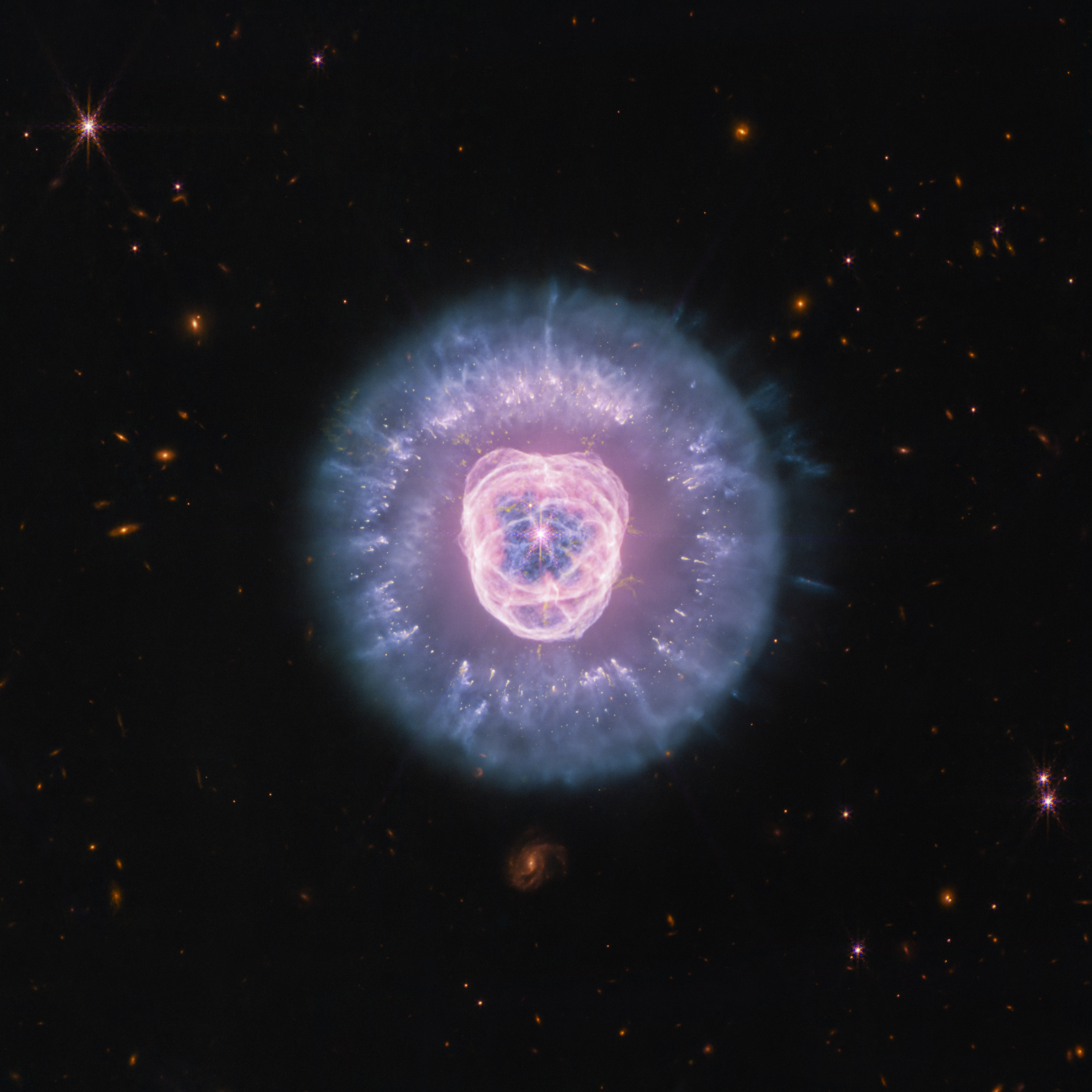
NGC 2392 has been on astronomers' radar for years. Located in the constellation Gemini, this planetary nebula earned its informal nickname from a distinctive visual resemblance to a lion's face — complete with a surrounding "mane" of diffuse, comet-shaped structures radiating outward from the central region. When NASA's Hubble Space Telescope imaged the object in visible light back in 2000, it produced one of the more recognizable portraits in the Hubble archive, clearly resolving that halo of elongated knots and filaments.
Now, more than a quarter century later, the same target has been revisited by a far more capable observatory. On August 10, 2026, the NASA/ESA/CSA James Webb Space Telescope released new images of NGC 2392, this time captured in infrared wavelengths. The result is a level of structural detail that Hubble's instruments, optimized for ultraviolet and optical light, were simply not equipped to deliver.
Infrared eyes on a dying star's remains
Webb's primary advantage over its predecessor is sensitivity across the near- and mid-infrared spectrum. For a target like NGC 2392, that translates directly into improved resolution of cooler, lower-contrast features that remain effectively invisible in optical imaging. The nebula's outer "mane" — those comet-like condensations that gave the object its nickname — appears with considerably greater clarity and internal structure in Webb's data.
The origin of these peripheral objects is still a subject of active research. Current thinking suggests they form through interactions between the fast-moving stellar winds expelled by the dying central star and denser shells of material cast off at earlier stages of the star's evolution. With Webb's resolution, the morphology of these knots can now be studied in enough detail to place meaningful constraints on theoretical models of intermediate-mass stellar evolution.
Despite the word "planetary" in their classification, planetary nebulae have nothing to do with planets. The term is a historical artifact, coined by early observers who found their round, glowing shapes vaguely reminiscent of planets seen through small telescopes. In reality, objects like NGC 2392 are the gaseous remnants shed by Sun-like stars as they exhaust their nuclear fuel, making them directly relevant to understanding the long-term future of our own solar system.
Webb and Hubble: a deliberate dialogue across decades
The decision to observe NGC 2392 with Webb reflects a broader scientific strategy of revisiting well-characterized Hubble targets to benchmark the new telescope's capabilities. By pairing observations of the same object made with different instruments and in different wavelength regimes, researchers can extract information that neither dataset could provide alone.
ESA, a core partner in the Webb mission alongside NASA and the Canadian Space Agency, released the imagery through its own channels simultaneously with NASA's publication, underscoring the collaborative nature of the project. Webb has been delivering science data since late 2021, and its observing program continues to span a wide range of targets — from nearby solar system objects to the most distant galaxies yet detected.
For NGC 2392, the latest images serve as a reminder that even objects considered well understood can yield new insight when examined with the right tools. As Webb's archive grows, the cumulative picture of how stars live and die is becoming sharper by the month.