A servicing mission grounded before it began
On August 19, 2026, NASA and American startup Katalyst Space jointly announced that they were canceling plans to boost the orbit of the Neil Gehrels Swift Observatory, the agency's long-running gamma-ray telescope. The culprit: attitude-control problems aboard Katalyst's LINK spacecraft that made the rendezvous and propulsion operation fundamentally unsafe to attempt.
Attitude control refers to a spacecraft's ability to precisely orient and stabilize itself in three-dimensional space. For a servicing vehicle tasked with approaching an active science satellite, docking or coupling with it, and then firing thrusters to alter its orbit, flawless attitude control is not optional — it is a hard prerequisite. Any instability in that system introduces an unacceptable risk of collision with or damage to the target spacecraft.
Swift: two decades of gamma-ray science, and counting
Launched in November 2004, the Swift Observatory was designed to detect, locate, and study gamma-ray bursts — short-lived but extraordinarily energetic events that remain one of astrophysics' most active research areas. After more than two decades in low Earth orbit, the spacecraft is experiencing the gradual orbital decay that affects all satellites at its altitude, as residual atmospheric drag slowly pulls it downward. Left unaddressed, this eventually leads to an uncontrolled reentry.
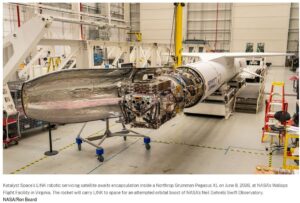
To counter that decay and extend Swift's scientific life by several years, NASA entered into an agreement with Katalyst Space to use the LINK vehicle for a reboost maneuver — essentially a propulsive nudge to raise the telescope's orbit to a safer altitude. Had it succeeded, the mission would have been a landmark demonstration of low Earth orbit servicing capabilities, a domain that both government agencies and private operators are watching closely.
A setback for orbital servicing, but not the end of the road
For Katalyst Space, the cancellation is a significant blow. The company had positioned LINK as a proof of concept for a broader suite of on-orbit services, including satellite maintenance, relocation, and life extension — a market segment that has attracted substantial investment and growing interest from agencies including NASA, the European Space Agency, and others.
Despite the failure to execute the reboost, both parties have signaled that their working relationship is not entirely over. Some form of continued collaboration appears to remain on the table, though no specifics have been disclosed as of the announcement date. Whether that involves a scaled-back technical demonstration or an entirely different operational objective remains to be seen.
For Swift itself, the situation is more pressing. With the reboost option now off the table, NASA will need to evaluate what, if any, alternatives exist to preserve the observatory's operational life. A controlled deorbit at some future point may become the default outcome — a prospect that the science community is unlikely to welcome, given Swift's continued contributions to high-energy astrophysics research.