Io has long held the title of the most volcanically active body in the solar system, its surface perpetually reshaped by eruptions fed by the gravitational grip of Jupiter. But what drives that violence from within has remained difficult to quantify — until now. NASA's Juno spacecraft has delivered the first direct temperature measurements from beneath Io's surface, offering a new lens through which to study this relentlessly restless world.
A Microwave Eye Beneath the Crust
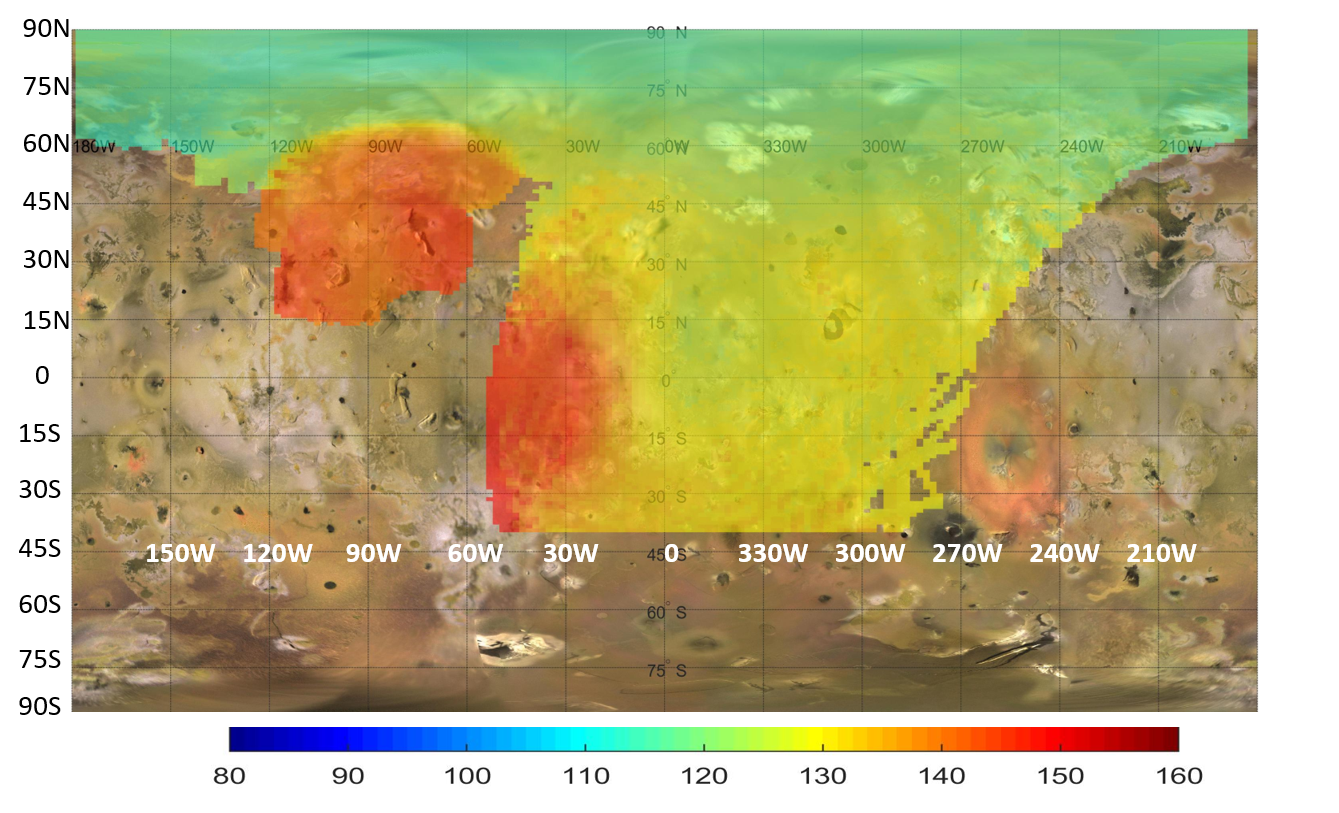
The measurements were gathered during two dedicated close approaches to Io, referred to as Perijove 57 on December 30, 2023, and Perijove 58 in early 2024. During each pass, Juno swooped to within a few hundred kilometers of the moon's surface, placing its Microwave Radiometer — the MWR — in an ideal position to collect data. The first flyby focused largely on the northern hemisphere; the second extended coverage across the rest of the globe.
What sets the MWR apart from the infrared instruments typically used to study Io is its ability to see through the uppermost layer of the ground. At its lowest operating frequencies — 0.6 and 1.25 gigahertz — the instrument can penetrate roughly 6 to 20 centimeters below the surface. That may seem shallow, but it is enough to detect thermal signals that surface-only sensors would miss entirely.
Unexpected Warmth, Unexpected Smoothness
The results carry two notable surprises. First, Io's shallow subsurface is significantly warmer than models had firmly predicted, with heat emanating from just below the crust in a pattern that cannot be explained by surface eruptions alone. This finding strengthens the case for tidal heating as the dominant energy source: the gravitational tug-of-war between Jupiter and the other Galilean moons — Europa, Ganymede, and Callisto — continuously flexes Io's interior, generating friction that keeps parts of its mantle in a molten state.
The second finding is equally striking. Despite Io's reputation as a chaotic, eruption-scarred landscape, the MWR data reveal that its surface is, on the whole, remarkably flat and composed largely of compositionally uniform material. Sulfurous deposits and lava flows appear to coat the ground in a broadly consistent layer, even as individual volcanic structures break up the terrain locally. This large-scale smoothness was not widely anticipated given the intensity of the moon's activity.
Juno's Expanding Scientific Mandate
These results are a reminder of how far Juno has traveled — scientifically speaking — from its original brief. Launched in 2011 and designed primarily to investigate Jupiter's atmosphere and deep interior, the spacecraft has, through successive mission extensions, become an explorer of the entire Jovian system. It has already conducted close flybys of Ganymede and Europa, and the Io encounters represent the latest chapter in that expanding itinerary.
The science team notes that full analysis of the MWR dataset is still underway, with peer-reviewed publications expected in the coming months. A more complete thermal map of Io, combined with refined tidal heating models, could have implications well beyond this single moon. Europa, whose icy shell conceals a subsurface ocean, may one day be examined with similar techniques — and the lessons learned at Io could prove essential to interpreting whatever lies beneath.